

Commentary
Nathalie Tocci, Jan Techau
{
  "authors": [
    "Jan Techau"
  ],
  "type": "legacyinthemedia",
  "centerAffiliationAll": "",
  "centers": [
    "Carnegie Endowment for International Peace",
    "Carnegie Europe"
  ],
  "collections": [
    "Brexit and UK Politics"
  ],
  "englishNewsletterAll": "",
  "nonEnglishNewsletterAll": "",
  "primaryCenter": "Carnegie Europe",
  "programAffiliation": "",
  "programs": [],
  "projects": [],
  "regions": [
    "Europe",
    "Western Europe",
    "United Kingdom",
    "France",
    "Germany"
  ],
  "topics": [
    "Foreign Policy",
    "EU",
    "Economy"
  ]
}
Source: Getty
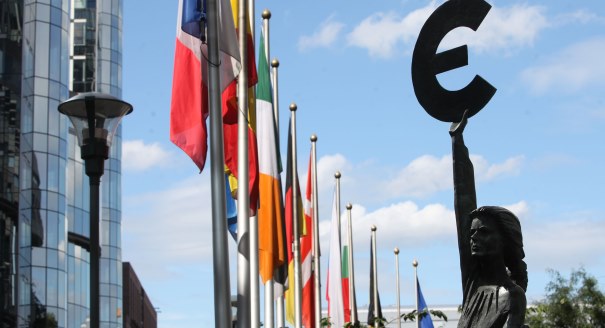
Although there is still great concern for the eurozone, the discourse has moved from predicting an immediate downfall a year ago to discussing the necessity of economic reform in the continent.
Source: Polskie Radio
Speaking on Polskie Radio, Carnegie Europe’s Jan Techau discussed the future of the eurozone. He explained that the worst is now over for the Europeans. Even though many problems remain, there has been a shift in the popular perception of the situation, which is in many ways more important than the situation itself. Techau said that although there is still great concern for the eurozone, the discourse has moved from predicting an immediate downfall a year ago to discussing the necessity of economic reform in the continent, more specifically in the south. He warned that the greatest concern right now is France, as stability in Europe depends on the stability of Franco-German cooperation. Techau concluded that despite its failings, the eurozone still remains an attractive model, pointing to Poland’s interest in joining the eurozone as evidence of its continuing appeal.

Director, Europe Team, Eurasia Group
Techau is director with Eurasia Group's Europe team, covering Germany and European security from Berlin. Previously, he was director of Carnegie Europe.
Recent Work

Nathalie Tocci, Jan Techau
Jan Techau
Carnegie does not take institutional positions on public policy issues; the views represented herein are those of the author(s) and do not necessarily reflect the views of Carnegie, its staff, or its trustees.

The Plaza Accord was not an externally imposed punishment of Japan but part of a broader restructuring that Japanese economists and policymakers themselves recognized was necessary. Its effects were undermined, however, when Tokyo responded to the resulting slowdown with policies that exacerbated investment, credit expansion, and the very imbalances the adjustment was intended to resolve.

Michael Pettis
China’s banking crisis in the 2000s was resolved by transferring the costs to households through financial repression—a decision that recapitalized the banks while exacerbating the structural imbalances that continue to shape the Chinese economy today.
Michael Pettis

But their "principal to principal" model will only be as effective as the political strength of each leader back home.

Damien Ma

U.S. unpredictability has allowed China to capitalize on its positioning as the “responsible great power”. Paradoxically, the more China wins the perception game, the more likely expectations will rise for Beijing to deliver not just words but to demonstrate with its deeds.

Chong Ja Ian

Hanoi and Beijing have long treated each other as distant cousins rather than comrades in arms. That might be changing as both sides draw closer to hedge against uncertainty and America’s erratic behavior.

Nguyễn Khắc Giang