

In The Media
David Rothkopf
{
  "authors": [
    "David Rothkopf"
  ],
  "type": "legacyinthemedia",
  "centerAffiliationAll": "",
  "centers": [
    "Carnegie Endowment for International Peace",
    "Malcolm H. Kerr Carnegie Middle East Center"
  ],
  "collections": [],
  "englishNewsletterAll": "",
  "nonEnglishNewsletterAll": "",
  "primaryCenter": "Carnegie Endowment for International Peace",
  "programAffiliation": "",
  "programs": [],
  "projects": [],
  "regions": [
    "North America",
    "United States",
    "Middle East",
    "Israel",
    "Palestine",
    "Levant"
  ],
  "topics": [
    "Political Reform",
    "Security",
    "Foreign Policy"
  ]
}
Source: Getty
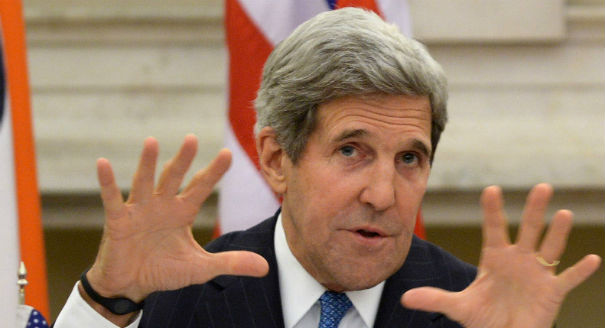
The cynical Beltway chatter about Secretary of State John Kerry paused last week with the announcement that peace talks between Israelis and Palestinians might begin shortly in Washington.
Source: CNN
The cynical Beltway chatter about Secretary of State John Kerry paused last week with the announcement that peace talks between Israelis and Palestinians might begin shortly in Washington. Perhaps he was not Don Quixote after all, tilting at the problem that has bedeviled negotiators for decades.
Perhaps all those trips to the Middle East were not, as some had suggested, simply an effort by Kerry to appear relevant. Perhaps he might actually deserve credit for doggedly pursuing peace, for taking the initiative in a part of the world where foreign policy is something that happens to us, beyond our control or influence.
Nonetheless, it is not too early to ask whether Kerry's tenacious efforts are a good use of his time or the Obama administration's resources and political capital. Is any chance at solving this defining problem of the modern Middle East worth the effort? Or is this just a Hail Mary pass from a politician-turned-diplomat in search of a big role or an administration in desperate need of a good news foreign policy story?There is no question that this is not the same old Arab-Israeli peace initiative. Yes, it has all the familiar combinations of distrust and mutual need, a debate over Israel's 1967 borders, seemingly irreconcilable differences over Jerusalem, and political divisions within both camps that seem likely to make negotiations hard and implementation harder.
But much has changed. Today, the American people have less stomach for the problems of the Middle East and a sense, thanks to the vaunted domestic energy revolution, that we are less dependent on that part of the world. Europe is back on its heels economically. China and India are not yet ready to step up and play a central role in the region. And the result is that getting a grip on regionwide instability is harder and harder to do. Such issues as Afghanistan, Iran's nuclear program, the Arab Spring, Syria, and the spread of militant extremism now arguably are more important to the U.S. than the venerable problem of Arab-Israeli peace.
Yes, regional ministers apparently said to John Kerry in talks last week that it is a central issue tied to many of the region's problems. But that old assertion needs to be viewed skeptically. It has served as an excuse for many in the region to explain their failure to govern or grow as their people wanted. It is easy to test, too. Just ask which among the litany of challenges mentioned would be solved or truly be made measurably easier to deal with were an Israeli-Palestinian deal struck. The answer is: Not many.
None of these reasons however suggests that this is a problem to ignore. First, it is one of the few regional problems in which there is a clear role for the U.S. to play. Israel is our most dependable ally in the region. The Palestinians deserve their own state and a chance at the economic opportunity that real peace would bring. And while peace between Israelis and Palestinians is unlike to transform the Middle East overnight, it is bound to help reduce some tensions and remove at least one old excuse for conflict.
Further, the clock is ticking demographically. Israel must cut a deal with the Palestinians sooner rather than later, or the idea of a Jewish state will be undercut by having a majority Palestinian population. What is more, virtually all of Israel's borders are at greater risk today than at any time in decades due to tumult in Egypt, Syria's crisis, refugee flows into Jordan, and so on. In that light, more stability in Gaza and the West Bank is more strategically important than ever.
None of this means that reaching a deal -- or even getting to meaningful talks that are about more than near-term issues like prisoner swaps -- is going to be easy. To the contrary, it'll be grueling and is likely to fail. But that doesn't mean it isn't worth trying. Kerry has recognized this and, through the power of tireless personal diplomacy, at least produced a little progress. For that he deserves credit and real support from the White House, Congress and the American people.
The White House should be immensely thankful that Kerry has been single-minded and immune to the cheap-shot criticisms of District of Columbia denizens. Right now, the U.S. looks pretty weak in the Middle East. Kerry's effort at least shows a sign of a pulse and a little vision for U.S. foreign policy in the region. Even if little else comes out of it, that alone makes it a risk worth taking.
Former Visiting Scholar
David Rothkopf was a visiting scholar at the Carnegie Endowment as well as the former CEO and editor in chief of the FP Group.
Recent Work
David Rothkopf
David Rothkopf
Carnegie does not take institutional positions on public policy issues; the views represented herein are those of the author(s) and do not necessarily reflect the views of Carnegie, its staff, or its trustees.

But their "principal to principal" model will only be as effective as the political strength of each leader back home.

Damien Ma

U.S. unpredictability has allowed China to capitalize on its positioning as the “responsible great power”. Paradoxically, the more China wins the perception game, the more likely expectations will rise for Beijing to deliver not just words but to demonstrate with its deeds.

Chong Ja Ian

Hanoi and Beijing have long treated each other as distant cousins rather than comrades in arms. That might be changing as both sides draw closer to hedge against uncertainty and America’s erratic behavior.

Nguyễn Khắc Giang

Across Asia, China is better positioned to withstand energy shocks from the fallout of the Iran war. Its abundant coal capacity can ensure stability in the near term. Yet at the same time, the country’s energy transition away from coal will make it even less vulnerable during the next shock.
Damien Ma

Malaysia’s chairmanship sought to fend off short-term challenges while laying the groundwork for minimizing ASEAN’s longer-term exposure to external stresses.

Elina Noor