

Article
C. Raja Mohan, Darshana M. Baruah
{
  "authors": [
    "C. Raja Mohan"
  ],
  "type": "legacyinthemedia",
  "centerAffiliationAll": "dc",
  "centers": [
    "Carnegie Endowment for International Peace",
    "Carnegie India"
  ],
  "collections": [],
  "englishNewsletterAll": "asia",
  "nonEnglishNewsletterAll": "",
  "primaryCenter": "Carnegie India",
  "programAffiliation": "AP",
  "programs": [
    "Asia",
    "South Asia"
  ],
  "projects": [],
  "regions": [
    "South Asia",
    "India",
    "East Asia",
    "South Korea"
  ],
  "topics": [
    "Security",
    "Foreign Policy"
  ]
}
Source: Getty
South Korea can help develop some interesting strategic options for India if the government in Delhi is willing to think boldly.
Source: Indian Express
Korea has long been known as a "shrimp among the whales", boxed as it is among China, Japan, Russia and the United States in northeast Asia. While the divided Korean Peninsula's geopolitics continues to be shaped by the great powers, South Korea is rapidly emerging as a middle power to reckon with in Asia and beyond. South Korea has long been an economic powerhouse. What we are seeing today is Seoul's conscious search for a political and diplomatic role in Asia and beyond. Sustained high growth rates since the 1960s had transformed South Korea from a backward country at the end of World War II into the world's 12th largest economy (PPP terms) and 15th largest (nominal GDP) by 2012.
As the world's seventh largest exporter and eighth largest importer, South Korea is one of the world's important trading nations. Its companies have steadily moved to the export of sophisticated products, including nuclear reactors. Samsung, for example, is giving Apple a run for its money in the global markets for smartphones and tablets.
South Korea has free trade agreements with many countries, including the US, Europe, the Association of Southeast Asian Nations (ASEAN) and India. It actively participates in the building of an Asian economic community within a framework led by the ASEAN.
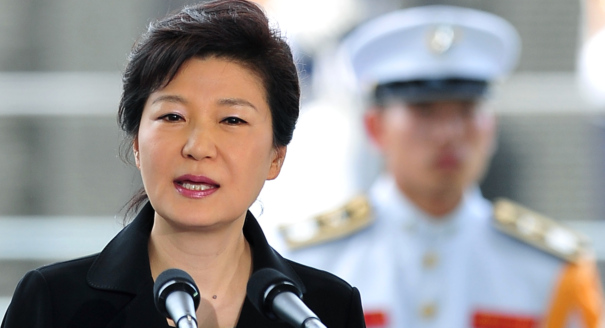
South Korean President Park Geun-hye is now building on her predecessor Lee Myung-bak's efforts to convert Seoul's growing economic power into political influence. Despite being hobbled by an unending conflict with North Korea, Seoul has begun to look beyond the Peninsula to establish a solid global strategic footprint. While holding on to its longstanding alliance with the US, Seoul has deepened ties with China and Russia, the major benefactors of North Korea. It has strategic partnership agreements with a number of countries, including Australia and Vietnam.
Korea now has active multilateral diplomacy. A Korean diplomat, Ban Ki-moon, is the secretary general of the United Nations. It became the first non-G-8 country to host a meeting of the G-20 and the first Asian power to host the Nuclear Security Summit. Korea has become a major donor of foreign aid and is promoting the "Korean model" of economic growth in Africa and Asia. South Korean troops now participate in UN peacekeeping operations. Meanwhile, Korean culture has begun to make a big impact on the world. Korean pop is here to stay after the huge success of "Gangnam Style". Korean movies have penetrated global entertainment markets, including India's Northeast.
Although South Korea has been a major economic partner of India for nearly two decades, the bilateral political relationship has remained an underdeveloped one. That, however, has begun to change in recent years. The two sides have declared the intent to build a strategic partnership. Korea was quick to negotiate an agreement for civil nuclear cooperation with India after the India-US nuclear deal.
The visit of Indian Defence Minister A.K. Antony in 2010 had laid the basis for deeper defence cooperation. The recent visit of Air Chief Marshal N.A.K. Browne to South Korea has opened the door for productive engagement between the armed forces of the two countries. South Korea is also quite close to clinching a deal on the supply of minesweepers for the Indian navy. Beyond the buyer-seller relationship, the two sides are exploring the prospects for defence industrial collaboration. There is growing recognition in both capitals that promoting maritime security in the Indo-Pacific and the structuring of a stable Asian balance of power demand stronger security cooperation between India and South Korea.
Earlier this month, National Security Advisor Shivshankar Menon was in Seoul to tie all these strands together and inject some real content into the proclaimed strategic partnership between the two countries. If Menon was the first Indian NSA to visit Seoul, his grandfather K.P.S. Menon, independent India's first foreign secretary, was the chairman of the nine-member UN Commission set up in 1947 to conduct elections in the Korean Peninsula.
As New Delhi and Seoul reconnect politically, the planned visit of President Park to India in the next few months provides an occasion to think boldly about the future of the bilateral partnership. If Delhi can look beyond China in its policies towards northeast Asia, it will find that South Korea can help develop very interesting strategic options for India.
Former Nonresident Senior Fellow, Carnegie India
A leading analyst of India’s foreign policy, Mohan is also an expert on South Asian security, great-power relations in Asia, and arms control.
Recent Work

C. Raja Mohan, Darshana M. Baruah


Alexander Gabuev, Paul Haenle, C. Raja Mohan, …
Carnegie does not take institutional positions on public policy issues; the views represented herein are those of the author(s) and do not necessarily reflect the views of Carnegie, its staff, or its trustees.

The nuclear relationship between China and the United States is increasingly shaped by widening perception gaps rather than deliberate strategic design.

Tong Zhao

Chinese biotech companies have been on the receiving end of U.S. economic coercion. Yet their responses have differed significantly because firm and state interests are not uniformly aligned. For Washington, treating all Chinese tech firms the same, irrespective of their actual interests, risks pushing them farther into Beijing’s corner.

Xue Gong

But their "principal to principal" model will only be as effective as the political strength of each leader back home.

Damien Ma

U.S. unpredictability has allowed China to capitalize on its positioning as the “responsible great power”. Paradoxically, the more China wins the perception game, the more likely expectations will rise for Beijing to deliver not just words but to demonstrate with its deeds.

Chong Ja Ian

Hanoi and Beijing have long treated each other as distant cousins rather than comrades in arms. That might be changing as both sides draw closer to hedge against uncertainty and America’s erratic behavior.

Nguyễn Khắc Giang