

Commentary
Yezid Sayigh
{
  "authors": [
    "Yezid Sayigh"
  ],
  "type": "legacyinthemedia",
  "centerAffiliationAll": "",
  "centers": [
    "Carnegie Endowment for International Peace",
    "Malcolm H. Kerr Carnegie Middle East Center"
  ],
  "collections": [],
  "englishNewsletterAll": "",
  "nonEnglishNewsletterAll": "",
  "primaryCenter": "Malcolm H. Kerr Carnegie Middle East Center",
  "programAffiliation": "",
  "programs": [],
  "projects": [],
  "regions": [
    "Levant",
    "Syria",
    "Middle East"
  ],
  "topics": [
    "Political Reform",
    "Security",
    "Foreign Policy"
  ]
}
Source: Getty
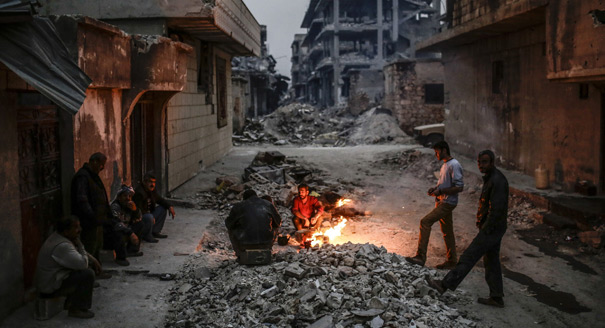
The Friends of Syria have played what may be their last card. What difference will it make on the ground?
Source: openSecurity
JO TYABJI: I’m Jo Tyabji, editor of openSecurity, and today, I’m with Yezid Sayigh, who is a senior associate of the Carnegie Middle East Center in Beirut. Yezid, thank you so much for being with me.
TYABJI: We started this week with an urgent statement from the Friends of Syria in Qatar, saying that measures would be taken to get all material equipment to the rebels in Syria. To what extent does this represent a real escalation—a military escalation—or is there room for the status quo to pretty much continue?
YEZID SAYIGH: I think there’s a lot of room for the status quo to continue, with some change. In other words, I think the Friends of Syria will allow a certain flow of weapons to to go to the Syrian rebels—maybe still via allies in the region, such as Qatar and Saudi Arabia. Although the Obama administration approved in min-June the direct supply of American military assistance—lethal military assistance—to the rebels, but the key issue here, I think, is that the Friends of Syria, and especially the Western partners of the Friends of Syria, have spun out this whole thing for many months. They’ve waived the threat of supplying arms to the opposition, they’ve gone back and forth on it, they’ve threatened to do it, and then at the end of May, the European Union ended its embargo—or its total embargo in supplying weapons to Syria—in order to allow individual member-states to provide some sort of military assistance to the rebels.
SAYIGH: So what we have is a lot of gesturing, a lot of signaling to the Syrians and to the Russians. And I think this is because the Friends of Syria basically have run out of cards to play. They imposed sanctions—economic sanctions and financial sanctions and very painful ones in Syria—quite early in the crisis, in other words, in the beginning of 2012. And that was pretty much their only really effective option, short of going to the Security Council, which they tried, but that got blocked, of course, by Russia and China. They still don’t have the option of getting collective international sanctions from the United Nations, because the Russians and the Chinese are still committed to blocking that. So, this leaves the Friends of Syria really with very few choices.

Senior Fellow, Malcolm H. Kerr Carnegie Middle East Center
Yezid Sayigh is a senior fellow at the Malcolm H. Kerr Carnegie Middle East Center in Beirut, where he leads the program on Civil-Military Relations in Arab States (CMRAS). His work focuses on the comparative political and economic roles of Arab armed forces, the impact of war on states and societies, the politics of postconflict reconstruction and security sector transformation in Arab transitions, and authoritarian resurgence.
Recent Work
Yezid Sayigh
Yezid Sayigh
Carnegie does not take institutional positions on public policy issues; the views represented herein are those of the author(s) and do not necessarily reflect the views of Carnegie, its staff, or its trustees.

But their "principal to principal" model will only be as effective as the political strength of each leader back home.

Damien Ma

U.S. unpredictability has allowed China to capitalize on its positioning as the “responsible great power”. Paradoxically, the more China wins the perception game, the more likely expectations will rise for Beijing to deliver not just words but to demonstrate with its deeds.

Chong Ja Ian

Hanoi and Beijing have long treated each other as distant cousins rather than comrades in arms. That might be changing as both sides draw closer to hedge against uncertainty and America’s erratic behavior.

Nguyễn Khắc Giang

Across Asia, China is better positioned to withstand energy shocks from the fallout of the Iran war. Its abundant coal capacity can ensure stability in the near term. Yet at the same time, the country’s energy transition away from coal will make it even less vulnerable during the next shock.
Damien Ma

Malaysia’s chairmanship sought to fend off short-term challenges while laying the groundwork for minimizing ASEAN’s longer-term exposure to external stresses.

Elina Noor