

Article
C. Raja Mohan, Darshana M. Baruah
{
  "authors": [
    "C. Raja Mohan"
  ],
  "type": "legacyinthemedia",
  "centerAffiliationAll": "dc",
  "centers": [
    "Carnegie Endowment for International Peace",
    "Carnegie China",
    "Carnegie India"
  ],
  "collections": [
    "China’s Foreign Relations"
  ],
  "englishNewsletterAll": "ctw",
  "nonEnglishNewsletterAll": "",
  "primaryCenter": "Carnegie India",
  "programAffiliation": "SAP",
  "programs": [
    "South Asia"
  ],
  "projects": [],
  "regions": [
    "East Asia",
    "China",
    "Southeast Asia"
  ],
  "topics": [
    "Arms Control",
    "Foreign Policy"
  ]
}
Source: Getty
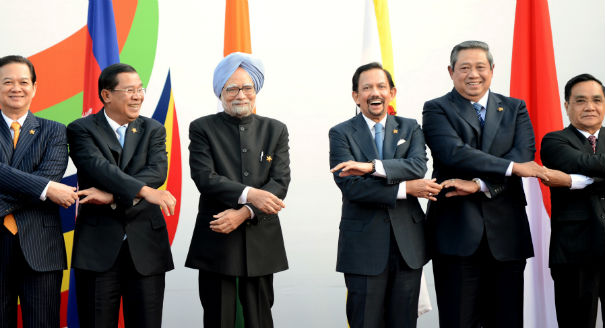
Those who think “spheres of influence” is an outdated idea in international relations should take a close look at China’s charm offensive in Southeast Asia.
Source: Indian Express
Those who think "spheres of influence" is an outdated idea in international relations should take a close look at China's charm offensive in Southeast Asia. At the recent annual regional summits in Brunei, Beijing actively pressed for an agreement on regular defence ministerial consultations with Southeast Asia. The Association of Southeast Asian Nations (ASEAN) did not bite, for now. But Beijing is unlikely to give up on the tease.
Despite numerous requests from Premier Li Keqiang, the statement emanating from the "ASEAN Plus China" meeting merely "noted" Beijing's proposal. Put in plain English, ASEAN was neither accepting nor rejecting the call from Beijing. The fact is that there are significant differences among the member states on accepting a separate defence track with China. ASEAN, it might be recalled, has already agreed to hold such a "plus one" defence dialogue with the United States. Earlier this year, ASEAN defence ministers accepted US Defence Secretary Chuck Hagel's invitation for a joint session in Hawaii during 2014.ASEAN's fear of a defence embrace with China is not surprising, given Beijing's intensifying maritime territorial disputes with Vietnam and the Philippines. Southeast Asia is also intrigued by another proposal from Li for a China-ASEAN treaty on "good neighbourliness, friendship and cooperation to consolidate the political foundation of mutual trust". China, it would seem, is eager to demonstrate that it does not pose a threat to ASEAN and signal its desire for a comprehensive partnership with the region.
Some see the proposal as a response to a recent initiative from Jakarta calling for an Indo-Pacific treaty of friendship and cooperation. If Jakarta wants to embed ASEAN's relationship with China in a broader structure of regional balance, Beijing is looking for an exclusive sphere of influence.
ASEAN's current reluctance to embrace China in the security sector did not stop Li from outlining the case for a deeper economic integration with Southeast Asia. If the last 10 years of engagement between the two has been a golden one, Li wants the next 10 to be the "diamond decade".
After the ASEAN summit, Li travelled to Thailand, where he pitched for high-speed transborder rail links between the two countries. Opening an exhibition showcasing China's high-speed rail technology in Bangkok, Li pressed for an expansion and modernisation of rail connectivity in the region.
Earlier agreements between Bangkok and Beijing to build high-speed rail links between the two countries have stalled amidst controversies within Thailand over high project costs, the methods of financing and the proposed route. Public backing for the project from the Chinese premier is expected to accelerate Bangkok's decision on executing the project.
While consolidating the strong ties with Thailand, Li has made a bold effort to improve strained relations with Vietnam. Maritime territorial disputes between China and Vietnam in the South China Sea have boiled over in recent years.
Vietnam has actively sought security cooperation with the US, Japan and other Asian countries, including India, to balance the giant neighbour to the north. If the previous leadership in Beijing frowned at Hanoi's insolence, China has now turned on "smile diplomacy". "The symphony of China-Vietnam diplomacy rises to a new crescendo," China's official Xinhua news agency gushed as Li arrived in Hanoi over the weekend.
Li signed a number of agreements to boost bilateral cooperation. The two agreed to boost bilateral trade to $60 billion by 2015 and promote cooperation in the areas of finance and infrastructure. Even more important was the decision to set up a joint working group that will explore joint exploration and development of the Gulf of Tonkin resources while they continue to negotiate a peaceful resolution of their territorial disputes.
At a joint press conference in Hanoi, Li declared that despite their current differences, China and Vietnam have the will to promote stability in the "South China Sea". His counterpart, Nguyen Tan Dung was less lyrical when he noted that the two sides agreed to maintain peace in the "East Sea".
Forget, for a moment, the different names that Li and Dung employed to describe the same disputed waters, but do keep an eye on the masters of realpolitik in Beijing and Hanoi circling each other in the coming months.
This article was originally published in the Indian Express.
Former Nonresident Senior Fellow, Carnegie India
A leading analyst of India’s foreign policy, Mohan is also an expert on South Asian security, great-power relations in Asia, and arms control.
Recent Work

C. Raja Mohan, Darshana M. Baruah


Alexander Gabuev, Paul Haenle, C. Raja Mohan, …
Carnegie does not take institutional positions on public policy issues; the views represented herein are those of the author(s) and do not necessarily reflect the views of Carnegie, its staff, or its trustees.

China’s banking crisis in the 2000s was resolved by transferring the costs to households through financial repression—a decision that recapitalized the banks while exacerbating the structural imbalances that continue to shape the Chinese economy today.

Michael Pettis

Chinese biotech companies have been on the receiving end of U.S. economic coercion. Yet their responses have differed significantly because firm and state interests are not uniformly aligned. For Washington, treating all Chinese tech firms the same, irrespective of their actual interests, risks pushing them farther into Beijing’s corner.

Xue Gong
China’s latest energy plan explicitly calls for integrating data centers into the electricity system, particularly connecting them to green energy. It appears Beijing wants to use compute as a source of domestic demand to absorb renewables excess capacity.

Damien Ma

But their "principal to principal" model will only be as effective as the political strength of each leader back home.
Damien Ma

U.S. unpredictability has allowed China to capitalize on its positioning as the “responsible great power”. Paradoxically, the more China wins the perception game, the more likely expectations will rise for Beijing to deliver not just words but to demonstrate with its deeds.

Chong Ja Ian