

In The Media
Lahcen Achy
{
  "authors": [
    "Lahcen Achy"
  ],
  "type": "legacyinthemedia",
  "centerAffiliationAll": "dc",
  "centers": [
    "Carnegie Endowment for International Peace",
    "Malcolm H. Kerr Carnegie Middle East Center"
  ],
  "collections": [],
  "englishNewsletterAll": "menaTransitions",
  "nonEnglishNewsletterAll": "",
  "primaryCenter": "Malcolm H. Kerr Carnegie Middle East Center",
  "programAffiliation": "MEP",
  "programs": [
    "Middle East"
  ],
  "projects": [],
  "regions": [
    "Egypt",
    "Gulf",
    "Levant",
    "Maghreb",
    "Middle East",
    "North Africa"
  ],
  "topics": [
    "Economy"
  ]
}
Source: Getty
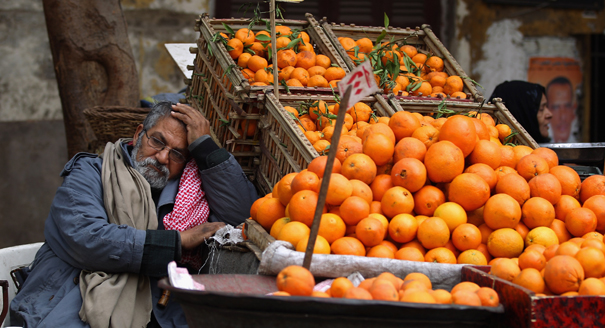
Delaying economic diversification exacerbates the crises Arab countries face, especially rising unemployment and fluctuating growth.
Source: Al-Hayat
In the early 1990’s, most Arab countries, in order to foster growth and create sufficient employment opportunities, looked to transition from economies dominated by a bloated public sector to ones in which the private sector is the main driver of growth; from closed economies to competitive ones integrated in the global economy; and from oil- and gas-based economies to greater economic diversity.
International experiences show that as countries become richer, the share of the agricultural sector in GDP decreases, and the share of manufacturing and services increases. This transformation usually occurs as a result of technological advances that improve agricultural productivity and shift the factors of production towards manufacturing and services. The productive structures in the Arab world have seen little diversification in the last thirty years. Although the agricultural sector’s relative size contracted, the share of manufacturing only rarely increased. At the same time, the relative size of the services sector shrunk.
Extractive industries, including oil and gas, continued to dominate, and its relative size increased even more during the last decades. This indicates that diversification is still an elusive goal. Recent World Bank reports show that the mining sector represents 37 percent of GDP for oil-exporting Arab countries, as opposed to only 28 percent in 1990. The sector comprises 85 percent of commodity exports and between 65 percent and 95 percent of government revenues. The reports also show that the size of the mining sector in Gulf Cooperation Council countries is about half of their GDP.In the wake of the last oil boom, oil-producing Gulf States resorted to heavy investments in sovereign wealth funds as a way to diversify their sources of income. Many funds include enormous holdings in cross-border assets. Although investing in sovereign funds helped reduce the impact of the global economic crisis and the fluctuations of oil prices on the countries concerned, the importance of true economic diversification must be emphasized for the following considerations:
First, economic diversification leads to a reduction in growth fluctuations, which encourages private investment in the various sectors of the economy. Fluctuation of growth in Arab countries is higher than in the rest of the world. In GCC states, fluctuation of growth is twice the average in other resource-rich Arab countries and four times that in non-oil exporting Arab countries.
Second, economic diversification is considered essential for job creation, especially in light of the rapidly increasing numbers of entrants to the job market. Countries cannot continue to rely on the public sector, the largest employer in many Arab countries, to reduce unemployment rates.
Third, diversification in manufacturing and high value-added services creates opportunities for exporting new products instead of just ramping up exports of the same products. The diversification of exports requires integration into the global economy that aims to foster long-term growth.
The experience of resource-rich countries underlines the importance of investing in human capital and fostering institutions in order to achieve economic diversification. Advanced manufacturing and service industries greatly depend on the enforcement of contracts between parties, the rule of law, and the transparency of legislation. Together, these factors encourage competition between investors and weaken the rent-seeking that dominates business environments in the Arab world.
Financial policy can influence economic diversification through the management and structure of public expenditures. For instance, investments in education and infrastructure are of utmost importance in strengthening the private sector and improving returns on future investments. But, if options for public spending are limited by the enormity of the budget for consumer subsidies and the dominance of employee salaries, the financial opportunity for investing in human capital and infrastructure becomes limited. Also, excess spending on fuel subsidies takes away from investing in manufacturing and service industries.
The challenge for Arab countries, especially oil-rich ones, is to ensure that financial policy can foster growth and economic diversification and that economic reforms can create job opportunities to keep up with the rapid growth of the labor force. As for the oil-importing Arab countries, they can no longer put off redirecting public expenditures from subsidies that do not help the poor to conditional cash transfers and active public investment programs. Through financial policy that aims to build human capital and suitable infrastructure, Arab countries can lay the foundations for successful economic diversification.
This article was originally published in Al-Hayat in Arabic.

Former Nonresident Senior Associate, Middle East Center
Achy is an economist with expertise in development, institutional economics, trade, and labor and a focus on the Middle East and North Africa.
Recent Work
Lahcen Achy
Lahcen Achy
Carnegie does not take institutional positions on public policy issues; the views represented herein are those of the author(s) and do not necessarily reflect the views of Carnegie, its staff, or its trustees.

China has showcased its engineering prowess with small modular reactor demonstration projects. But turning these technological achievements into commercial success will be a greater challenge.

Tong Zhao

The Plaza Accord was not an externally imposed punishment of Japan but part of a broader restructuring that Japanese economists and policymakers themselves recognized was necessary. Its effects were undermined, however, when Tokyo responded to the resulting slowdown with policies that exacerbated investment, credit expansion, and the very imbalances the adjustment was intended to resolve.

Michael Pettis
China’s banking crisis in the 2000s was resolved by transferring the costs to households through financial repression—a decision that recapitalized the banks while exacerbating the structural imbalances that continue to shape the Chinese economy today.
Michael Pettis

In the latest Five-Year Plan, the Chinese president cements the shift to an innovation-driven economy over a consumption-driven one.

Damien Ma
Rather than climate ambitions, compatibility with investment and exports is why China supports both green and high-emission technologies.

Mathias Larsen