

Commentary
Alexey Malashenko
{
  "authors": [
    "Alexey Malashenko"
  ],
  "type": "commentary",
  "centerAffiliationAll": "",
  "centers": [
    "Carnegie Endowment for International Peace",
    "Carnegie Russia Eurasia Center"
  ],
  "collections": [],
  "englishNewsletterAll": "",
  "nonEnglishNewsletterAll": "",
  "primaryCenter": "Carnegie Russia Eurasia Center",
  "programAffiliation": "",
  "programs": [],
  "projects": [],
  "regions": [
    "Caucasus",
    "Georgia"
  ],
  "topics": []
}
Source: Getty
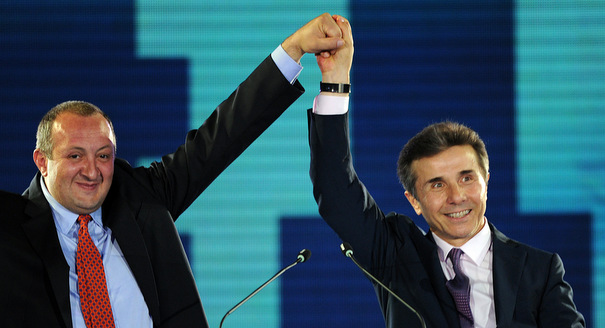
The predictability of the election outcomes contrasts with unpredictability of Georgia’s further development.
What is special about the upcoming Georgian presidential elections scheduled to take place on October 27? First, these are probably the first “normal” elections—that is the elections that are taking place in the atmosphere of calm and are not accompanied by protests. After revolutions, unrest, and even a war, Georgian society looks peaceful. Second, these are democratic elections. The so-called “administrative resource,” which still remains one of the main instruments of the electoral process in most of the post-Soviet space, has been exhausted in Georgia. Any attempt to use it will only backfire, regardless of whether it may come from Giorgi Margvelashvili of Georgian Dream or David Barkadze, who replaced Mikheil Saakashvili as the United National Movement (UNM) leader. Third, presently, none of the 23 candidates has great charisma, thus their personal popularity and appeal will have no considerable effect on the outcome of the elections. “The messiahs’ mission is over,” as Georgia’s Prime Minister Bidizina Ivanishvili brilliantly punned. Forth, populist slogans, which are already past their prime in Georgia, are not part of these elections. And finally, fifth, Georgia’s territorial integrity can hardly be an important theme during the election season. Of course, Georgian society will not abandon this issue (not for one or two generations, to be more exact); nevertheless, the reunification with Abkhazia and South Ossetia will not be the main political priority during these elections. Rather, economic and social issues will take the center stage in the struggle for the president’s office.
All the analysts predict the Georgian Dream candidate’s victory, disagreeing only about whether the run-off will take place or the first round of voting will be sufficient. Merab Pachulia, an authoritative expert and head of the Georgian Opinion Research Business International (GORBI), is certain that one round will be enough, while the U.S. National Democratic Institute poll points to the inevitability of the second round because the frontrunner, according to the survey, is not likely to secure even 40 percent of the vote.
Predictions about the inevitable loss of Saakashvili’s UNM are equally unanimous. However, one should not rush to final conclusions here. In my view, the number of votes that David Bakradze will manage to get will make a material difference. It will not simply affect the UNM’s fate but will also determine whether the Georgian Dream will have a serious opponent in the future. If UNM does receive a significant percentage of votes, this will mark further normalization of Georgian political life.
The second-place finish by the eternal Nino Burjanadze may come as a surprise, albeit not entirely unexpected. She has withstood numerous tests and has been able to maintain her popularity.
The predictability of the election outcomes contrasts with unpredictability of Georgia’s further development. After bringing political stability to the country, as well as pushing it a bit further away from the economic cliff and reaching preliminary mutual understanding with Russia, Bidzina Ivanishvili has said that he wants to leave politics. However, most Georgians do not want this calm, sane person to leave them out in the cold and refuse to believe that this will actually happen. It appears likely that he will not bring himself to do this after all. But again, this decision to a large extent hinges on how successful Giorgi Margvelashvili of the Georgian Dream—the party that Ivanishvili created—will be in the upcoming elections.
Former Scholar in Residence, Religion, Society, and Security Program
Malashenko is a former chair of the Carnegie Moscow Center’s Religion, Society, and Security Program.
Recent Work
Alexey Malashenko
Alexey Malashenko
It’s about managing oil prices, bread prices, and strategic partnerships.



Amr Hamzawy, Karim Sadjadpour, Aaron David Miller, …
As North Korea continues to stall talks with the United States and South Korea, there is a greater need for China to play a more assertive role to help break the impasse.

Tong Zhao
Pitched as a new Silk Road sweeping from Asia to Europe, China’s enormous Belt and Road Initiative is an ambitious, multinational infrastructure project. Experts from four Carnegie global centers explain other countries’ perspectives.


Paul Haenle, Dmitri Trenin, Alexander Gabuev, …
Despite the BRI’s prevalence in discussions of China’s global engagement, many experts are divided on how to interpret it. Is it a global strategy or just an interregional initiative? How can countries and international companies participate in its growth and development?
Feng Yujun, Alexander Gabuev, Paul Haenle, …
With the threat of nuclear war growing, China, Russia, and the United States should not wait until political relations improve before making efforts to manage new technologies.

James M. Acton, Tong Zhao, Li Bin