

Article
- +1
Toby Dalton, Mark Hibbs, Nicole Grajewski, …
{
  "authors": [
    "Mark Hibbs"
  ],
  "type": "legacyinthemedia",
  "centerAffiliationAll": "dc",
  "centers": [
    "Carnegie Endowment for International Peace",
    "Malcolm H. Kerr Carnegie Middle East Center"
  ],
  "collections": [
    "Iranian Proliferation",
    "U.S. Nuclear Policy"
  ],
  "englishNewsletterAll": "ctw",
  "nonEnglishNewsletterAll": "",
  "primaryCenter": "Carnegie Endowment for International Peace",
  "programAffiliation": "NPP",
  "programs": [
    "Nuclear Policy"
  ],
  "projects": [],
  "regions": [
    "North America",
    "United States",
    "Middle East",
    "Iran"
  ],
  "topics": [
    "Nuclear Policy",
    "Arms Control"
  ]
}
Source: Getty
The endgame for negotiations would be an Iran whose entire nuclear program would be subject to routine but rigorous oversight to make sure everything is accounted for.
Source: CNN
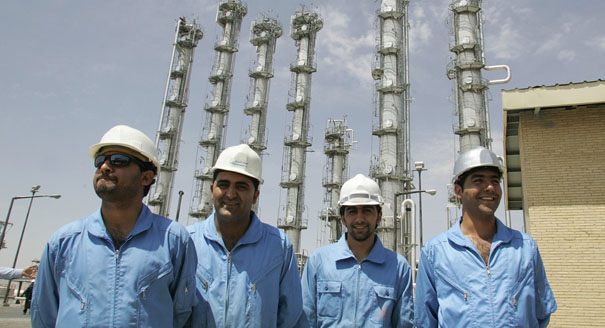
France appeared at the weekend to drive a stake into the heart of a deal that it and five other powers have been quietly negotiating with Iran to end the Iran nuclear crisis. The move didn’t prove fatal – both sides are committed to resume negotiations in Geneva on November 20. But France objected that the outline of a deal favored by the United States didn’t commit Iran to suspend work to finish a reactor at Arak, which could make bomb-grade fuel, but only not to start up the reactor during the next six months. When the powers return to Geneva to resume negotiations, they should tell Iran that an initial confidence-building agreement should freeze work on the reactor project.
Suspension would give negotiators space to forge a long-term commitment to address proliferation concerns that are shared by all the powers, Israel, and the Arab Gulf states. Under such an arrangement, Iran could receive assistance to complete the reactor with modern instrumentation, equipment, and fuel, making it safe to operate. The unfinished reactor could be replaced with a less-threatening unit, or its design could be modified to enhance nonproliferation and maximize its potential for peaceful nuclear research and medical isotope production. In return, Iran would agree not to access the reactor’s plutonium and to allow IAEA inspections in perpetuity. One of the six powers – France, perhaps – could take back the plutonium-laden spent fuel.Without a comprehensive settlement of the crisis, the Arak project poses a proliferation threat, yet the logic of the nuclear negotiations implies that it doesn’t have to. That’s because the endgame would be an Iran whose entire nuclear program would be subject to routine but rigorous oversight to make sure everything is accounted for. Only on that basis will Iran agree to negotiate. Iran at the same time must understand that, in light of its past deceptions, it must provide greater assurances than most countries. If these conditions are met, Iran will cogently argue that it should have its reactor.
The director general of the International Atomic Energy Agency (IAEA), Yukiya Amano, met with Iranian officials in Tehran on Monday, spelling out how, if Iran fully cooperates, IAEA inspectors can announce they’re satisfied that Iran’s entire nuclear program is well understood, transparent, and peaceful. The IAEA has given such a “broader conclusion” for over 50 countries. It could get to that point in Iran in a couple of years.
Iran could, for its part, take a critical step in that direction by providing the IAEA all of the reactor engineering data it needs to design an inspection regime for the Arak unit. So far, Iran has balked at doing that. Without the data, IAEA oversight will be less effective, translating into less confidence that the reactor won’t be used to secretly siphon off nuclear material to make bombs.
However, if the Arak project is not frozen by the pending confidence-building deal, Iran can complete work needed that would inhibit the IAEA from getting optimal access. In reactor projects like this elsewhere today, reactor designers instead facilitate ease of IAEA access in advance of construction.
The fact is that an agreement by Iran to simply not start up the reactor for six months wouldn’t generate additional confidence because the reactor can’t be finished that soon. Eventually, however – perhaps a year from now – Iran might finish and then operate it, using fuel Iran is now producing by hand and will continue to make during the next six to nine months unless work is halted.
In 2010, the IAEA concluded that Iran, sanctioned from access to foreign expertise, doesn’t have the wherewithal to systematically test that fuel. There may also be other safety concerns, since Iran is building the reactor without help from international safety authorities and experts.
Iran and the powers should therefore agree on November 20 that, as part of their initial agreement to build confidence, the Arak project should be suspended. That would depressurize talks to consider the long-term future of this project – without lingering concern that next year Iran will complete the reactor and operate it, obviating further negotiations on this critical issue.
If the powers negotiating with Iran mean what they say, a successful outcome will mean an Iran with a nuclear program under effective IAEA surveillance. But to get there Iran must satisfy the IAEA’s need for information to confirm that its program is peaceful. In return, the powers will have to accommodate Iran’s legitimate peaceful nuclear aspirations – including for a safe and versatile research reactor.

Nonresident Senior Fellow, Nuclear Policy Program
Hibbs is a Germany-based nonresident senior fellow in Carnegie’s Nuclear Policy Program. His areas of expertise are nuclear verification and safeguards, multilateral nuclear trade policy, international nuclear cooperation, and nonproliferation arrangements.
Recent Work


Toby Dalton, Mark Hibbs, Nicole Grajewski, …
Mark Hibbs
Carnegie does not take institutional positions on public policy issues; the views represented herein are those of the author(s) and do not necessarily reflect the views of Carnegie, its staff, or its trustees.

The nuclear relationship between China and the United States is increasingly shaped by widening perception gaps rather than deliberate strategic design.

Tong Zhao

But their "principal to principal" model will only be as effective as the political strength of each leader back home.

Damien Ma

U.S. unpredictability has allowed China to capitalize on its positioning as the “responsible great power”. Paradoxically, the more China wins the perception game, the more likely expectations will rise for Beijing to deliver not just words but to demonstrate with its deeds.

Chong Ja Ian
For Malaysia, the conjunction that works is “and” not “or” when it comes to the United States and China.

Elina Noor
Regulation, not embargo, allows Beijing to shape how other countries and firms adapt to its terms.
Alvin Camba