

Article
Thomas de Waal
{
  "authors": [
    "Thomas de Waal"
  ],
  "type": "commentary",
  "centerAffiliationAll": "",
  "centers": [
    "Carnegie Endowment for International Peace",
    "Carnegie Europe",
    "Carnegie Russia Eurasia Center"
  ],
  "collections": [],
  "englishNewsletterAll": "",
  "nonEnglishNewsletterAll": "",
  "primaryCenter": "Carnegie Europe",
  "programAffiliation": "",
  "programs": [],
  "projects": [],
  "regions": [
    "Russia",
    "Eastern Europe",
    "Ukraine",
    "Western Europe"
  ],
  "topics": [
    "Political Reform",
    "Democracy",
    "Foreign Policy",
    "Civil Society"
  ]
}
Source: Getty
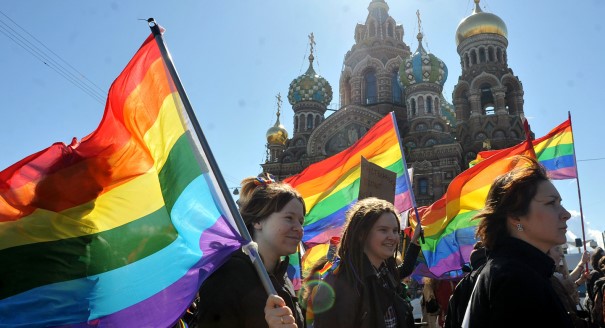
Not only in Russia where ideologists use the issue of homosexual rights as a dividing line between the East and the West, but in some other post-communist states as well the European agenda on gay and lesbian rights is not shared by the majority of population.
Not free trade, not democracy. Who could have guessed that the big ideological dividing line Russian ideologists are drawing between East and West would be homosexuality?
New words have entered the Russian political lexicon. Pro-western opposition leaders are described as “liberasti,” a combination of the words “liberal” and “pederast.” And anti-EU activists are claiming that the Euromaidan is actually a “Euro-Sodom.”
The marginal fringe of this group portrays Europe as a scary place where the state abducts your children and no longer permits usage of the words “mommy” and “daddy.”
The mainstream, led by the new-old media-darling of Russian patriotic television, Dmitry Kiselev, is more sarcastic. Kiselev publicly mocked the (openly gay) German Foreign Minister Guido Westerwelle, saying that when he met the opposition brothers, boxers Vitali and Wladimir Klitschko, in Kiev, he was “heated and maybe overheated by the bodies of the heavyweights.”
The divide is genuine. A recent article by Michael Lipka of the Pew Research Center presents a map of attitudes to gay rights that runs more or less down the line of the old Iron Curtain (although Greece and the Czech Republic fall on the other side).
Citing a Pew survey from 2010, Lipka records responses across Europe to the statement, “Gay men and lesbians should be free to live their own lives as they wish.” West European countries, headed by the Netherlands, Sweden, and Denmark, are at the top of the list, with 89 percent or more of respondents approving the statement.
Down at the bottom are Ukraine and Russia, with only 28 and 25 percent respectively respecting gay rights.
Westerners who fight for gay rights should take this seriously. While not giving up the struggle, they should reflect that you will not make much progress if in these countries (or in parts of Alabama or Oklahoma for that matter) you just use the same discourse that you use at home.
Two other findings from the same poll give more food for thought. One is that the traditionally Catholic Spain has undergone a massive generational change—80 percent of Spaniards approved that statement. The second is that the third lowest response, on a par with Ukraine, was in another traditionally Catholic country, Lithuania.
Lithuania however, is a member of the European Union and NATO. It can be assumed that many Ukrainians will also “choose Europe” without fully sharing the European agenda on gay and lesbian rights.

Senior Fellow, Carnegie Europe
Thomas de Waal is a senior fellow at Carnegie Europe, specializing in Eastern Europe and the Caucasus.
Recent Work
Thomas de Waal
Thomas de Waal
Carnegie does not take institutional positions on public policy issues; the views represented herein are those of the author(s) and do not necessarily reflect the views of Carnegie, its staff, or its trustees.

But their "principal to principal" model will only be as effective as the political strength of each leader back home.

Damien Ma

U.S. unpredictability has allowed China to capitalize on its positioning as the “responsible great power”. Paradoxically, the more China wins the perception game, the more likely expectations will rise for Beijing to deliver not just words but to demonstrate with its deeds.

Chong Ja Ian

Hanoi and Beijing have long treated each other as distant cousins rather than comrades in arms. That might be changing as both sides draw closer to hedge against uncertainty and America’s erratic behavior.

Nguyễn Khắc Giang

Across Asia, China is better positioned to withstand energy shocks from the fallout of the Iran war. Its abundant coal capacity can ensure stability in the near term. Yet at the same time, the country’s energy transition away from coal will make it even less vulnerable during the next shock.
Damien Ma

Malaysia’s chairmanship sought to fend off short-term challenges while laying the groundwork for minimizing ASEAN’s longer-term exposure to external stresses.

Elina Noor