

Article
China has showcased its engineering prowess with small modular reactor demonstration projects. But turning these technological achievements into commercial success will be a greater challenge.
Tong Zhao
{
  "authors": [
    "Julie Leighton"
  ],
  "type": "commentary",
  "centerAffiliationAll": "",
  "centers": [
    "Carnegie Endowment for International Peace",
    "Carnegie Russia Eurasia Center"
  ],
  "collections": [],
  "englishNewsletterAll": "",
  "nonEnglishNewsletterAll": "",
  "primaryCenter": "Carnegie Endowment for International Peace",
  "programAffiliation": "",
  "programs": [],
  "projects": [],
  "regions": [
    "Russia",
    "Eastern Europe",
    "Ukraine"
  ],
  "topics": [
    "Economy",
    "Foreign Policy"
  ]
}
Source: Getty
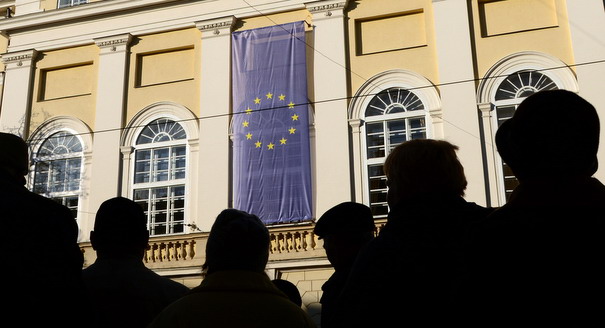
Regarding finances, the Russian government has used three methods to keep the Ukrainians from signing the Association Agreement with the EU: bullying, bribery, and defending Russian national interests.
Regarding finances, the Russian government has used three methods to keep the Ukrainians from signing the Association Agreement (AA): bullying, bribery, and defending Russian national interests.
Bullying and blackmail:
The August Trade Wars, marked by increasingly arduous border inspections and product restrictions, resulted in a 25 percent reduction in Ukrainian trade and an estimated $15 billion loss.
This was complemented by a bait-and-switch scenario which promised lower loans, decreased gas prices, and Gazprom debt forgiveness—on the condition that the “strategic partnership and friendship” between the two countries remained status quo. Putin’s adviser Sergei Glazyev, as quoted by The Guardian, explained that if the special relationship between the two countries is compromised then “Russia could no longer guarantee Ukraine’s status as a state and could possibly intervene if pro-Russian regions of the country appealed directly to Moscow.” He also said that, “Signing this treaty will lead to political and social unrest. The living standard will decline dramatically ...there will be chaos.”
Summary: Ukraine could opt for the AA, but only at the risk of crippling economic sanctions and possible state disintegration. Or, it can stay with Russia and receive debt forgiveness.
Bribery:
This was a two-pronged initiative.
The first issue was subsidies. The EU was able to offer $827 million in loans, with the possibility of an additional $1 billion from the IMF. Russia, on the other hand, has allegedly offered billions in a combination of subsidies and debt forgiveness.
The second issue was the potential for further Ukrainian infrastructural and internal development. The EU is clunky and inefficient. The likelihood of it being able to make an immediate and positive impact within the Ukrainian domestic realm is slim. In contrast, Russia released proposals for joint projects in the nuclear, space, and aviation industries that were designed to stabilize and diversify the Ukrainian economy. If implemented, these could have a long-lasting and conclusive effect on the country.
Optimistic conclusion: Russia appears to have a concrete and progressive plan for Ukraine, which the EU cannot match.
Defending Russian interests:
Vladimir Putin suggested an EU-Ukraine free trade agreement would be a “big threat” to the Russian economy, that a new commercial partnership would result in European goods flooding Russian markets, which would have the dramatic long-term effects of destabilizing industry and heightening the unemployment rate—a scenario Putin summed up as: “Do we have to choke entire sectors of our economy for them to like us?"
Conclusion: unconvincing and unnecessary.
Looked at side by side, it is easy to see why some would feel that the EU is simply unprepared and unwilling to take on the Ukrainian challenge. The Russian proposals and threats were predictable. All in all, a spectacular fail for Europe.
Julie Leighton is an independent Russian researcher. She was a research assistant at Russia and Eurasia Program at the Carnegie Endowment for International Peace.
Julie Leighton
Former Research Assistant, Russia and Eurasia Program
Carnegie does not take institutional positions on public policy issues; the views represented herein are those of the author(s) and do not necessarily reflect the views of Carnegie, its staff, or its trustees.

China has showcased its engineering prowess with small modular reactor demonstration projects. But turning these technological achievements into commercial success will be a greater challenge.

Tong Zhao

The Plaza Accord was not an externally imposed punishment of Japan but part of a broader restructuring that Japanese economists and policymakers themselves recognized was necessary. Its effects were undermined, however, when Tokyo responded to the resulting slowdown with policies that exacerbated investment, credit expansion, and the very imbalances the adjustment was intended to resolve.

Michael Pettis
China’s banking crisis in the 2000s was resolved by transferring the costs to households through financial repression—a decision that recapitalized the banks while exacerbating the structural imbalances that continue to shape the Chinese economy today.
Michael Pettis

But their "principal to principal" model will only be as effective as the political strength of each leader back home.

Damien Ma

U.S. unpredictability has allowed China to capitalize on its positioning as the “responsible great power”. Paradoxically, the more China wins the perception game, the more likely expectations will rise for Beijing to deliver not just words but to demonstrate with its deeds.

Chong Ja Ian