

Article
Marc Pierini
{
  "authors": [
    "Marc Pierini"
  ],
  "type": "legacyinthemedia",
  "centerAffiliationAll": "",
  "centers": [
    "Carnegie Endowment for International Peace",
    "Carnegie Europe",
    "Carnegie Russia Eurasia Center"
  ],
  "collections": [
    "Turkey’s Transformation",
    "Europe’s Eastern Neighborhood"
  ],
  "englishNewsletterAll": "",
  "nonEnglishNewsletterAll": "",
  "primaryCenter": "Carnegie Europe",
  "programAffiliation": "",
  "programs": [],
  "projects": [
    "Eurasia in Transition"
  ],
  "regions": [
    "Middle East",
    "Europe",
    "Türkiye",
    "Eastern Europe",
    "Ukraine"
  ],
  "topics": [
    "Foreign Policy",
    "Democracy"
  ]
}
Source: Getty
Protests in Istanbul and Kiev have similar root causes and similar effects. The demonstrations have shown that citizens can and do take charge in their demand for freedom.
Source: Hurriyet Daily News
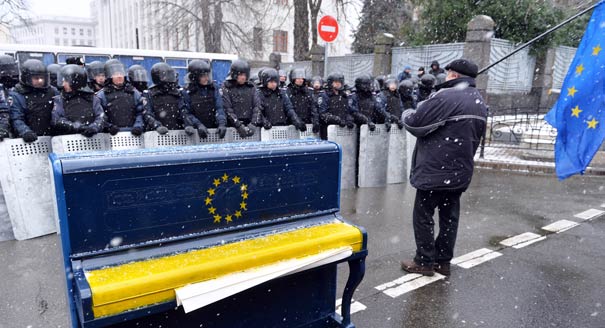
Protests on Istanbul’s Taksim Square in May and June and protests on Kiev’s Independence Square since November have similar root causes (too much authoritarianism, too little press freedom, too few individual liberties) and similar effects (excessive use of force by the authorities, recourse to unfounded conspiracy theories).
Beyond the obvious differences between the two situations, it is interesting to observe that President Putin (more than Viktor Yanukovych) and Prime Minister Erdoğan have reacted in a similar way: protesters are organizing a “pogrom” in one case, they are “looters” in the other. Some analysts like to compare the two leaders as acting in a similar fashion. What is more interesting is their similar, and in my view misguided, assessment of the state of the civil society in both Ukraine and Turkey. In both cases, the protesters are voicing simple demands: they claim their individual liberties, no more, no less. And they are taking to the streets for that. The mere existence of such a huge difference between these demands and the leadership’s view is by definition creating a lasting, fundamental problem which a purely repressive approach will not resolve.
In Ukraine, where the protests may still turn more violent, a part of the political establishment understands the issue: on December 4, three former presidents, Leonid Kravchuk, Leonid Kuchma and Viktor Yushchenko, said “We express solidarity with the peaceful civic actions of hundreds of thousands of young Ukrainians […] For the first time, the Ukrainian people have come out on the streets with an apolitical demand that has unprecedented mass support.” But the ruling president and prime minister, under pressure from the Kremlin, do not see the situation in that way. Such a flawed perception is influenced by the specifics of Russia’s political and civil society context. In Russia, the ruler rules and the civil society seems to be content with a limited number of liberties: business, consumption, travel. This is not applicable to Ukraine, where EU values have taken roots.In Turkey, the ruler wants to impose his religiously conservative agenda, but half the society resists because it has a different set of values and a long tradition of secularism. There is now a wide-open nuance between the prime minister and other prominent figures of the conservative establishment on the way to handle coexistence and tolerance in the society. In this domain, the EU accession negotiations have provided a reference point and an anchor. The current paradox is that the government’s harsh handling of the Taksim protests could well have stopped the accession process, but EU leaders decided not to, precisely because they were deeply impressed by the popular upsurge in defense of liberal democratic values. This was obviously not the time to run away from Turkey. In turn, the EU’s attitude compelled the government to entertain again the EU accession process and to make long-awaited progress in other areas, such as switching from harsh anti-EU rhetoric to a positive narrative or signing the readmission agreement.
Protests in Ukraine and Turkey have illustrated a simple fact: in this day and age, citizens do take charge and, when the ballot box does not cater for the appropriate mix of individual liberties, they object. They have a plain requirement: freedom! Who said the EU soft power was a thing of the past? The Kremlin might not be impressed at all, but in Kiev and Ankara the governments are learning democracy the unpleasant way. Assuming a reasonable way forward is found, this in turn will improve the stability and prosperity of the two countries.
This article was originally published in Hurriyet Daily News.

Senior Fellow, Carnegie Europe
Marc Pierini is a senior fellow at Carnegie Europe, where his research focuses on developments in the Middle East and Turkey from a European perspective.
Recent Work
Marc Pierini
Marc Pierini
Carnegie does not take institutional positions on public policy issues; the views represented herein are those of the author(s) and do not necessarily reflect the views of Carnegie, its staff, or its trustees.

But their "principal to principal" model will only be as effective as the political strength of each leader back home.

Damien Ma

U.S. unpredictability has allowed China to capitalize on its positioning as the “responsible great power”. Paradoxically, the more China wins the perception game, the more likely expectations will rise for Beijing to deliver not just words but to demonstrate with its deeds.

Chong Ja Ian

Hanoi and Beijing have long treated each other as distant cousins rather than comrades in arms. That might be changing as both sides draw closer to hedge against uncertainty and America’s erratic behavior.

Nguyễn Khắc Giang

Across Asia, China is better positioned to withstand energy shocks from the fallout of the Iran war. Its abundant coal capacity can ensure stability in the near term. Yet at the same time, the country’s energy transition away from coal will make it even less vulnerable during the next shock.
Damien Ma

Malaysia’s chairmanship sought to fend off short-term challenges while laying the groundwork for minimizing ASEAN’s longer-term exposure to external stresses.

Elina Noor