

Commentary
- +1
Paul Haenle, Xue Gong, Ngeow Chow Bing, …
{
  "authors": [
    "Paul Haenle"
  ],
  "type": "legacyinthemedia",
  "centerAffiliationAll": "",
  "centers": [
    "Carnegie Endowment for International Peace",
    "Carnegie China"
  ],
  "collections": [
    "China and the Developing World",
    "U.S.-China Relations",
    "China’s Foreign Relations"
  ],
  "englishNewsletterAll": "",
  "nonEnglishNewsletterAll": "",
  "primaryCenter": "Carnegie China",
  "programAffiliation": "",
  "programs": [],
  "projects": [],
  "regions": [
    "North America",
    "United States",
    "East Asia",
    "China",
    "Japan"
  ],
  "topics": [
    "Arms Control",
    "Security",
    "Foreign Policy"
  ]
}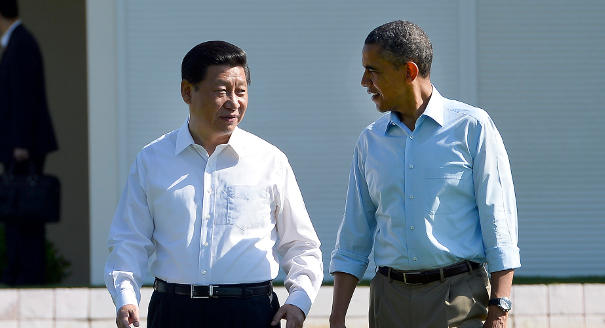
Source: Getty
As a rising power, China has a central role to play in resolving critical global challenges.
Source: Phoenix TV
As a rising power, China has a central role to play in resolving critical global challenges. During an interview with Phoenix Television, Carnegie–Tsinghua’s Paul Haenle shared his perspective on how the U.S.-China bilateral relationship is instrumental to resolving points of tension in the Asia-Pacific. He emphasized that China and the United States both have economic and security interests in Asia and have a stake in the region’s growth and prosperity.
Chinese President Xi Jinping’s more active foreign policy, coupled with China’s continued economic growth, has contributed to China’s increase in global influence, Haenle said. He made the case that if China wants to be recognized as a global power, it should lend its own ideas to solve global challenges. In particular, he mentioned the ongoing issues with North Korea’s nuclear program and security interests in Afghanistan as common ground for the United States and China to start engaging in Xi's concept of a new type of great-power relations. Elaborating further on security interests in the Asia-Pacific, Haenle explained that China and Japan must maintain open lines of communication on multiple levels in order to avoid a military clash in the South China Sea.

Former Maurice R. Greenberg Director’s Chair, Carnegie China
Paul Haenle held the Maurice R. Greenberg Director’s Chair at the Carnegie Endowment for International Peace and is a visiting senior research fellow at the East Asian Institute, National University of Singapore. He served as the White House China director on the National Security Council staffs of former presidents George W. Bush and Barack Obama.
Recent Work


Paul Haenle, Xue Gong, Ngeow Chow Bing, …

Paul Haenle, Chong Ja Ian
Carnegie does not take institutional positions on public policy issues; the views represented herein are those of the author(s) and do not necessarily reflect the views of Carnegie, its staff, or its trustees.

China’s banking crisis in the 2000s was resolved by transferring the costs to households through financial repression—a decision that recapitalized the banks while exacerbating the structural imbalances that continue to shape the Chinese economy today.

Michael Pettis

Chinese biotech companies have been on the receiving end of U.S. economic coercion. Yet their responses have differed significantly because firm and state interests are not uniformly aligned. For Washington, treating all Chinese tech firms the same, irrespective of their actual interests, risks pushing them farther into Beijing’s corner.
Xue Gong

China’s latest energy plan explicitly calls for integrating data centers into the electricity system, particularly connecting them to green energy. It appears Beijing wants to use compute as a source of domestic demand to absorb renewables excess capacity.

Damien Ma

But their "principal to principal" model will only be as effective as the political strength of each leader back home.
Damien Ma

U.S. unpredictability has allowed China to capitalize on its positioning as the “responsible great power”. Paradoxically, the more China wins the perception game, the more likely expectations will rise for Beijing to deliver not just words but to demonstrate with its deeds.
Chong Ja Ian