

Commentary
Dmitri Trenin
{
  "authors": [
    "Dmitri Trenin"
  ],
  "type": "commentary",
  "centerAffiliationAll": "",
  "centers": [
    "Carnegie Endowment for International Peace",
    "Carnegie Russia Eurasia Center"
  ],
  "collections": [],
  "englishNewsletterAll": "",
  "nonEnglishNewsletterAll": "",
  "primaryCenter": "Carnegie Russia Eurasia Center",
  "programAffiliation": "",
  "programs": [],
  "projects": [],
  "regions": [
    "North America",
    "United States",
    "East Asia",
    "South Korea",
    "China",
    "Japan",
    "Russia",
    "Eastern Europe",
    "Ukraine",
    "Western Europe",
    "North Korea"
  ],
  "topics": [
    "Economy",
    "Trade",
    "Climate Change",
    "Foreign Policy"
  ]
}
Source: Getty
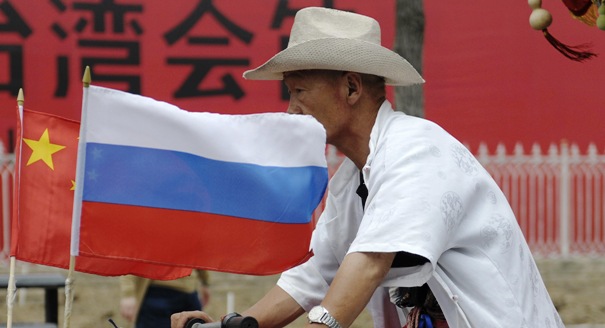
Russia’s economic, political and strategic environment in the West is fast deteriorating. One obvious way to respond to this is to reach out to Asia and the Pacific.
Last Friday, fireworks displays in Sevastopol, Simferopol and Moscow marked Crimea's accession to the Russian Federation. Just before that, the United States introduced first real economic sanctions against Russia by targeting a bank. Half a million Russian MasterCard/Visa cardholders were immediately affected. Responding to this, the Russian government reactivated the suspended project for a national electronic payments system, broadly analogous to Japan's JCB. The French government has postponed its decision as regards the Mistral ships which France is building for the Russian Navy. It may well be that that order will be canceled. Ukraine, faced with the prospect of losing the special gas price granted by President Vladimir Putin to Viktor Yanukovych, will begin receiving some of the gas it needs via Germany. Meanwhile, Germany and other EU countries, encouraged by the United States, are considering steps to fundamentally reduce Europe's dependence on Russian energy supplies.
China, however, cannot be a source of high technology for Russia, and Moscow is probing the Japanese as to how far they will be prepared to go in their economic relations with Russia. At a business forum last week in Tokyo, Rosneft's Igor Sechin was inviting the Japanese to invest in energy projects in Siberia and the Arctic. Japan's businessmen are certainly interested. Prime Minister Shinzō Abe has long been known to take a strategic view vis-a-vis Russia. In the run-up to Crimea's referendum, the head of Japan's newly-formed National Security Council visited Moscow. Some in Tokyo wonder whether, after having returned Crimea to Russia, President Putin might become more flexible on the Kuril Islands dispute with Japan. Abe, however, will have a hard job convincing President Barack Obama that, even under the current circumstances, a Japan-Russia rapprochement will actually benefit U.S. strategy in the Asia-Pacific.
South Korea is another potential purveyor of technology and investment to Russia—and another U.S. ally. The Koreans, of course, will not break ranks with the Americans on Russia. Seoul, however, is worried that the breakdown in U.S.-Russian relations may lead to Russia turning less cooperative on the Korean Peninsula. Pyongyang, for its part, by making statements in support of Moscow, is already seeking to exploit the Russian-Western cold war in its own interest. What Moscow needs, however, is new economic opportunities rather than statements. The Trans-Korean gas pipeline and rail link projects it advocates could help—and they would also improve the general situation on the Peninsula.
As with Japan, Moscow will understand South Korea siding with the United States rhetorically, while continuing or even expanding business relations with Russia. However, either country joining U.S. economic sanctions against Russia will have an adverse geopolitical effect for them, something which Tokyo and Seoul would want to avoid. Beyond North-East Asia, Russia looks to the advanced economies of Singapore and Taiwan as sources of technology, investment, and best practices. Again, the United States, in principle, can check the economic moves of its Asian allies toward Russia. By doing so, it will help make the China-Russia link stronger.
Former Director, Carnegie Moscow Center
Trenin was director of the Carnegie Moscow Center from 2008 to early 2022.
Recent Work
Dmitri Trenin
Dmitri Trenin
Carnegie does not take institutional positions on public policy issues; the views represented herein are those of the author(s) and do not necessarily reflect the views of Carnegie, its staff, or its trustees.

The nuclear relationship between China and the United States is increasingly shaped by widening perception gaps rather than deliberate strategic design.

Tong Zhao

China’s banking crisis in the 2000s was resolved by transferring the costs to households through financial repression—a decision that recapitalized the banks while exacerbating the structural imbalances that continue to shape the Chinese economy today.

Michael Pettis

Chinese biotech companies have been on the receiving end of U.S. economic coercion. Yet their responses have differed significantly because firm and state interests are not uniformly aligned. For Washington, treating all Chinese tech firms the same, irrespective of their actual interests, risks pushing them farther into Beijing’s corner.

Xue Gong

China’s latest energy plan explicitly calls for integrating data centers into the electricity system, particularly connecting them to green energy. It appears Beijing wants to use compute as a source of domestic demand to absorb renewables excess capacity.

Damien Ma

But their "principal to principal" model will only be as effective as the political strength of each leader back home.
Damien Ma