

Paper
James M. Acton, Ankit Panda
{
  "authors": [
    "James M. Acton"
  ],
  "type": "other",
  "centerAffiliationAll": "dc",
  "centers": [
    "Carnegie Endowment for International Peace"
  ],
  "collections": [
    "U.S. Nuclear Policy"
  ],
  "englishNewsletterAll": "ctw",
  "nonEnglishNewsletterAll": "",
  "primaryCenter": "Carnegie Endowment for International Peace",
  "programAffiliation": "NPP",
  "programs": [
    "Nuclear Policy"
  ],
  "projects": [],
  "regions": [
    "North America",
    "United States"
  ],
  "topics": [
    "Nuclear Policy",
    "Arms Control"
  ]
}
Source: Getty
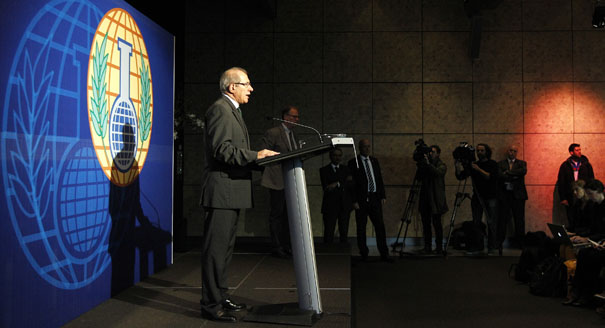
While intelligence sharing creates risks for both national intelligence agencies and international verification organizations, it is ultimately critical to the effective verification of arms control agreements.
Source: Intelligence and National Security
Both national intelligence agencies (NIAs) and international verification organizations (IVOs) attempt to assess compliance with arms control treaties. Their strengths and weaknesses are complementary. Because IVOs are seen as legitimate, they are able to conduct on-site inspections to verify declared activities and to confirm or disprove allegations of clandestine cheating.
NIAs are more flexible and have a greater ability to uncover preliminary evidence of clandestine activities on which further investigations can be based. Such investigations require NIAs to share intelligence with IVOs. While this kind of intelligence sharing is generally permitted by arms control agreements, it is controversial.Nonetheless, it appears to have become more common in recent years, particularly during the International Atomic Energy Agency’s investigation of Iran’s nuclear program. While intelligence sharing creates risks for both IVOs and NIAs, it is ultimately critical to the effective verification of arms control agreements and steps can and should be taken to ensure it becomes more common and less controversial....
The chapter "International Verification and Intelligence" was originally published in the special issue "Intelligence and Nuclear Proliferation" of Intelligence and National Security.

Jessica T. Mathews Chair, Co-director, Nuclear Policy Program
Acton holds the Jessica T. Mathews Chair and is co-director of the Nuclear Policy Program at the Carnegie Endowment for International Peace.
Recent Work

James M. Acton, Ankit Panda
James M. Acton
Carnegie does not take institutional positions on public policy issues; the views represented herein are those of the author(s) and do not necessarily reflect the views of Carnegie, its staff, or its trustees.

The nuclear relationship between China and the United States is increasingly shaped by widening perception gaps rather than deliberate strategic design.

Tong Zhao

But their "principal to principal" model will only be as effective as the political strength of each leader back home.

Damien Ma

U.S. unpredictability has allowed China to capitalize on its positioning as the “responsible great power”. Paradoxically, the more China wins the perception game, the more likely expectations will rise for Beijing to deliver not just words but to demonstrate with its deeds.

Chong Ja Ian

For Malaysia, the conjunction that works is “and” not “or” when it comes to the United States and China.

Elina Noor

Regulation, not embargo, allows Beijing to shape how other countries and firms adapt to its terms.
Alvin Camba