

Commentary
Nathan J. Brown
{
  "authors": [
    "Nathan J. Brown"
  ],
  "type": "legacyinthemedia",
  "centerAffiliationAll": "dc",
  "centers": [
    "Carnegie Endowment for International Peace",
    "Malcolm H. Kerr Carnegie Middle East Center"
  ],
  "collections": [],
  "englishNewsletterAll": "menaTransitions",
  "nonEnglishNewsletterAll": "",
  "primaryCenter": "Malcolm H. Kerr Carnegie Middle East Center",
  "programAffiliation": "MEP",
  "programs": [
    "Middle East"
  ],
  "projects": [],
  "regions": [
    "Middle East",
    "Israel",
    "Palestine",
    "Levant"
  ],
  "topics": [
    "Political Reform",
    "Security"
  ]
}
Source: Getty
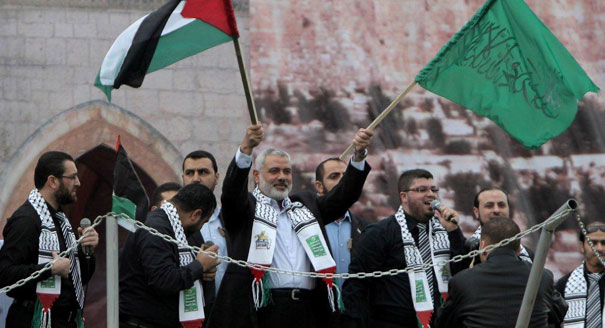
Predicting how Hamas is likely to act and react requires probing what the organization can do, what it wants, and how it sees itself. From Hamas’s angle, the current fighting offers just as many opportunities as threats.
Source: Washington Post
When Prime Minister Benjamin Netanyahu talks about Israel’s ground offensive against Hamas in the Gaza Strip, he says that “without action, the price that we would pay would be much greater.” But predicting how Hamas is likely to act and react requires probing what the organization can do, what it wants and how it sees itself. From Hamas’s angle, the current fighting offers just as many opportunities as threats. Let’s examine five myths about the militant Islamist organization.
As a movement, Hamas offers resistance — attacking civilians, launching rockets and ransoming captives — but it cannot field a military force that could face Israel on the battlefield. Indeed, all the ground combat is happening in Gaza; Israeli territory remains relatively unscathed. As of Saturday, at least four Israelis had been killed in the latest round of fighting, while Israel’s actions had led to more than 330 Palestinian deaths. So it is absolutely true that Hamas does not pose an existential threat to Israel.
However, more than Israel’s existence is being threatened. The abduction and murder of three Israeli teens last month may or may not have been a Hamas operation — but the event captured the attention of the Israeli public, and the Israeli government reacted as if Hamas were responsible. While the effectiveness of Israel’s Iron Dome antimissile system is debated — officials boast that it intercepts 90 percent of Hamas’s missiles — large parts of the Israeli population now feel within Hamas’s reach as the range of its rockets creeps higher. Some have relocated farther away from Gaza, and those who remain show signs of stress. Israel’s political, military and security leaders are focused on deterring the rocket attacks.Hamas may never come close to vanquishing Israel on the battlefield, but changes in its capabilities — tunnels, abductions, missiles and even a drone — continue to make Israelis nervous and force them to react.
Outsiders sometimes see Hamas as something like an American big-city machine that trades jobs and welfare benefits in return for political loyalty and votes — though a machine with an armed wing.
Hamas does have an armed wing, and other parts of the organization attempt to provide some social services, but the number of Palestinians who benefit from those services is small. And it’s dwarfed by those who get assistance from the Palestinian government, international aid bodies and nongovernmental organizations. This fact is missed by outsiders who often mistake anything Islamic for Hamas.
Hamas’s support from Palestinian civilians, when it comes, stems from other things. For example, the movement poses as uncompromising on Palestinian rights and uncorrupted by money and power. The political and diplomatic solutions, such as the Oslo peace process, offered by other factions such as Fatah seem meaningless to most Palestinians, who have grown cynical about their leaders’ ability to deliver.
The image of Hamas as an uncorrupt movement unconcerned with the trappings of power grew outdated once the group stepped into power after its 2006 election victory. But earlier this year, Hamas resigned all its cabinet positions and agreed to surrender political leadership of the Gaza Strip. With the decision to stop being a government as well as a movement, Hamas’s reputation may begin to recover. And some of its leaders may be saying now: What better way to start the effort than to return to the movement’s roots in armed resistance?
In all kinds of ways, recent opinion polling shows that the majority of Palestinians back positions that Hamas rejects regarding diplomacy and resistance. Hamas remains more hard-line than the public it seeks to lead, and surveys also show that the group would have tremendous trouble repeating its 2006 election win.
But right now, Hamas’s leaders aren’t concerned about whether they could obtain a majority of the vote. Elections are unlikely any time soon. And the despair among Palestinians is so deep, the numbers do not look much better for any leader or faction; at this point Palestinian President Mahmoud Abbas is seen as isolated, aloof and having spent all his political capital on a failed peace process.
What concerns Hamas’s leaders is their relevance, their ability to articulate the deep senses of frustration and injustice that most Palestinians feel — and whether their rhetoric will resonate with the public. The current path of the conflict, and its fiery rhetoric, offer Hamas opportunities to present itself as more in line with the times.
Yes, Hamas surrendered its cabinet positions to people appointed by Abbas. And yes, Hamas is taking a beating and its activists are being driven underground. But its credentials as the movement that does not bend and dares to take on Israel are being burnished among much of the audience it cares about.
Hamas’s base in Syria was shut down two years ago. Its Iranian allies have greatly reduced their support. Its big brothers in Egypt, Mohamed Morsi and the Muslim Brotherhood, can do little for the movement now that they are out of power. In the last round of fighting, in 2012, Egypt helped broker a cease-fire; now its position seems as hard-line on Hamas as Israel’s. Internationally isolated and strapped for cash, Hamas is in crisis.
But by jettisoning its governing role , Hamas is no longer saddled with the responsibilities that had made it more circumspect for many years. Israel and Hamas both realized back in 2007 that holing the movement up in Gaza was a bit of a trap, forcing Hamas to take on responsibility for sewage, schooling and zoning. Hamas has many headaches to deal with now but also a bit more freedom to maneuver.
Hamas presents itself as the un-Fatah: Rather than grow fat and comfortable in government or become distracted by international diplomacy, it keeps its eye on the prize of the liberation of Palestine.
But the secret it does not want to share is that it has no idea how to get there. The movement is resilient, cagey and, in a perverse way, principled in its dedication to armed resistance. But it has no map, and all its actions to date — targeting civilians, capturing Israeli soldiers, running in elections, passing laws and caring for the sick — have brought Palestinians no closer to any kind of national goal.
In its failure to develop long-term answers, Hamas is hardly alone. With the collapse of the two-state solution, Israelis and Palestinians are learning a twist on Jean-Paul Sartre’s famous line: Hell is other peoples.

Nonresident Senior Fellow, Middle East Program
Nathan J. Brown, a professor of political science and international affairs at George Washington University, is a distinguished scholar and author of nine books on Arab politics and governance, as well as editor of five books.
Recent Work
Nathan J. Brown
Nathan J. Brown
Carnegie does not take institutional positions on public policy issues; the views represented herein are those of the author(s) and do not necessarily reflect the views of Carnegie, its staff, or its trustees.

The Thai-Cambodian conflict highlights the limits to China's peacemaker ambition and the significance of this role on Southeast Asia’s balance of power.

Pongphisoot (Paul) Busbarat

Beijing believes that Washington is overestimating its own leverage and its ability to handle the trade war’s impacts.


Rick Waters, Sheena Chestnut Greitens

Tapping our network of China experts in the region, Carnegie China offers this latest “China Through a Southeast Asian Lens” report to offer preliminary assessments of whether the U.S. effort to reshape the global trading order will lead countries in the region to tilt toward Beijing.



Selina Ho, Khin Khin Kyaw Kyee, Joseph Ching Velasco, …

Because strategic, economic, and ideological perceptions of China contain multiple, sometimes contradictory facets in Southeast Asia, receptions of and responses to Beijing diverge across and within state lines.



Evan A. Feigenbaum, Chong Ja Ian, Elina Noor

Most Southeast Asian states behave as if the actions of their Northeast Asian neighbors and the Philippines will be sufficient to maintain a regional status quo from which they can benefit.
Chong Ja Ian