

Paper
Yezid Sayigh
{
  "authors": [
    "Yezid Sayigh"
  ],
  "type": "legacyinthemedia",
  "centerAffiliationAll": "dc",
  "centers": [
    "Carnegie Endowment for International Peace",
    "Malcolm H. Kerr Carnegie Middle East Center"
  ],
  "collections": [],
  "englishNewsletterAll": "menaTransitions",
  "nonEnglishNewsletterAll": "",
  "primaryCenter": "Malcolm H. Kerr Carnegie Middle East Center",
  "programAffiliation": "MEP",
  "programs": [
    "Middle East"
  ],
  "projects": [],
  "regions": [
    "Gulf",
    "Israel",
    "Iraq",
    "Middle East"
  ],
  "topics": [
    "Political Reform",
    "Foreign Policy"
  ]
}
Source: Getty
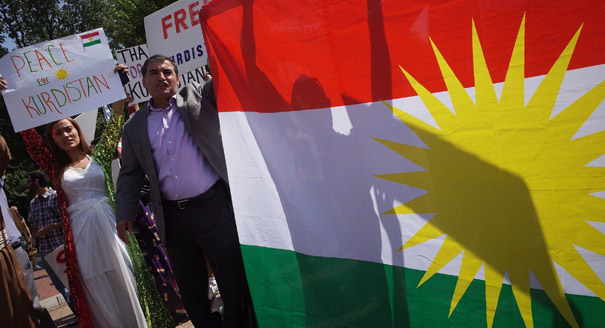
Israeli Prime Minister Benjamin Netanyahu has called for the creation of an independent Kurdish state. But why has Israel expressed support for Kurdish independence?
Source: Press TV
Israeli President Shimon Peres told U.S. President Barack Obama on June 25 that Iraq could not be kept together and asked for support for Kurdish independence. The next day, Israeli Foreign Minister Avigdor Lieberman told U.S. Secretary of State John Kerry in Paris that the establishment of an independent Kurdish state was probably inevitable.
In addition, Prime Minister Benjamin Netanyahu said, “We have to support the independence aspirations of the Kurds.” This was not the first time Israeli leaders have pushed for Kurdish independence. They have repeatedly echoed this line in the decade since the invasion of Iraq.
Historical relationships between some Kurdish factions and Israel go back to the early days of the Zionist project. Dividing the Middle East into countries of warring minorities can be traced back to the days of British colonialism and today Israel is at the forefront of making sure it happens.
To discuss Israel’s support for an independent Kurdistan and the separation of Kurdistan from Iraq, Press TV’s Middle East Files spoke with Carnegie’s Yezid Sayigh.

Senior Fellow, Malcolm H. Kerr Carnegie Middle East Center
Yezid Sayigh is a senior fellow at the Malcolm H. Kerr Carnegie Middle East Center in Beirut, where he leads the program on Civil-Military Relations in Arab States (CMRAS). His work focuses on the comparative political and economic roles of Arab armed forces, the impact of war on states and societies, the politics of postconflict reconstruction and security sector transformation in Arab transitions, and authoritarian resurgence.
Recent Work
Yezid Sayigh
Yezid Sayigh
Carnegie does not take institutional positions on public policy issues; the views represented herein are those of the author(s) and do not necessarily reflect the views of Carnegie, its staff, or its trustees.

But their "principal to principal" model will only be as effective as the political strength of each leader back home.

Damien Ma

U.S. unpredictability has allowed China to capitalize on its positioning as the “responsible great power”. Paradoxically, the more China wins the perception game, the more likely expectations will rise for Beijing to deliver not just words but to demonstrate with its deeds.

Chong Ja Ian

Hanoi and Beijing have long treated each other as distant cousins rather than comrades in arms. That might be changing as both sides draw closer to hedge against uncertainty and America’s erratic behavior.

Nguyễn Khắc Giang

Across Asia, China is better positioned to withstand energy shocks from the fallout of the Iran war. Its abundant coal capacity can ensure stability in the near term. Yet at the same time, the country’s energy transition away from coal will make it even less vulnerable during the next shock.
Damien Ma

Malaysia’s chairmanship sought to fend off short-term challenges while laying the groundwork for minimizing ASEAN’s longer-term exposure to external stresses.

Elina Noor