

Commentary
But their "principal to principal" model will only be as effective as the political strength of each leader back home.
Damien Ma
{
  "authors": [
    "Alexey Arbatov"
  ],
  "type": "commentary",
  "centerAffiliationAll": "",
  "centers": [
    "Carnegie Endowment for International Peace",
    "Carnegie Russia Eurasia Center"
  ],
  "collections": [],
  "englishNewsletterAll": "",
  "nonEnglishNewsletterAll": "",
  "primaryCenter": "Carnegie Endowment for International Peace",
  "programAffiliation": "",
  "programs": [],
  "projects": [],
  "regions": [
    "North America",
    "United States",
    "Russia",
    "Western Europe"
  ],
  "topics": [
    "Security",
    "Military",
    "Foreign Policy",
    "Nuclear Policy",
    "Arms Control"
  ]
}
Source: Getty
The tensions between Russia and the West heightened over the issues of compliance with the INF treaty. In this case, it would not be prudent for Russia to seriously compromise its long-term security yet again while pursuing tactical goals or relying on superficial arguments.
As if the escalation of the Ukrainian crisis did not provide the requisite excitement, the tensions between Russia and the West were also heightened at the end of July over the issues of compliance with the Intermediate-Range Nuclear Forces Treaty (INF) signed by the Soviet Union and the United States in 1987 and subsequently inherited by Russia. The subject first gained top-level recognition through Barack Obama’s official statement addressed to Vladimir Putin. The unprecedented escalation of tensions between Russia and the West over the situation in Ukraine has clearly contributed to this development.
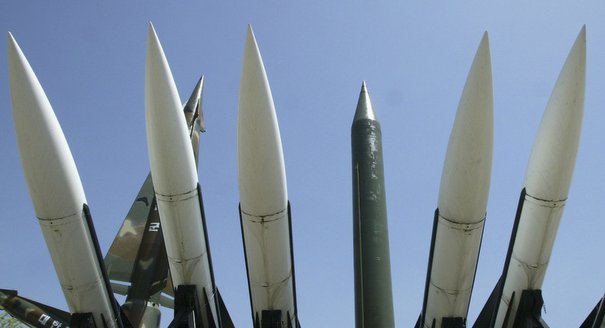
Nevertheless, the strategic component of the problem is important too. Specifically, Washington is accusing Moscow of testing ground-launched R-500 Iskander cruise missiles with a range of over 500 km, which is prohibited by the INF. If Russia would like to preserve the treaty, it is expected to present explanations that would refute the American accusations. But many Russian analysts subscribe to quite a different view. Moreover, the highest-ranking Russian officials have expressed their reservations as to the benefits of the treaty. How justified are Moscow’s reservations, and what constitutes “the extraordinary events the notifying Party regards as having jeopardized its supreme interests” (as stated in article XV on withdrawal provisions).
At the present time, seven states possess ground-launched intermediate-range ballistic missiles (IRBMs) with ranges prohibited by the treaty. These are China, India, Israel, North Korea, Pakistan, Iran, and Saudi Arabia—missiles from all of these countries are capable of reaching Russian territory. However, not all of these countries assign their weapons against Russia. China is Russia’s strategic partner and is never officially mentioned as a potential threat to Russia and the object of its deterrence strategy. This is even more true in the case of India, whose missiles are intended to deter China and Pakistan, but not Russia. Pakistan’s IRBMs are directed exclusively against India, while Israel aims them at Iran and its adversaries in the Arab world. North Korean missiles are designed to threaten the United States and its South Korean and Japanese allies. Saudi Arabia and Iran aim their missiles at each other and Israel.
It is often said about China, and sometimes about Iran and Pakistan, that political intentions may change while the missiles are here to stay. But even in this case, Russia’s capability to deter the United States is more than sufficient for deterring all of the above third countries, either individually or collectively. Russia possesses strategic missiles that are capable of striking intermediate-range targets at shortened trajectories, as well as medium and heavy bombers and shorter-range weapons. On the whole, with the exception of the United States, Russia’s nuclear forces are four to five times larger than the forces of all other nuclear-weapon states combined in terms of number of weapons (let alone their quality). If this enormous potential does not deter these states from a nuclear attack, Russia’s exit from the INF and subsequent deployment of a certain number of intermediate-range ballistic and cruise missiles will hardly remedy the situation.
As for the NATO missile defense program in Europe, it will have very little impact on the Russian nuclear deterrence potential—both in terms of the planned number of missile interceptors and their technical characteristics. This is especially true in light of the cancellation of the fourth phase of the plan, which would involve the deployment of the SM-3 Block IIB interceptors in Poland and on ships in the northern seas. To say nothing of Russia’s broad strategic nuclear forces modernization program which is deploying and developing five new types of land and sea-based missiles with sophisticated penetration aids and leaves no chance for NATO missile defenses.
The arguments in favor of explicit INF denunciation or tacit non-compliance are mostly inspired by the perceived threat coming from the United States and NATO. However, the same strategic logic should anticipate reciprocal steps on their part. True, President Obama stated that the United States is not planning to take steps of the same kind, but he is leaving the White House in two and a half years, and in the midst of an anti-Russian campaign his successor might favor a different approach.
In the early 1980’s, the possibility of U.S. Pershing II missiles reaching the Moscow region with a short flight time was seen as a serious threat. In the future, similar systems deployed in the territory of new NATO members (Poland, the Baltic countries, Romania, and Bulgaria) can reach the entire Russian territory up to the Urals and far beyond it. Unlike the European missile defense, this could be a real threat to Russia’s nuclear deterrence potential. It would force Russia to completely overhaul its nuclear forces, warning and command-control systems, and air-space defense at a tremendous additional cost. In addition, Russia’s exit from the INF treaty would consolidate NATO once again on such issues as increasing military spending and coordinating the development of offensive and defensive weapons, including the significant expansion of missile defense in Europe. Thereby countering imagined threats Moscow may generate real dangers to its deterrence potential and strategic stability.
It would not be prudent for Russia to seriously compromise its long-term security yet again while pursuing tactical goals or relying on superficial arguments.

Alexey Arbatov
Alexey Arbatov is the head of the Center for International Security at the Primakov National Research Institute of World Economy and International Relations.
Carnegie does not take institutional positions on public policy issues; the views represented herein are those of the author(s) and do not necessarily reflect the views of Carnegie, its staff, or its trustees.

But their "principal to principal" model will only be as effective as the political strength of each leader back home.

Damien Ma

U.S. unpredictability has allowed China to capitalize on its positioning as the “responsible great power”. Paradoxically, the more China wins the perception game, the more likely expectations will rise for Beijing to deliver not just words but to demonstrate with its deeds.

Chong Ja Ian

Hanoi and Beijing have long treated each other as distant cousins rather than comrades in arms. That might be changing as both sides draw closer to hedge against uncertainty and America’s erratic behavior.

Nguyễn Khắc Giang

Across Asia, China is better positioned to withstand energy shocks from the fallout of the Iran war. Its abundant coal capacity can ensure stability in the near term. Yet at the same time, the country’s energy transition away from coal will make it even less vulnerable during the next shock.
Damien Ma

Malaysia’s chairmanship sought to fend off short-term challenges while laying the groundwork for minimizing ASEAN’s longer-term exposure to external stresses.

Elina Noor