

Commentary
Dmitri Trenin
{
  "authors": [
    "Dmitri Trenin"
  ],
  "type": "commentary",
  "centerAffiliationAll": "",
  "centers": [
    "Carnegie Endowment for International Peace",
    "Carnegie Russia Eurasia Center"
  ],
  "collections": [],
  "englishNewsletterAll": "",
  "nonEnglishNewsletterAll": "",
  "primaryCenter": "Carnegie Russia Eurasia Center",
  "programAffiliation": "",
  "programs": [],
  "projects": [],
  "regions": [
    "Russia",
    "Eastern Europe",
    "Ukraine"
  ],
  "topics": [
    "Security",
    "Foreign Policy"
  ]
}
Source: Getty
Going to war in 1914 was suicidal for the Russian state. Today, a Russian military invasion of Ukraine might well lead to a catastrophe with dire consequences for Russia itself, or to an all-out conflict between Russia and NATO.
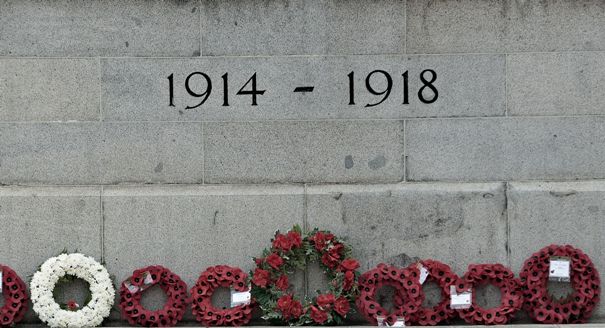
President Vladimir Putin has formally rehabilitated Russia's "forgotten war." This is particularly important for a country where few World War I graves have survived, and no monuments to its heroes and victims have ever been erected. Now, at least, there is one on Poklonnaya Hill, which also hosts the triumphal arch dating back to the Patriotic War of 1812, to repel Napoleon's invasion, and a museum devoted to the Great Patriotic War of 1941-1945, against the Nazis. The "imperialist war" of 1914-1918, reviled by the Bolsheviks, but also used by them to destroy the old Russian state, is now reinstalled as part of Russia's military glory, with its generals and soldiers made part of the nation's pantheon.
With hindsight, it is clear that going to war in 1914 was suicidal for the Russian state. Reformist Prime Minister Petr Stolypin's famous plea for "twenty years of quiet" to transform Russia applied equally to avoiding domestic and foreign conflicts. Today, whatever happens in Donbass, a Russian military invasion of Ukraine might well lead to a catastrophe reminiscent of Afghanistan, with dire consequences for Russia itself, or to an all-out conflict between Russia and NATO.
During World War I, only the far-left Bolsheviks came out as proponents of national defeat, which they worked hard to turn into a social revolution. They would have never succeeded, had the Romanov monarchy, on one hand, and Russia's liberal, conservative and socialist parties, on the other, found a way to cooperate on the basis of the shared national interest. Today, national unity in Russia is as essential as ever, and it can be obtained on the basis of clean and accountable government; independent and efficient courts; and national solidarity.
Finally, Russia's real ambitions today lie at home, particularly in the fields of economics, demographics, and nation-building. The Ukraine crisis is a powerful jolt, which, in principle, could set in motion new forward-looking policies across the board. As to Ukraine itself, it will need to go through its own trials. Russia will never lose interest in Ukraine, but that very interest commands that Russia treat it as a neighboring country, not a potential part of Russia itself, or a Moscow-led union. There is only one Crimea. Gathering people, rather than lands, is a surer path toward self-empowerment.
Former Director, Carnegie Moscow Center
Trenin was director of the Carnegie Moscow Center from 2008 to early 2022.
Recent Work
Dmitri Trenin
Dmitri Trenin
Carnegie does not take institutional positions on public policy issues; the views represented herein are those of the author(s) and do not necessarily reflect the views of Carnegie, its staff, or its trustees.

But their "principal to principal" model will only be as effective as the political strength of each leader back home.

Damien Ma

U.S. unpredictability has allowed China to capitalize on its positioning as the “responsible great power”. Paradoxically, the more China wins the perception game, the more likely expectations will rise for Beijing to deliver not just words but to demonstrate with its deeds.

Chong Ja Ian

Hanoi and Beijing have long treated each other as distant cousins rather than comrades in arms. That might be changing as both sides draw closer to hedge against uncertainty and America’s erratic behavior.

Nguyễn Khắc Giang

Across Asia, China is better positioned to withstand energy shocks from the fallout of the Iran war. Its abundant coal capacity can ensure stability in the near term. Yet at the same time, the country’s energy transition away from coal will make it even less vulnerable during the next shock.
Damien Ma

Malaysia’s chairmanship sought to fend off short-term challenges while laying the groundwork for minimizing ASEAN’s longer-term exposure to external stresses.

Elina Noor