

Commentary
But their "principal to principal" model will only be as effective as the political strength of each leader back home.
Damien Ma
{
  "authors": [
    "James M. Acton",
    "Catherine Dill",
    "Jeffrey Lewis"
  ],
  "type": "legacyinthemedia",
  "centerAffiliationAll": "dc",
  "centers": [
    "Carnegie Endowment for International Peace",
    "Carnegie Russia Eurasia Center"
  ],
  "collections": [],
  "englishNewsletterAll": "ctw",
  "nonEnglishNewsletterAll": "",
  "primaryCenter": "Carnegie Endowment for International Peace",
  "programAffiliation": "NPP",
  "programs": [
    "Nuclear Policy"
  ],
  "projects": [],
  "regions": [
    "East Asia",
    "China"
  ],
  "topics": [
    "Nuclear Policy"
  ]
}
Source: Getty
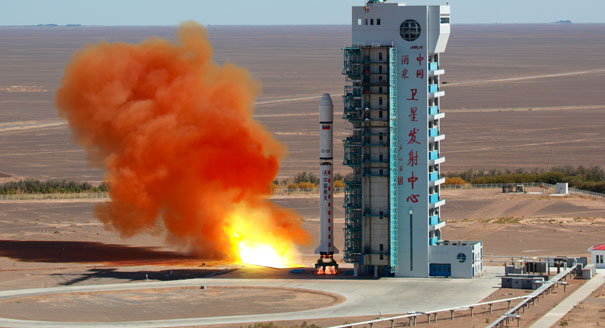
On August 7, China conducted a test of a hypersonic weapon. Open-source information about what happened that day in a remote part of Inner Mongolia allows for a few observations.
Source: Arms Control Wonk
By a lake in an Inner Mongolian desert, about 200 km south-east of Ordos—the oft-described ghost city that hosted the Miss World contest in 2012—lies a Chinese resort called the Bulong Hu Hot Springs Resort (布龙湖温泉度假区). On August 7, at about 11am, tourists in the resort were presumably doing what tourists at a lake-side spa do. Maybe a young couple from Beijing was soaking in the hot springs, enjoying a luxurious end to a hot and dusty trek around Inner Mongolia. Perhaps a retiree from Ordos, bored of watching Miss World highlights on Good Morning Ordos, was enjoying the relative excitement of fishing on the lake. Maybe a shepherd was grazing his sheep in the cultivated land just outside the resort. What we can safely assume is that none of them knew what was, almost literally, about to hit them.
The noise—a thundering crash—must have been the first terrifying indication of what had happened. Fortunately, we don’t have to speculate about what they saw because some of them photographed it: huge clouds of red smoke billowing up from the desert. Someone even got near enough to the crash site to take photos of it. Even to his or her (presumably) untrained eye, it must have been clear that the debris littering the area was from some sort of a rocket.These cell phone images appeared online almost immediately. However, they seem to have been suppressed and quickly vanished from the Chinese websites where they first appeared. But this is the internet, so nothing can be deleted.
Almost immediately, Chinese internet sources connected the rocket with a test of what the Pentagon calls the WU-14—a hypersonic glider, launched by a rocket, that China is known to have tested at least once before, in January 2014. (Technically, the term “WU-14” probably refers to the whole package of booster and glider, but it’s become the glider’s de-facto name).
Bill Gertz, of the Washington Free Beacon, picked up on these rumors and on, August 19, published a somewhat alarmist article, which appears to have been largely based on Chinese internet sources—although he also reported that two anonymous U.S. officials had confirmed that the test did involve the WU-14. Three days later, the South China Morning Post reported that the test was a failure. Chinese internet sources had said the same thing but Gertz did not, implying that such debris was to be expected.
It turns out that there is a wealth of open-source information about the August 7 test. It has allowed us to find the exact location of the crash site, and to make several important observations about what happened that day in a remote part of Inner Mongolia: the WU-14 hypersonic vehicle was almost certainly tested, but the test was probably a failure. More generally, our analysis indicates that the Chinese hypersonic glider program is probably significantly less ambitious than the U.S. Advanced Hypersonic Weapon—a U.S. hypersonic glider that was tested 18 days after the WU-14 and also failed.

Jessica T. Mathews Chair, Co-director, Nuclear Policy Program
Acton holds the Jessica T. Mathews Chair and is co-director of the Nuclear Policy Program at the Carnegie Endowment for International Peace.
Catherine Dill
Jeffrey Lewis
Carnegie does not take institutional positions on public policy issues; the views represented herein are those of the author(s) and do not necessarily reflect the views of Carnegie, its staff, or its trustees.

But their "principal to principal" model will only be as effective as the political strength of each leader back home.

Damien Ma

U.S. unpredictability has allowed China to capitalize on its positioning as the “responsible great power”. Paradoxically, the more China wins the perception game, the more likely expectations will rise for Beijing to deliver not just words but to demonstrate with its deeds.

Chong Ja Ian

Hanoi and Beijing have long treated each other as distant cousins rather than comrades in arms. That might be changing as both sides draw closer to hedge against uncertainty and America’s erratic behavior.

Nguyễn Khắc Giang

Across Asia, China is better positioned to withstand energy shocks from the fallout of the Iran war. Its abundant coal capacity can ensure stability in the near term. Yet at the same time, the country’s energy transition away from coal will make it even less vulnerable during the next shock.
Damien Ma

In the latest Five-Year Plan, the Chinese president cements the shift to an innovation-driven economy over a consumption-driven one.
Damien Ma