

Q&A
Eugene Rumer
{
  "authors": [
    "Eugene Rumer"
  ],
  "type": "legacyinthemedia",
  "centerAffiliationAll": "dc",
  "centers": [
    "Carnegie Endowment for International Peace"
  ],
  "collections": [],
  "englishNewsletterAll": "ctw",
  "nonEnglishNewsletterAll": "",
  "primaryCenter": "Carnegie Endowment for International Peace",
  "programAffiliation": "russia",
  "programs": [
    "Russia and Eurasia"
  ],
  "projects": [],
  "regions": [
    "Eastern Europe",
    "Ukraine"
  ],
  "topics": [
    "Economy",
    "Security",
    "Foreign Policy"
  ]
}
Source: Getty
Ukraine does not need extra arms to fight a war that it cannot win and that can only prolong its suffering. What it needs is economic aid.
Source: Financial Times
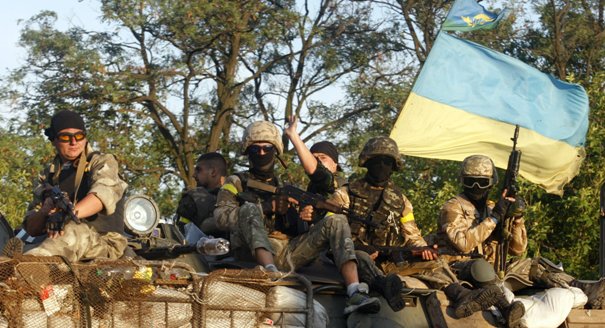
Petro Poroshenko, Ukraine’s president, arrives in Washington to meet President Barack Obama today. His visit is certain to trigger more calls to supply his embattled nation with weaponry to defend itself against Russian aggression. Such calls are misguided. Ukraine does not need extra arms to fight a war that it cannot win and that can only prolong its suffering. What it needs is economic aid.
Without a boots-on-the-ground military intervention by Nato, Ukraine cannot stand up to Russia militarily. What is more, Nato’s leaders have made clear the alliance will not intervene.
Ukraine’s army, long prey to the same corruption and mismanagement as the rest of the public sector, is no match for the Russian military machine. More weapons will not help. It needs to build a new army – professional, well trained, well equipped, with the properly functioning command and control, intelligence and logistics of a modern force. That will take money, international assistance and years, if not decades. Throwing more weapons at the existing mixture of poorly trained regular troops, volunteers and private armies funded by Ukrainian oligarchs will only prolong the agony.Economic assistance, by contrast, is vital. The International Monetary Fund projects that the Ukrainian economy will shrink by more than 6 per cent this year. Inflation is projected to reach 19 per cent. Unemployment, currently at almost 9 per cent, is rising. Exports have fallen nearly 10 per cent as a result of the conflict, according to official figures.
Visitors to Kiev, the capital, report that electricity is being turned off twice a day. The IMF warns Ukraine may need $19bn more in external financing to the end of 2015 if the conflict in the east continues. The costs of war are not known but they are certain to be high.
No doubt this weighs heavily on Mr Poroshenko when he speaks of the ceasefire in eastern Ukraine as “winning the peace”. Ukraine needs peace to rebuild the country, a far more urgent task than avenging Russian aggression.
Ukraine also needs far more assistance than it has received from the west. The $17bn package given by the IMF in May is tied to painful economic reforms. US aid since the start of the crisis last year has fallen way short of the rhetoric – less than $250m, including technical assistance with reforms, an international conference on how to trace stolen state assets and election monitoring.
On paper, the EU has been more generous with its $14bn aid package but the sum looks better than its parts. It includes $2bn in loans and “up to” $10bn in reconstruction loans. There is also, of course, technical assistance to nudge Ukraine to implement the dreaded reforms.
The experience of other countries, from Russia in the 1990s to Greece in 2010, shows that IMF-mandated reforms – the price of its loans – always choke off growth. The theory is that short-term economic pain for the population brings long-term gain, but if a country lacks the essentials that make growth possible – political institutions, property rights, rule of law and so on – the gains are hard to realise.
Ukraine has no choice but to accept the sad reality that it cannot repel Russian aggression. Allowing Donetsk and Lugansk, both held by Ukrainian rebels backed by Russian troops, to live with special self-governing status and focusing on domestic reconstruction and reform is the only option open to Mr Poroshenko.
Ukraine’s friends can help. They need to push for a UN-sanctioned peacekeeping force for eastern Ukraine to keep the ceasefire. And they need to come up with a more robust economic assistance package to help the country weather the economic crisis and shore up its government. If, as many have said, the fate of Europe whole and free depends on it, then it is a price worth paying.
This article was originally published in the Financial Times.
Director and Senior Fellow, Russia and Eurasia Program
Rumer, a former national intelligence officer for Russia and Eurasia at the U.S. National Intelligence Council, is a senior fellow and the director of Carnegie’s Russia and Eurasia Program.
Recent Work
Eugene Rumer
Eugene Rumer
Carnegie does not take institutional positions on public policy issues; the views represented herein are those of the author(s) and do not necessarily reflect the views of Carnegie, its staff, or its trustees.

The Plaza Accord was not an externally imposed punishment of Japan but part of a broader restructuring that Japanese economists and policymakers themselves recognized was necessary. Its effects were undermined, however, when Tokyo responded to the resulting slowdown with policies that exacerbated investment, credit expansion, and the very imbalances the adjustment was intended to resolve.

Michael Pettis
China’s banking crisis in the 2000s was resolved by transferring the costs to households through financial repression—a decision that recapitalized the banks while exacerbating the structural imbalances that continue to shape the Chinese economy today.
Michael Pettis

But their "principal to principal" model will only be as effective as the political strength of each leader back home.

Damien Ma

U.S. unpredictability has allowed China to capitalize on its positioning as the “responsible great power”. Paradoxically, the more China wins the perception game, the more likely expectations will rise for Beijing to deliver not just words but to demonstrate with its deeds.

Chong Ja Ian

Hanoi and Beijing have long treated each other as distant cousins rather than comrades in arms. That might be changing as both sides draw closer to hedge against uncertainty and America’s erratic behavior.

Nguyễn Khắc Giang