

In The Media
Lina Khatib
{
  "authors": [
    "Lina Khatib"
  ],
  "type": "legacyinthemedia",
  "centerAffiliationAll": "dc",
  "centers": [
    "Carnegie Endowment for International Peace",
    "Malcolm H. Kerr Carnegie Middle East Center"
  ],
  "collections": [],
  "englishNewsletterAll": "menaTransitions",
  "nonEnglishNewsletterAll": "",
  "primaryCenter": "Malcolm H. Kerr Carnegie Middle East Center",
  "programAffiliation": "MEP",
  "programs": [
    "Middle East"
  ],
  "projects": [],
  "regions": [
    "Gulf",
    "Levant",
    "Yemen",
    "Middle East"
  ],
  "topics": [
    "Political Reform",
    "Security"
  ]
}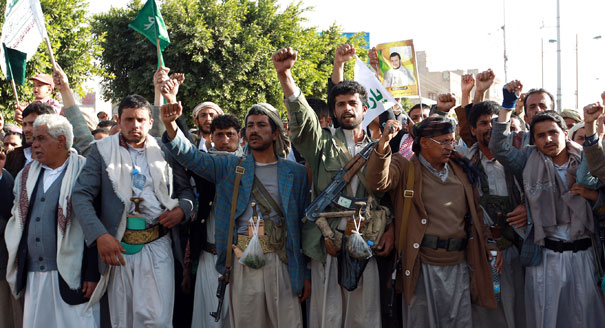
Source: Getty
The Houthis and al-Qaeda are currently benefiting from the chaos in Yemen. But the separation of the country will pit them against one another directly, and this can only mean prolonged civil war in Yemen.
Source: Al-Hayat
The Houthi takeover of Sanaa is bringing Yemen closer to a failed state scenario. Al-Qaeda in the Arabian Peninsula (AQAP), namely its main arm in Yemen Ansar al-Sharia, is seeing in this scenario an opportunity for resurrection that is similar to the one witnessed in 2009 when AQAP was established following the weakening of al-Qaeda’s central leadership. This resurrection may balance out al-Qaeda’s anticipated losses in Syria if its current affiliate Jabhat al-Nusra decides to split from the mother organization.
Until recently, AQAP had been incurring losses in Yemen. The Yemeni government under both presidents Ali Abdullah Saleh and then Abd Rabbu Mansour Hadi had cooperated closely with the United States to fight al-Qaeda. This cooperation concentrated on intelligence sharing and American drone attacks against AQAP members and leaders on Yemeni soil. But this loss for al-Qaeda was not absolute; drone attacks were not as precise as the United States painted them to be, and resulted in the killing of several civilians, especially in southern Yemen where al-Qaeda has its stronghold. This translated into wide resentment against both the Yemeni government as well as the United States in the south but also across Yemen.
Meanwhile in the north, the Houthis, who had for a while been demanding an increased share in power, saw in the aftermath of the Saudi-led Gulf Cooperation Council Initiative that forced Saleh to hand over the presidency to Hadi further alienation of their community. Although they participated in the National Dialogue that was launched in Yemen as a result of the GCC Initiative, they ultimately rejected the Initiative, seeing it as a Saudi ploy to take over Yemen. The multiple failures of the Yemeni government under Hadi—economic, social, and political—presented an opportunity for the Houthis to try to consolidate their influence over the country.The longstanding resentment against the government by the Houthis as well as growing resentment in the south as a result of the drone attacks coupled with the failure of the new Yemeni government under Hadi to unify Yemen around a clear political and development path presented an opportunity for Yemen’s Southern Movement (Hirak) to begin to escalate demands for the cessation of the south from the north. Wide civil unrest in Yemen put significant pressure on the government, which did not have the governance capacity to absorb it.
The Houthis took advantage of this unrest to escalate their action to the level of an armed coup that began in September 2014, which led to the resignation of Hadi, the dissolution of parliament, and the control of Sanaa by the Houthis. This angered many Sunni tribes, which have started protesting against the Houthis. Meanwhile, the Southern Movement has begun to see in the Houthi control of the north a golden opportunity to push for independence in the south. With no clear path for resolution in sight despite persistent calls by the United Nations for a new national dialogue, Yemen appears to be heading to a failed state scenario. Foreign countries have begun closing down their embassies in Sanaa, and the joint Yemeni-American counterterrorism cooperation program is now in disarray due to the Houthi control of the government.
Al-Qaeda in the Arabian Peninsula has been watching these developments with interest, since al-Qaeda thrives on chaos and sees in countries with weak governance an opportunity to exert control. Building on the resentment against the Sanaa government in the south, and on the lack of government capacity to respond following the Houthi takeover, AQAP has begun a process of resurrection in the south. Last week it was reported that Ansar al-Sharia seized an army camp in the southern province of Shabwa and obtained heavy weaponry through the attack. AQAP has also announced its intention to establish an Islamic emirate in Yemen.
These developments are running parallel to a potential loss for al-Qaeda in Syria, as it is rumored that Mohammed al-Jolani, the head of al-Qaeda affiliate Jabhat al-Nusra, is negotiating with al-Qaeda’s leader Ayman al-Zawahiri to split Jabhat al-Nusra, or at least some of its brigades, from al-Qaeda central. Al-Nusra’s motivation in pursuing this scenario has to do with self-preservation: The international coalition attacking the Islamic State in Iraq and Syria (ISIS) is also targeting Jabhat al-Nusra in its airstrikes, mainly because the United States and other members of the coalition cannot be seen as indirectly aligning themselves with al-Qaeda were they to limit the strikes to ISIS only. Al-Nusra is also facing increasing resentment in areas under its control within Syria, with public protests against it being led by secular civil society groups that reject both the tyranny of the Bashar al-Assad regime as well as the extremism of al-Qaeda. Jabhat al-Nusra’s best bet, then, would be to declare independence from al-Qaeda. Although this may be a tactical separation, it still means that any plans to establish an emirate for al-Qaeda in Syria would have to be put on hold.
Al-Qaeda therefore would need a way to compensate for this setback. If Yemen finds itself pulled in different directions by the Houthis, the Southern Movement, and al-Qaeda, the latter will use this disintegration to consolidate its power and declare an Islamic emirate in southern Yemen, especially that such a declaration would help it compete with its main rival, ISIS, which has already declared the establishment of a caliphate in Syria and Iraq. Although both the Houthis and al-Qaeda are currently benefitting from the chaos in Yemen, the separation of the country to north and south will pit them against one another directly. This can only mean prolonged civil war in Yemen, which in turn provides optimal conditions for al-Qaeda to once again use the country to resuscitate its franchise.
This article was originally published in Arabic by Al-Hayat.
Former Director, Middle East Center
Khatib was director of the Carnegie Middle East Center in Beirut. Previously, she was the co-founding head of the Program on Arab Reform and Democracy at Stanford University’s Center on Democracy, Development, and the Rule of Law.
Recent Work
Lina Khatib
Lina Khatib
Carnegie does not take institutional positions on public policy issues; the views represented herein are those of the author(s) and do not necessarily reflect the views of Carnegie, its staff, or its trustees.

China’s political future will be shaped between now and next October. As the Communist Party enters its intense “campaign season” to prepare for a major political transition in 2027, reading Beijing's actions and responses may become more difficult as domestic politics weigh on its behavior more than usual.

Damien Ma

The Thai-Cambodian conflict highlights the limits to China's peacemaker ambition and the significance of this role on Southeast Asia’s balance of power.

Pongphisoot (Paul) Busbarat
Beijing believes that Washington is overestimating its own leverage and its ability to handle the trade war’s impacts.


Rick Waters, Sheena Chestnut Greitens
Tapping our network of China experts in the region, Carnegie China offers this latest “China Through a Southeast Asian Lens” report to offer preliminary assessments of whether the U.S. effort to reshape the global trading order will lead countries in the region to tilt toward Beijing.



Selina Ho, Khin Khin Kyaw Kyee, Joseph Ching Velasco, …
Because strategic, economic, and ideological perceptions of China contain multiple, sometimes contradictory facets in Southeast Asia, receptions of and responses to Beijing diverge across and within state lines.



Evan A. Feigenbaum, Chong Ja Ian, Elina Noor