

Article
C. Raja Mohan, Darshana M. Baruah
{
  "authors": [
    "C. Raja Mohan"
  ],
  "type": "legacyinthemedia",
  "centerAffiliationAll": "dc",
  "centers": [
    "Carnegie Endowment for International Peace",
    "Carnegie India"
  ],
  "collections": [],
  "englishNewsletterAll": "ctw",
  "nonEnglishNewsletterAll": "",
  "primaryCenter": "Carnegie India",
  "programAffiliation": "SAP",
  "programs": [
    "South Asia"
  ],
  "projects": [],
  "regions": [
    "Asia",
    "South Asia",
    "India",
    "East Asia",
    "China"
  ],
  "topics": [
    "Foreign Policy"
  ]
}
Source: Getty
Those who worried that Modi might be provoking China by drawing too close to the United States have reasons to be reassured as External Affairs Minister Sushma Swaraj concludes a very successful visit to Beijing.
Source: Indian Express
Those in New Delhi who worried that Prime Minister Narendra Modi might be provoking China by drawing too close to US President Barack Obama last month have reasons to be reassured this week as External Affairs Minister Sushma Swaraj concludes a very successful visit to Beijing. On her first trip to Beijing as India’s top diplomat, Swaraj signalled India’s determination to intensify the engagement with China on a pragmatic basis.
Contrary to the fears in Delhi, the Chinese leadership had no desire to quiz Swaraj on what India was up to with America. That is not how big boys deal with each other. Whatever concerns that the Chinese leaders might have on the future of India’s relations with America, their focus for now is on down-playing contradictions with India and finding common ground between Beijing and Delhi. For, China has enough problems in Asia, especially in its East Asian frontyard. Nor have China’s differences with America become irreconcilable. Not yet.
Chinese Foreign Minister Wang Yi was quite calm in responding to questions from reporters about Obama’s visit to India. “India has its relationship with the US; we have our own,” Wang said. “As a good friend of India,” Wang added, “We want India to make friends everywhere.”Wang underlined Beijing’s strong commitment to expand the cooperative engagement with the Modi government. Much in the manner that Washington values a purposeful regime in Delhi that is capable of doing deals, Beijing too is eager to advance on a wide range of issues with the Modi government.
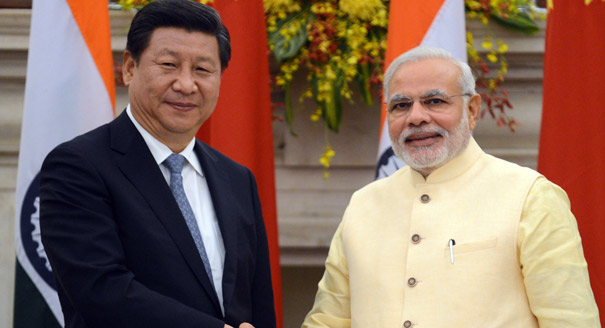
President Xi Jinping, who received Swaraj, expressed satisfaction at the progress in ties since he came to India last September. If Modi hosted Xi in home state Gujarat, the Chinese president wants to show Modi his home town Xian, which is also the ancient capital of China.
The warm welcome to Swaraj in China should help India look beyond the proposition that Delhi can simultaneously improve its relations with both Washington and Beijing. It suggests that expanding the relationship with one improves Delhi’s chances with the other.
With neither America nor China asking India to choose between them, the Modi government is in a good position to strengthen its cooperation with both and boost India’s comprehensive national power. It is India’s strategic community that must learn to discard the traditional binaries in its foreign policy discourse — either America or China and alignment versus non-alignment.
There is no reason, too, for India to maintain equal distance from the world’s two greatest powers. There will be some issues on which India will be closer to America — for example, on how to reduce tensions in the South China Sea. On others, like non-intervention in the internal affairs of third countries, Delhi would like to sit in Beijing’s corner.
India’s expanding engagement with China and the United States does not mean they will evolve either symmetrically or at the same pace. For example, on the economic front, China could be the preferred partner in some sectors like physical infrastructure development. The US partnership is critical for the development of India’s knowledge-based industries.
On security issues, America is a distant power with which India has no direct disputes. China, on the other hand, is a large neighbour whose power is growing rapidly. India has big problems with China, including a long and contested boundary. India’s security partnership with America flows naturally from the logic of geopolitics. But how far Delhi might go with Washington would depend on its assessment of the security threats from Beijing.
In Beijing, Swaraj pressed the right buttons when she outlined a six-point framework to rejuvenate Sino-Indian relations. She called for an “action-oriented approach that can broaden the base of bilateral engagement, deepen convergence on regional and global issues, develop new areas of cooperation, expand strategic communication and build an Asian Century”.
The key word here is “action-oriented”. Swaraj is saying Delhi is ready to go beyond the Indian diplomatic tradition that privileged rhetoric over substance, especially towards China.
Swaraj promised to address Chinese concerns about doing business in India and, at the same time, demanded greater market access in China for Indian goods. She called for more contact and communication between the peoples of the two countries and the promotion of tourism.
She also hinted at the prospects for the two sides exploring “out-of-the-box” solutions to the long-pending territorial dispute. With strong leaders at the helm in both capitals, Swaraj was suggesting, it was time to make bold moves. She was telling her Chinese hosts that Delhi is eager to ensure that Modi’s proposed visit to China, most likely in May, is an “outcome-oriented” one.
This article was originally published in the Indian Express.
Former Nonresident Senior Fellow, Carnegie India
A leading analyst of India’s foreign policy, Mohan is also an expert on South Asian security, great-power relations in Asia, and arms control.
Recent Work

C. Raja Mohan, Darshana M. Baruah


Alexander Gabuev, Paul Haenle, C. Raja Mohan, …
Carnegie does not take institutional positions on public policy issues; the views represented herein are those of the author(s) and do not necessarily reflect the views of Carnegie, its staff, or its trustees.

But their "principal to principal" model will only be as effective as the political strength of each leader back home.

Damien Ma

U.S. unpredictability has allowed China to capitalize on its positioning as the “responsible great power”. Paradoxically, the more China wins the perception game, the more likely expectations will rise for Beijing to deliver not just words but to demonstrate with its deeds.

Chong Ja Ian

Hanoi and Beijing have long treated each other as distant cousins rather than comrades in arms. That might be changing as both sides draw closer to hedge against uncertainty and America’s erratic behavior.

Nguyễn Khắc Giang

Across Asia, China is better positioned to withstand energy shocks from the fallout of the Iran war. Its abundant coal capacity can ensure stability in the near term. Yet at the same time, the country’s energy transition away from coal will make it even less vulnerable during the next shock.
Damien Ma

In the latest Five-Year Plan, the Chinese president cements the shift to an innovation-driven economy over a consumption-driven one.
Damien Ma