

Commentary
Dmitri Trenin
{
  "authors": [
    "Dmitri Trenin"
  ],
  "type": "legacyinthemedia",
  "centerAffiliationAll": "",
  "centers": [
    "Carnegie Endowment for International Peace",
    "Carnegie Russia Eurasia Center"
  ],
  "collections": [],
  "englishNewsletterAll": "",
  "nonEnglishNewsletterAll": "",
  "primaryCenter": "Carnegie Russia Eurasia Center",
  "programAffiliation": "",
  "programs": [],
  "projects": [],
  "regions": [
    "North America",
    "United States",
    "East Asia",
    "China",
    "Russia",
    "Western Europe"
  ],
  "topics": [
    "Foreign Policy"
  ]
}
Source: Getty
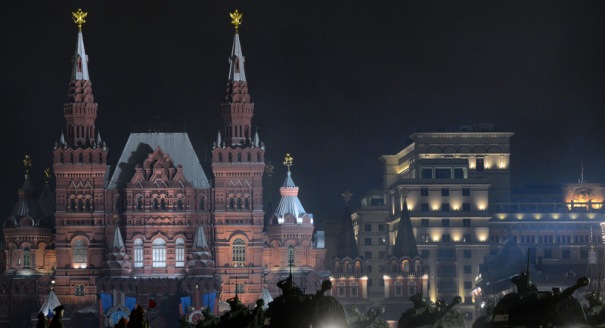
On May 9—the Victory Day—the majority of top-level visitors will come to Moscow from the non-Western countries. Russia’s quest for acceptance in or by the West is finally over, and its foreign policy will require a new identity and new orientation.
Source: Global Times
Politics, including international relations, is about symbols as well as actions. When Russia staged the 2014 Winter Olympics in Sochi, it sought to present the image of a modern country, open to the world. Next month, when Russia will hold a military parade in Red Square to celebrate the 70th anniversary of victory in the Great Patriotic War against Nazi Germany, it will be restating its role in the allied victory in World War II. The USSR, which the present-day Russian Federation regards as its direct predecessor, lost at least 28 million people in that epic war.
Russians generally believe that their most valuable contribution to humanity was the defeat of Hitler's war machine. May 9, Victory Day, has been Russia's true, and truly sacred, national day, ever since 1945.
Since the end of Cold War, the Kremlin has made a habit of inviting world leaders to the Victory Day anniversaries in Moscow.In 1995, then US president Bill Clinton came to Moscow; in 2005, it was George W. Bush. In 2015, they invited Barack Obama. However, not only Obama is staying at home; with very few exceptions, Western leaders are collectively boycotting the event. This is a way for them to protest over Russia's actions in Crimea and its policies toward Ukraine.
The trend toward minimizing direct contacts with Vladimir Putin had been evident even before the Ukraine crisis. Most Western countries, led by the US, stayed away from the Sochi Olympics, censuring Russia for other transgressions, such as legislation banning gay "propaganda" to minors. In 2013, Obama, in an unprecedented step, canceled his official visit to Moscow, over the Snowden affair.
This tightening boycott illustrates the depth and breadth of the chasm now separating Russia and the West. To many ordinary Russians, the collective Western no-show is more than a sign of disapproval of their leader's policies. This is a slight against their most cherished national heritage. What is worse, they also hear that the West is supporting a Ukrainian leadership that formally equates communism with Nazism, and blames Stalin, alongside Hitler, for the outbreak of WWII.
As a result, common victory in WWII, which even during the highly ideological Cold War was recognized as a measure of the potential for Soviet-Western cooperation and a thus hope for a better future, is no longer shared.
On May 9, the lineup of Moscow's guests of honor will demonstrate the dramatic change in Russia's international position over the past 18 months. The two dozen or so top-level visitors will come mostly from the non-Western countries of Asia, Latin America, and Africa. Among them, Chinese President Xi Jinping will be the most prominent.
Russia's divorce from its Western partners will be clear for everyone to see. Even the German chancellor will pointedly avoid the Red Square parade, only to appear the following day for a wreath-laying ceremony.
The rupture is as much symbolic as it is real. Russia's quarter-century-long quest for acceptance in or by the West is finally over.
In 2014, the country returned to its traditional Eurasian posture, albeit no longer as an aspiring hegemon in either Europe or Asia. Solidifying relations with its partners in the region such as Armenia, Belarus, or Kazakhstan, will be very important, but the key relationship for Moscow in the foreseeable future will be that with Beijing.
In return for Xi's decision to visit Victory Day parade in Red Square, Putin will visit China to celebrate the event to mark the end of WWII in September, something no Russian or Soviet leader has done before.
Russia's focus on the non-Western world is not limited to China, of course. Prime Minister Dmitry Medvedev has recently completed a visit to Vietnam and Thailand, looking for economic opportunities in Southeast Asia. Kim Jong-un, the North Korean leader, is also expected to make it to Moscow on May 9. Ties to Turkey, Iran, Egypt and Syria are all being expanded. Two months after the parade in Red Square, Putin will be hosting back-to-back summits of BRICS and the Shanghai Cooperation Organization in Ufa.
Anniversaries, parades and even summits are mostly about public relations. However, beyond the fanfares, martial music and the roar of aircraft flying over Red Square, Russia's foreign policy will require a new identity and new orientation.
Having seen, in the past year, its Plan A, Western integration of Russia, fail and Plan B for Eurasian integration around Russia scaled down, Moscow will have to come up with a realistic Plan C, featuring a close and yet balanced partnership with China and expanded relations with non-Western countries around the world.
Former Director, Carnegie Moscow Center
Trenin was director of the Carnegie Moscow Center from 2008 to early 2022.
Recent Work
Dmitri Trenin
Dmitri Trenin
Carnegie does not take institutional positions on public policy issues; the views represented herein are those of the author(s) and do not necessarily reflect the views of Carnegie, its staff, or its trustees.

Chinese biotech companies have been on the receiving end of U.S. economic coercion. Yet their responses have differed significantly because firm and state interests are not uniformly aligned. For Washington, treating all Chinese tech firms the same, irrespective of their actual interests, risks pushing them farther into Beijing’s corner.

Xue Gong

China’s latest energy plan explicitly calls for integrating data centers into the electricity system, particularly connecting them to green energy. It appears Beijing wants to use compute as a source of domestic demand to absorb renewables excess capacity.

Damien Ma

But their "principal to principal" model will only be as effective as the political strength of each leader back home.
Damien Ma

U.S. unpredictability has allowed China to capitalize on its positioning as the “responsible great power”. Paradoxically, the more China wins the perception game, the more likely expectations will rise for Beijing to deliver not just words but to demonstrate with its deeds.

Chong Ja Ian

Hanoi and Beijing have long treated each other as distant cousins rather than comrades in arms. That might be changing as both sides draw closer to hedge against uncertainty and America’s erratic behavior.

Nguyễn Khắc Giang