

Commentary
Dmitri Trenin
{
  "authors": [
    "Dmitri Trenin"
  ],
  "type": "legacyinthemedia",
  "centerAffiliationAll": "",
  "centers": [
    "Carnegie Endowment for International Peace",
    "Carnegie Russia Eurasia Center",
    "Carnegie China"
  ],
  "collections": [],
  "englishNewsletterAll": "",
  "nonEnglishNewsletterAll": "",
  "primaryCenter": "Carnegie Endowment for International Peace",
  "programAffiliation": "",
  "programs": [],
  "projects": [],
  "regions": [
    "East Asia",
    "China",
    "Russia"
  ],
  "topics": [
    "Security",
    "Military",
    "Foreign Policy",
    "Arms Control"
  ]
}
Source: Getty
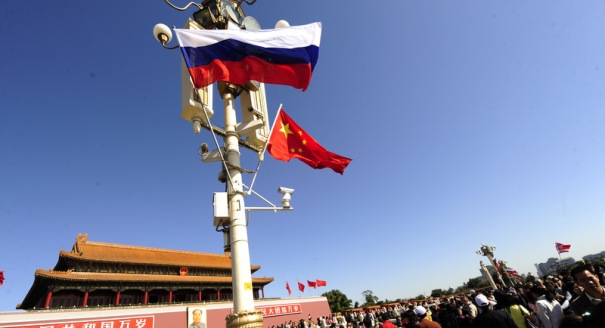
The Russia-China rapprochement is a sign of the changing world order, in which the West is still very relevant, but no longer dominant.
Source: China Daily
On May 9, when Russia celebrates the 70th anniversary of Victory in the Great Patriotic War against Nazi Germany, Moscow's Red Square will for the first time see a unit of China's People's Liberation Army marching past the reviewing stand. Among the foreign dignitaries reviewing the military parade, Chinese President Xi Jinping will be the most prominent.
Xi's presence at the Victory Parade will be in stark contrast to the decision of Western leaders to stay away from it in protest against Russia's involvement in Ukraine. In September, Russian President Vladimir Putin will return the compliment by traveling to Beijing to mark the 70th anniversary of Victory in the War of Chinese People's Resistance against Japanese Aggression and the end of World War II.
In mid-May, nine ships from the Russian and Chinese navies will hold joint drills in the Mediterranean Sea. Similar bilateral exercises have been held since 2012, but all of them have been in the western Pacific Ocean. Taking the naval drill to what used to be a NATO pond after the end of the Cold War is certainly designed as a not-too-subtle message to the United States.Also, Russia has decided to allow the transfer of more sophisticated weapons, such as the S-400 air defense system, to China. Japan, which has had to bow to US pressure and join sanctions against Russia, will not be amused. Does all this suggest incremental moves toward a de facto military alliance between Moscow and Beijing?
The answer is no. China and Russia both basically rely on nuclear deterrence as ultimate national security guarantee, and an alliance brings little added value.
Besides, every country is adamant about its own strategic independence. Right now, there is no common military threat of a caliber warranting a Sino-Russian alliance. For all their mutual resentment toward US global dominance, strategies of Russia and China toward the US differ greatly. And even though Russia-China relations have progressed greatly since being normalized a quarter century ago, military security remains a highly sensitive area where neither side wants to open up too much, and too soon.
Yet the fact that there is no Sino-Russian alliance in the offing does not mean that the relationship has remained static. In the last 15 months or so, it has made a big leap forward from a "marriage of convenience" to something of an entente, that is, a close political alignment.
The Ukraine crisis, which has resulted in a confrontation between Russia and the US and a rupture between Russia and the European Union, produced a major geopolitical shift in Eurasia, pushing Moscow's geopolitical and strategic axis eastward. At the same time, Beijing's "Belt and Road Initiatives" laid a blueprint for a more active Chinese role in Eurasia. Facing US-led opposition along its eastern seaboard, China has embarked on a journey westward. China and Russia, which until recently were standing back to back on their long border, no longer fearful of each other but each looking away, will come face to face.
Given the present global environment, Moscow and Beijing are more likely to cooperate than to compete. The common agenda is both expanding and deepening. It includes energy and transportation, infrastructure and banking, agriculture and water resources, space and technology, regional security and continental order. In each area, qualitative steps are being taken or envisaged, taking cooperation to a higher level.
The process may not be smooth and interests do not always coincide, but the direction of the change is clear. From East Asia to Eastern Europe, and from the Arctic to the South China Sea, a new pattern of much closer interaction is emerging. China is becoming a clear priority for Russia. Beijing, for its part, is forming a Eurasian strategy, with Moscow being a key part of it.
Other countries, from the US to European nations to Japan, need to pay attention. They should not expect a new Sino-Russian bloc, complete with a military pact. However, the Russia-China rapprochement is a sign of the changing world order, in which the West is still very relevant, but no longer dominant. The non-West, a highly diverse group of countries, is beginning to flesh out international structures of its own, from the Shanghai Cooperation Organization to BRICS to the Asian Infrastructure Investment Bank. The Sino-Russian entente is a major driver of the process.
Former Director, Carnegie Moscow Center
Trenin was director of the Carnegie Moscow Center from 2008 to early 2022.
Recent Work
Dmitri Trenin
Dmitri Trenin
Carnegie does not take institutional positions on public policy issues; the views represented herein are those of the author(s) and do not necessarily reflect the views of Carnegie, its staff, or its trustees.

Chinese biotech companies have been on the receiving end of U.S. economic coercion. Yet their responses have differed significantly because firm and state interests are not uniformly aligned. For Washington, treating all Chinese tech firms the same, irrespective of their actual interests, risks pushing them farther into Beijing’s corner.

Xue Gong

China’s latest energy plan explicitly calls for integrating data centers into the electricity system, particularly connecting them to green energy. It appears Beijing wants to use compute as a source of domestic demand to absorb renewables excess capacity.

Damien Ma

But their "principal to principal" model will only be as effective as the political strength of each leader back home.
Damien Ma

U.S. unpredictability has allowed China to capitalize on its positioning as the “responsible great power”. Paradoxically, the more China wins the perception game, the more likely expectations will rise for Beijing to deliver not just words but to demonstrate with its deeds.

Chong Ja Ian

Hanoi and Beijing have long treated each other as distant cousins rather than comrades in arms. That might be changing as both sides draw closer to hedge against uncertainty and America’s erratic behavior.

Nguyễn Khắc Giang