

Commentary
But their "principal to principal" model will only be as effective as the political strength of each leader back home.
Damien Ma
{
  "authors": [
    "Pavel Koshkin",
    "Alexey Malashenko"
  ],
  "type": "legacyinthemedia",
  "centerAffiliationAll": "dc",
  "centers": [
    "Carnegie Endowment for International Peace",
    "Malcolm H. Kerr Carnegie Middle East Center",
    "Carnegie Russia Eurasia Center"
  ],
  "collections": [],
  "englishNewsletterAll": "ctw",
  "nonEnglishNewsletterAll": "",
  "primaryCenter": "Carnegie Russia Eurasia Center",
  "programAffiliation": "russia",
  "programs": [
    "Russia and Eurasia"
  ],
  "projects": [],
  "regions": [
    "Gulf",
    "Levant",
    "Middle East",
    "Syria",
    "Russia"
  ],
  "topics": [
    "Security",
    "Foreign Policy",
    "Religion"
  ]
}
Source: Getty
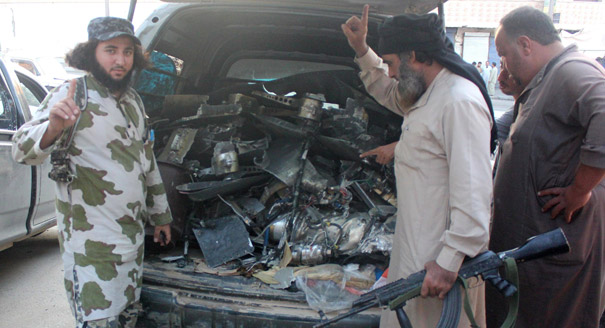
Not only Russia, but also the entire world might face a dilemma: Choosing between a very sinister authoritarian regime and the Islamic State.
Source: Russia Direct
This interview originally appeared in Russia Direct.
According to recent media reports, Russia is about to change its policy toward Syria and potentially even turn its back on President Bashar Al-Assad’s regime, which now appears to be under increasing pressure from the Islamic State of Iraq and the Greater Syria(ISIS). If the Assad regime falls, however, Russia will have to contend with an expanded ISIS presence near its borders.
And that is especially significant given the increasing signs that ISIS is starting to gain a toehold in the North Caucasus and some states in the post-Soviet space. There are now even reports about a student from Moscow State University running off to join ISIS.
Amidst the background of these events, Russia Direct recently sat down with Alexey Malashenko, an expert on religion and security matters for the Carnegie Moscow Center. Below, Malashenko shares his thoughts on Syria, the threat posed by ISIS, and the opportunities that Russia might have to partner with other nations in the Middle East against radical Islam.
Any change in policy with regard to Assad is not a sign of the flexibility of Russia, but rather a sort of ambivalence. But there is another question: With no support for Assad, who should the Kremlin back? Should Russia support an obscure [opposition] coalition that consists of Islamists or nationalists, some of who are allegedly moderate?
But given the recent events [in the Middle East] and the more active role of the Islamic State, I don’t know who is better. In the end, not only Russia, but also the entire world might face a dilemma: Choosing between a very sinister authoritarian regime and the Islamic State. There is no other choice because all talk about democracy in the Middle East is for little children.
So far, nobody has come up with this compromise and there is no reason to speculate on this issue. But the fact is that the Syrian problem is a specific case of the Middle East. That’s why to assume that coming up with a consensus only on Syria and then dealing with the rest of the problems is not the best way of thinking. In fact, Syria is a complex problem that needs to be resolved in a complex way.
Moreover, it is impossible to resolve it at the level of U.S.-Russia bilateral relations, because the world in the Middle East is indeed multipolar, with interests of America, Russia, Turkey, Iran and Saudi Arabia shaping it geopolitical landscape. And without consensus of all these stakeholders, it is impossible to achieve progress. But, so far, there is no sign of consensus.
The fact is that Moscow brought together people who don’t have any differences: They didn’t have something to talk about. In Astana, there was a hope that the Syria peace talks would bring together somebody else. But what results did these negotiations lead to finally? I didn’t see real opponents there who could really clash with each other and, then, could agree on the thorniest issues.
Yes, the opposition that attended these negotiations is monochrome, but not the real opposition, which consists of radicals who believe that they have enough potential [to win the war]. Again, the situation in the Middle East is very complex, with a lot of links subtly intertwined. And the main mistake of Americans and Europeans is that they missed this complexity. Initially, they assumed that as the worst-case scenario the radicals would form a sort of Al-Qaeda, but, in reality, we have seen a qualitatively different phenomenon [ISIS].
For Russia, it is rather a specific episode, not the trend, even though there are the same examples in other countries, such as France. So far, I haven’t seen girls coming to ISIS on a massive scale. In the case of the Russian student, it is not recruiting, but rather a psychological shift, the desire to find oneself. There is a lot of speculation on these topics and all discussion adds up to the need to increase the patriotic upbringing among young people.
Some naively believe it will prevent them from wearing hijab and going to the Islamic State. But there is no mention [in public debates] that there is a big difference between a hijab and a Kalashnikov rifle. In addition, it is not clear how we are going to nurture patriotism, given the fact there are more than 16 million Muslims in Russia, who are very active in defending their positions. So, it is a heavy-handed and inefficient approach of resolving the problem [the ISIS threat]. Now there is more irrelevant noise than good proposals.
Even though Muslim neophytes are very active in Russia, this specific case of the student coming to ISIS is just an episode. There is a version that she went to ISIS to teach Russian. The question is: Whom was she going to teach?
So far, it is significantly exaggerated by Russia’s intelligence and security services. But at the same time, we should not forget about ISIS propaganda, which is indeed transmitted in about 23 languages, including Russian. And there have been some results. Totally, there are between 1,700 and 3,000 Russian citizens who have joined the Islamic State.
But having been disappointed, some came back. But thinking that those who returned to Russia from ISIS pose a significant threat is again an exaggeration. But in the case of a worsening economic situation and economic crisis, corruption and the growth of indignation in Northern Caucasus, there might be social unrest, which could, partly, turn into religious radicalism. In this case, those who returned from ISIS, given their military experience, could play a role.
This is the question that should be addressed to Russian Predient Vladimir Putin. The Kremlin missed the moment when it was necessary to do something in the 1990s. Now the third generation of Islamic opposition is fighting [on the side of ISIS].
Absolutely. They plucked at the hornet’s nest. It is impossible to kill or imprison all radicals. Even though we want to talk, we are not able to foster dialogue with them. The problem is that Islam is not a homogeneous tradition and culture, but it contains a significant number of branches. And this problem will be forever in place.
They won’t get nuclear weapons, but they might get chemical and biological weapons. It is just a matter of time before they get them. They could poison wells. Water is much easier to poison. And it is a very serious problem to prevent these madmen from getting weapons of mass destruction, whether they are chemical or biological.
And this threat is real. Andthere will always be a madman who will dare to launch it in the Volga, the Rhine, the Moscow River or elsewhere. And this is impossible to predict, like it was impossible to foresee the 9/11 attack on the World Trade Center in New York. Something is bound to happen.
Russia now is like a lonely wanderer. It is looking for its own position. But the fact Russia doesn’t directly participate in the campaign against ISIS, it scores additional points, because the fight against ISIS is perceived by Muslims - even by moderate ones - as the fight against Islam.
Pavel Koshkin
Former Scholar in Residence, Religion, Society, and Security Program
Malashenko is a former chair of the Carnegie Moscow Center’s Religion, Society, and Security Program.
Carnegie does not take institutional positions on public policy issues; the views represented herein are those of the author(s) and do not necessarily reflect the views of Carnegie, its staff, or its trustees.

But their "principal to principal" model will only be as effective as the political strength of each leader back home.

Damien Ma

U.S. unpredictability has allowed China to capitalize on its positioning as the “responsible great power”. Paradoxically, the more China wins the perception game, the more likely expectations will rise for Beijing to deliver not just words but to demonstrate with its deeds.

Chong Ja Ian

Hanoi and Beijing have long treated each other as distant cousins rather than comrades in arms. That might be changing as both sides draw closer to hedge against uncertainty and America’s erratic behavior.

Nguyễn Khắc Giang

Across Asia, China is better positioned to withstand energy shocks from the fallout of the Iran war. Its abundant coal capacity can ensure stability in the near term. Yet at the same time, the country’s energy transition away from coal will make it even less vulnerable during the next shock.
Damien Ma

Malaysia’s chairmanship sought to fend off short-term challenges while laying the groundwork for minimizing ASEAN’s longer-term exposure to external stresses.

Elina Noor