

Commentary
Andrei Kolesnikov
{
  "authors": [
    "Andrei Kolesnikov"
  ],
  "type": "legacyinthemedia",
  "centerAffiliationAll": "",
  "centers": [
    "Carnegie Endowment for International Peace",
    "Carnegie Russia Eurasia Center"
  ],
  "collections": [
    "Iranian Proliferation"
  ],
  "englishNewsletterAll": "",
  "nonEnglishNewsletterAll": "",
  "primaryCenter": "Carnegie Endowment for International Peace",
  "programAffiliation": "",
  "programs": [],
  "projects": [],
  "regions": [
    "North America",
    "United States",
    "South America",
    "Middle East",
    "Iran",
    "Russia"
  ],
  "topics": [
    "Security",
    "Foreign Policy",
    "Nuclear Policy"
  ]
}
Source: Getty
The Iran nuclear deal and the restoration of diplomatic relations between the United States and Cuba are victories achieved through informal or semi-informal diplomacy. As for the Russian-American relations, this diplomacy successfully worked even during the Cold War—but not now.
Source: Vedomosti
Thanks to the restoration of diplomatic relations between the United States and Cuba, the Cuban flag is flying over Washington, and, perhaps, the Soviet-era pop song “Cuba, My Love” can finally be appreciated in America.
Like the Iran nuclear deal, the opening with Cuba is yet another diplomatic victory for Barack Obama as his second term draws to a close. Both victories were achieved through informal or semi-informal diplomacy relying on various backchannels and go-betweens.
The president of the Carnegie Endowment for the International Peace, Ambassador William Burns, played an important role in bringing about the Iranian agreement, while Pope Francis was instrumental in the Cuba deal. His Holiness displayed true patience and cordiality, even when Bolivian President Evo Morales presented him a crucifix in the shape of a hammer and sickle. In a different era, an earlier Pope, John XXIII, had donned the mantle of peacemaker during and after the Cuban missile crisis. Who knows how history might have played out if the Pontiff hadn’t succumbed to stomach cancer, if Kennedy hadn’t been shot, and if Khrushchev hadn’t been removed.In the wake of the Cuban crisis, the Pope encouraged famed Saturday Review editor and anti-nuclear activist Norman Cousins to try to kick-start relations between the Kremlin and the Vatican. He met Nikita Khrushchev in Moscow and Pitsunda, where he played badminton and spent hours talking to the Soviet premier while his daughters frolicked in Khrushchev’s pool. The Soviet leader complained to Cousins about the shoddiness of the Soviet propaganda machine and about the obstinacy of his hardline generals. These conversations and a plea from the Pope resulted in the release of Ukrainian and Czech Catholic archbishops from the Gulag. Later, Cousins found himself playing a key role as intermediary between Kennedy and Khruschev during negotiation of the Limited Test Ban Treaty.
Détente was initially built through a backchannel between Henry Kissinger and Anatoly Dobrynin, the longtime Soviet ambassador in Washington. As Richard Nixon’s national security advisor, Kissinger often worked without consulting the American ambassador in Moscow or even higher-ups in the State Department in Washington. When Leonid Brezhnev dragged Kissinger out on wild boar hunts, the American diplomat explained to him that missed shorts were still likely to kill the animals by giving them a heart attack. Standing in his hunting tower, Brezhnev told Kissinger about how he had had to scramble to find a decent uniform to wear at the 1945 Red Square victory parade and suggested that the Soviets were reaching “the point in history where we should stop building monuments for military heroes.” And that’s how détente was established.
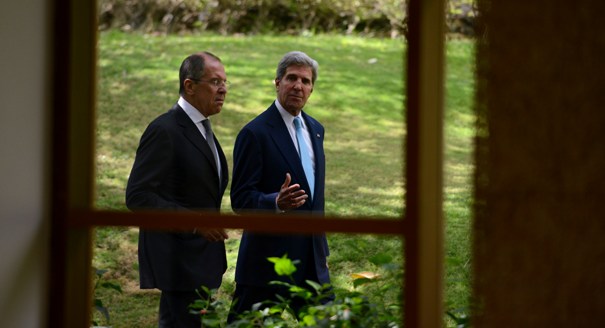
For a brief while, it seemed like John Kerry and Sergei Lavrov’s well-documented long walks might provide the impetus for creating a channel of mutual trust and good will. But unlike Burns’s, Pope Francis’s, Pope John’s and Kissinger’s missions, none of these efforts have gotten any traction.
“…[F]ortunately for the boars—for whom I was rooting—night was beginning to fall, and Brezhnev missed two shots at long range,” Kissinger writes in his memoirs. Sadly, it’s hard to imagine finding a boar that might inspire Russian leaders to give at least a little thought to the higher purpose of peacemaking.
This article originally appeared in Russian in Vedomosti.
Former Senior Fellow, Carnegie Russia Eurasia Center
Kolesnikov was a senior fellow at the Carnegie Russia Eurasia Center.
Recent Work
Andrei Kolesnikov
Andrei Kolesnikov
Carnegie does not take institutional positions on public policy issues; the views represented herein are those of the author(s) and do not necessarily reflect the views of Carnegie, its staff, or its trustees.

The nuclear relationship between China and the United States is increasingly shaped by widening perception gaps rather than deliberate strategic design.

Tong Zhao

But their "principal to principal" model will only be as effective as the political strength of each leader back home.

Damien Ma

U.S. unpredictability has allowed China to capitalize on its positioning as the “responsible great power”. Paradoxically, the more China wins the perception game, the more likely expectations will rise for Beijing to deliver not just words but to demonstrate with its deeds.

Chong Ja Ian

Hanoi and Beijing have long treated each other as distant cousins rather than comrades in arms. That might be changing as both sides draw closer to hedge against uncertainty and America’s erratic behavior.

Nguyễn Khắc Giang

Across Asia, China is better positioned to withstand energy shocks from the fallout of the Iran war. Its abundant coal capacity can ensure stability in the near term. Yet at the same time, the country’s energy transition away from coal will make it even less vulnerable during the next shock.
Damien Ma