

Article
Paul Stronski
{
  "authors": [
    "Paul Stronski"
  ],
  "type": "commentary",
  "centerAffiliationAll": "",
  "centers": [
    "Carnegie Endowment for International Peace",
    "Carnegie Russia Eurasia Center"
  ],
  "collections": [],
  "englishNewsletterAll": "",
  "nonEnglishNewsletterAll": "",
  "primaryCenter": "Carnegie Endowment for International Peace",
  "programAffiliation": "",
  "programs": [],
  "projects": [],
  "regions": [
    "Caucasus",
    "Russia",
    "Armenia",
    "Western Europe"
  ],
  "topics": [
    "Political Reform",
    "Democracy",
    "Economy",
    "Climate Change",
    "Civil Society"
  ]
}
Source: Getty
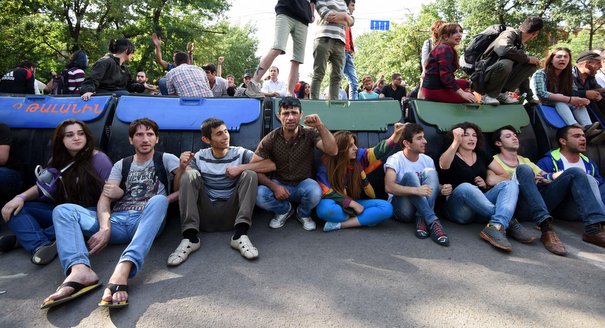
The Armenian protesters are motivated by socio-economic issues and the desire for social justice—not larger notions of democracy that constitute international human rights advocacy.
According to the Kremlin narrative, the protests that have rocked Armenia over the past two weeks are the result of the hidden hand of Western intelligence operatives. This narrative is part of a tried and true script of the Western "color revolution," modeled on similar events in Ukraine and Georgia. However, that view profoundly misreads these protests, which arose for domestic, Armenian reasons and are not part of a geopolitical tug-of-war.
Discontent spiked in January after the murder of an Armenian family by a Russian soldier outside Russia’s military base in Gyumri. Russia’s economic slowdown—exacerbated by Western sanctions—is rumbling into Armenia and undermining Armenians’ sense of economic security. But it was the recent decision to raise electricity rates at the request of Electric Networks of Armenia (ENA), the country’s electricity provider, that sparked these protests. ENA is a subsidy of InterRAO UES, a Russian energy conglomerate with ties to Kremlin-friendly oligarchs. Protestors accuse ENA of providing lavish perks for managers and overpaying its oligarch-owned suppliers. ENA has become a symbol of Armenian corruption as well as the murky connections between the government and oligarchs and between Moscow and Yerevan.
What lessons should we draw from these protests?
Armenians are pushing back at the regional turn toward authoritarianism. These protestors are young, and they are not led by well-known opposition leaders. This youth is positive because it shows that civil society is rejuvenating itself, and negative because it lacks leadership. Individual protesters who have risen to prominence defer to the crowd in deciding how the movement should engage the government. However, democracy by crowd rarely brings stable change. It is unclear whether this movement can develop a platform or a strategy to sustain itself.
The protestors are motivated by socio-economic issues and the desire for social justice—not larger notions of democracy that constitute international human rights advocacy. This desire for economic fairness is not uniquely Armenian but forms part of a regional trend that has been seen in Russia as well. The West might therefore have more success in promoting reform in Eurasia by stressing this more narrow theme as opposed to its traditional advocacy for elections, political parties, and human rights across the board.
Armenian authorities are learning from their mistakes. The June 23 police crackdown ended with violence, but only fueled more protests and hardened demonstrators’ demands. The government has behaved better since. It is trying to meet the protestors halfway—a sign that civil society can succeed in pushing the government to address its concerns. Sargsyan announced that his government would bear the costs of the rate hike until an audit of ENA determines whether the hike is justified. Yet, it is unclear where he will get the money, and his government has a poor record of engendering trust. Some protestors rejected his concession and remain in the street, defying police and organizers’ calls to move the protest to a nearby park. There are now two dueling demonstrations, frictions between them, and signs of the waning of the protests. Though this may be a potential success for the government in defusing the situation, the lull is likely to be temporary since the underlying grievances remain.
The West is learning from its mistakes too. In 2013, the European Union forced regional leaders to make a definitive choice between Europe and Russia. It did so based on an artificial schedule of EU leader summits no matter whether countries were ready for that commitment. Its new effort to negotiate an alternate arrangement with Armenia recognizes that each country is unique and that the failed one-policy-suits-all approach was unrealistic. The new approach provides the EU with leverage to urge restraint. Another violent crackdown could freeze those negotiations—something Sargsyan seems keen to avoid given Armenia’s struggling economy.
The United States has been careful not give the impression that it is taking sides in this internal dispute, signaling instead that it is watching and that Armenians should resolve it peacefully through constitutional means. It has not implied that anyone should make zero-sum decisions between Russia and Europe.
While the West is taking an appropriately cautious stance, it is unclear whether Moscow has learned its lesson. Just as it did with former Ukrainian President Viktor Yanukovych in 2014, the Kremlin is likely pressuring Armenian authorities to make that zero-sum decision and to quell the protest decisively. Unfortunately, we all know how well that approach worked out.

Former Senior Fellow, Russia and Eurasia Program
Paul Stronski was a senior fellow in Carnegie’s Russia and Eurasia Program, where his research focuses on the relationship between Russia and neighboring countries in Central Asia and the South Caucasus.
Recent Work
Paul Stronski
Paul Stronski
Carnegie does not take institutional positions on public policy issues; the views represented herein are those of the author(s) and do not necessarily reflect the views of Carnegie, its staff, or its trustees.

The Plaza Accord was not an externally imposed punishment of Japan but part of a broader restructuring that Japanese economists and policymakers themselves recognized was necessary. Its effects were undermined, however, when Tokyo responded to the resulting slowdown with policies that exacerbated investment, credit expansion, and the very imbalances the adjustment was intended to resolve.

Michael Pettis
China’s banking crisis in the 2000s was resolved by transferring the costs to households through financial repression—a decision that recapitalized the banks while exacerbating the structural imbalances that continue to shape the Chinese economy today.
Michael Pettis

In the latest Five-Year Plan, the Chinese president cements the shift to an innovation-driven economy over a consumption-driven one.

Damien Ma
Rather than climate ambitions, compatibility with investment and exports is why China supports both green and high-emission technologies.

Mathias Larsen
“Involution” is a new word for an old problem, and without a very different set of policies to rein it in, it is a problem that is likely to persist.
Michael Pettis