

Article
C. Raja Mohan, Darshana M. Baruah
{
  "authors": [
    "C. Raja Mohan"
  ],
  "type": "legacyinthemedia",
  "centerAffiliationAll": "dc",
  "centers": [
    "Carnegie Endowment for International Peace",
    "Carnegie India"
  ],
  "collections": [],
  "englishNewsletterAll": "ctw",
  "nonEnglishNewsletterAll": "",
  "primaryCenter": "Carnegie India",
  "programAffiliation": "SAP",
  "programs": [
    "South Asia"
  ],
  "projects": [],
  "regions": [
    "Asia",
    "South Asia",
    "Afghanistan",
    "India",
    "Pakistan"
  ],
  "topics": [
    "Foreign Policy"
  ]
}
Source: Getty
To be an effective player in Central Asia, India must find a way either through Pakistan, or around it.
Source: Indian Express
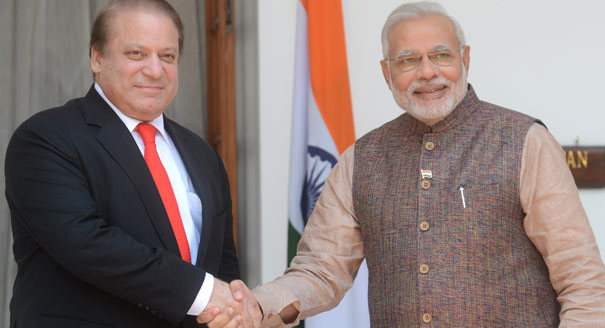
As Prime Minister Narendra Modi returns from a gruelling “Look North” tour, the domestic focus continues to be on his surprising outreach to Pakistan’s PM Nawaz Sharif rather than his renewed engagement with the Central Asian republics. But the two are not unrelated, since Pakistan looms so large in India’s Eurasian strategy. It was perhaps entirely appropriate that Modi’s pivot to Pakistan took place on the margins of the Shanghai Cooperation Organisation (SCO), with its ambitious agenda for integrating inner Asia.
Indian and Pakistani leaders have a long tradition of meeting in distant lands rather than hopping across the border. Manmohan Singh, who was not allowed by the Congress to travel to Pakistan even once in his decade-long tenure as PM, sustained the dialogue with Pakistan in meetings around the world.
Modi seemed to break that tradition last year by inviting the Pakistan PM to New Delhi to join him on his very first day in office. If the abrupt suspension of the talks three months later was a setback, observers of India-Pakistan relations knew it was a matter of time before Modi picked up the thread.The SCO summit, welcoming India and Pakistan as full members, was indeed a good place to restart the dialogue. Partition and its geopolitical consequences made Pakistan a great barrier between India and inner Asia. To be an effective player in Central Asia, India must find a way either through Pakistan, or around it.
Through his five-nation tour of the region and in his interaction with SCO leaders, Modi focused on both options. The priority was indeed on deepening connectivity to Central Asia through Iran. The PM called for accelerated development of the International North-South Transportation Corridor (INSTC) established way back in 2000 by India, Iran and Russia. Ten other countries in Eurasia and Oman in the Gulf have become members since. Modi also sought India’s admission to the Ashgabat Agreement that involves Oman, Turkmenistan, Iran, Uzbekistan and Kazakhstan, and facilitates easy movement of goods across their borders.
But Modi did not forget that India’s shortest route to Central Asia runs through Lahore, Rawalpindi and Peshawar. In a speech at the Nazarbayev University in Astana, the Kazakh capital, Modi hoped that “we can restore the traditional route to Central Asia through Pakistan and Afghanistan”. Despite repeated appeals from India and Afghanistan as well as the US in recent years, Pakistan has refused to grant overland transit facilities for India.
One exception to Islamabad’s reluctance to advance transborder economic cooperation has been sustained negotiations with Delhi and Kabul on the TAPI pipeline. On the drawing board for nearly two decades, the pipeline is designed to bring natural gas from Turkmenistan to India through Afghanistan and Pakistan. Despite multiple troubles, the three nations have persisted with the project. During his visit to Turkmenistan, Modi underlined the importance of the TAPI pipeline in promoting regional integration between the subcontinent and Central Asia and called for its early implementation.
Modi is betting he might be able to turn the TAPI exception into a “new normal” between India and Pakistan on economic cooperation. While sceptics might smirk, Modi is aware of the new dynamic rapidly altering the regional context. The American withdrawal from Afghanistan, Russian and Chinese desire to stabilise Afghanistan and Pakistan, Moscow’s eagerness to mobilise India into an inner Asian coalition, Beijing’s interest in rebuilding the silk road across Eurasia and the prospects for a nuclear accommodation between Washington and Tehran are making it difficult for Delhi and Islamabad to avoid transborder economic cooperation.
Until recently, it was the US and its Western allies that urged India and Pakistan to settle their bilateral disputes, initiate confidence-building measures and embark on practical cooperation. The Chinese and Russians have replaced them as the lead singers in the international orchestra for Indo-Pak amity. Instead of telling them to mind their own business, Modi appears to have recognised that he can use the weight of Beijing and Moscow to facilitate India’s engagement with Pakistan.
This article was originally published in the Indian Express.
Former Nonresident Senior Fellow, Carnegie India
A leading analyst of India’s foreign policy, Mohan is also an expert on South Asian security, great-power relations in Asia, and arms control.
Recent Work

C. Raja Mohan, Darshana M. Baruah


Alexander Gabuev, Paul Haenle, C. Raja Mohan, …
Carnegie does not take institutional positions on public policy issues; the views represented herein are those of the author(s) and do not necessarily reflect the views of Carnegie, its staff, or its trustees.

The Plaza Accord was not an externally imposed punishment of Japan but part of a broader restructuring that Japanese economists and policymakers themselves recognized was necessary. Its effects were undermined, however, when Tokyo responded to the resulting slowdown with policies that exacerbated investment, credit expansion, and the very imbalances the adjustment was intended to resolve.

Michael Pettis

The nuclear relationship between China and the United States is increasingly shaped by widening perception gaps rather than deliberate strategic design.

Tong Zhao
China’s banking crisis in the 2000s was resolved by transferring the costs to households through financial repression—a decision that recapitalized the banks while exacerbating the structural imbalances that continue to shape the Chinese economy today.
Michael Pettis

Chinese biotech companies have been on the receiving end of U.S. economic coercion. Yet their responses have differed significantly because firm and state interests are not uniformly aligned. For Washington, treating all Chinese tech firms the same, irrespective of their actual interests, risks pushing them farther into Beijing’s corner.

Xue Gong

But their "principal to principal" model will only be as effective as the political strength of each leader back home.

Damien Ma