

Commentary
Maksim Samorukov
{
  "authors": [
    "Maksim Samorukov"
  ],
  "type": "commentary",
  "centerAffiliationAll": "",
  "centers": [
    "Carnegie Endowment for International Peace",
    "Carnegie Russia Eurasia Center"
  ],
  "collections": [],
  "englishNewsletterAll": "",
  "nonEnglishNewsletterAll": "",
  "primaryCenter": "Carnegie Endowment for International Peace",
  "programAffiliation": "",
  "programs": [],
  "projects": [],
  "regions": [
    "Russia",
    "Eastern Europe"
  ],
  "topics": [
    "Foreign Policy"
  ]
}
Source: Getty
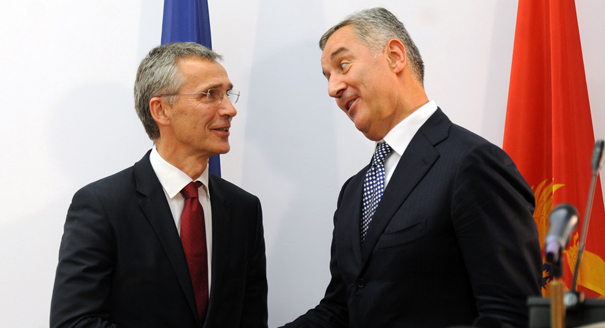
Montenegro’s veteran leader has maneuvered his country into NATO. Russia is upset, but unlikely to respond in a serious manner.
NATO is about to have a surprising new member, a country that had long counted as a Russian ally in the Balkans.
The imminent accession of Montenegro into NATO, after a long break when the alliance had not taken on new members, is causing anger in Moscow. But there is little chance that Russia will punish the Western Balkan country, despite its heavy Russian economic interests.
Perhaps the biggest surprise is the revelation that the NATO accession gambit was engineered by Montenegro’s longtime prime minister, Milo Đukanović. This is a man who twenty years ago condemned then president of Serbia Slobodan Milošević as a traitor of Serbian interests, chastising him for being “too soft” in negotiating the Dayton accords on Bosnia.
For its part, NATO is overlooking the fact that Montenegro is the only Central or East European country where there has been no transition of power since the collapse of Communism, and ignoring an arrest warrant against Đukanović issued by public prosecutors in Naples.
Instead, NATO is driven by concerns that the Balkans are falling into a new bout of instability, exacerbated by the Ukraine crisis. Western leaders decided they could not wait for a more decent generation of leaders to come to power in the Balkans and for old conflicts to be forgotten, and calculated that they had to step in to fill a growing security vacuum.
Đukanović himself saw this as a perfect opportunity to exploit Western anxieties about the Western Balkans and about Russia’s potential intervention in the region’s politics. Đukanović first made his move in early 2014, deciding that he would take the big risk of putting revenues from Russia in tourism, trade, and real estate investments—and basically relations with Russia in general—on the line in order to guide Montenegro towards NATO and the EU.
In March 2014, Montenegro broke ranks with its neighbors in former Yugoslavia and joined the EU sanctions regime against Russia. It then voted with the West and against Russia in the UN General Assembly resolution on Crimea. In April 2014, Đukanović visited Washington and told Vice President Joe Biden that NATO needed to expand further east in response to the Ukraine crisis.
This naturally jeopardized once-close relations with Russia. Đukanović turned down the invitation to attend the World War II Victory Day celebrations in Moscow in 2015. Montenegrin media outlets further soured the atmosphere with purported leaks from shady sources claiming that the Kremlin was demanding that Montenegro host a Russian naval base if Russia lost its foothold in Syria. The reports alleged that the Kremlin was promising billions if Montenegro agreed and, if it did not, threatening to send in “polite people” —the Russian term for armed men in unmarked military uniforms, who are also known as “little green men.”
Russia is fiercely opposed to NATO expansion. There have been condemnations and complaints and Foreign Minister Sergei Lavrov strongly criticized NATO’s decision. But we cannot expect much more than that. This is chiefly because the Kremlin gave up on the Balkans a long time ago, and cares even less now that it is not concentrating on energy projects in the region.
So, Russia did not take any practical steps to punish Montenegro, such as using economic pressure or interfering in domestic politics. Đukanović himself denounces any opposition rallies against him as Kremlin-sponsored provocations aimed at overthrowing Montenegro’s government and derailing its foreign policy course. This of course is far from being the case: Đukanović has been in power for twenty-five years and his own policies are the chief cause of opposition protests.
If it wanted to destabilize Montenegro, Russia would have plenty of levers of influence. Russians are still the most numerous foreign tourists in the country, accounting for over 20 percent of all tourists. The Kremlin could have abolished the visa-free regime with Montenegro, launched a negative media campaign, or even banned tourist travel to Montenegro out of patriotic considerations—just as it did recently with Turkey. But nothing of the sort happened, even though tourism brings in about 20 percent of Montenegro’s GDP.
Russia could also have retaliated in the sanctions war: Montenegro first introduced sanctions against Russia in March 2014. Yet Russia only expanded its own food counter-embargo to include Montenegro in August 2015, and also chose to exempt Montenegro’s main export to Russia, wine. Moreover, the free trade agreement between Russia and Montenegro remains in effect.
The Russian media has not been noticeably aggressive against Montenegro. There is no sign that Russians are selling off their real estate acquisitions in Montenegro. Separately, Montenegro is engaged in a long-running financial dispute with Russian oligarch Oleg Deripaska over the KAP Aluminum Plant in Podgorica, Montenegro’s largest industrial enterprise, but that began a long time ago and has nothing to do with recent political developments.
Of course the Montenegro-Russia relationship may still deteriorate after the country officially joins NATO. But it is highly unlikely that Russia will make any big steps in the Western Balkans. All of Russia’s major projects in the region have already run out of steam. Russia is divided from the region by a cordon of EU states, and this small, financially-strapped segment of Europe carries no economic interest for Russia. Furthermore, the local leaders, even in Serbia, do not want to jeopardize their relations with the West for Russia’s sake. Both sides have more important issues to focus on.
Fellow, Carnegie Russia Eurasia Center
Samorukov is a fellow at the Carnegie Russia Eurasia Center.
Recent Work
Maksim Samorukov
Maksim Samorukov
Carnegie does not take institutional positions on public policy issues; the views represented herein are those of the author(s) and do not necessarily reflect the views of Carnegie, its staff, or its trustees.

But their "principal to principal" model will only be as effective as the political strength of each leader back home.

Damien Ma

U.S. unpredictability has allowed China to capitalize on its positioning as the “responsible great power”. Paradoxically, the more China wins the perception game, the more likely expectations will rise for Beijing to deliver not just words but to demonstrate with its deeds.

Chong Ja Ian

Hanoi and Beijing have long treated each other as distant cousins rather than comrades in arms. That might be changing as both sides draw closer to hedge against uncertainty and America’s erratic behavior.

Nguyễn Khắc Giang

Across Asia, China is better positioned to withstand energy shocks from the fallout of the Iran war. Its abundant coal capacity can ensure stability in the near term. Yet at the same time, the country’s energy transition away from coal will make it even less vulnerable during the next shock.
Damien Ma

Malaysia’s chairmanship sought to fend off short-term challenges while laying the groundwork for minimizing ASEAN’s longer-term exposure to external stresses.

Elina Noor