

Q&A
- +1
Sheena Chestnut Greitens, Oriana Skylar Mastro, Yukon Huang, …
{
  "authors": [
    "Tong Zhao"
  ],
  "type": "legacyinthemedia",
  "centerAffiliationAll": "",
  "centers": [
    "Carnegie Endowment for International Peace",
    "Carnegie China"
  ],
  "collections": [],
  "englishNewsletterAll": "",
  "nonEnglishNewsletterAll": "",
  "primaryCenter": "Carnegie China",
  "programAffiliation": "",
  "programs": [],
  "projects": [],
  "regions": [
    "East Asia",
    "China"
  ],
  "topics": [
    "Arms Control",
    "Nuclear Policy"
  ]
}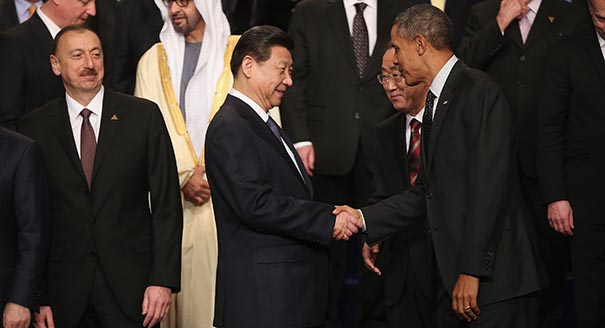
Source: Getty
Over the past few years, China has begun to make the threat of nuclear terrorism a higher priority on its national security agenda.
Source: Beijing Review
With President Xi Jinping planning to visit Washington, DC to attend the fourth, and almost certainly the last, Nuclear Security Summit, China's top leaders will have personally participated in each of the summits. The continuous high-level attention being paid by the Chinese government to a specific challenge faced by all members of the international community—nuclear terrorism—is unprecedented.
In his historic 2009 Prague speech, President Obama declared nuclear terrorism to be “the single most important threat” to U.S. national security. At that time, China seemed to have a different perception. Traditional Chinese thinking on security has long focused on managing geostrategic threats posed by states. Dealing with the possibility of non-state actors illegally obtaining nuclear and radioactive materials and using them to conduct nuclear or radiological terrorist attacks was not high on Chinese leaders’ priority list. However, the perception has changed over the past several years.
Against the background of a worldwide resurgence of Islamic extremism and terrorism, China is facing an increasing threat from international and domestic terrorism. Given the global nature of terrorism, weaknesses in nuclear security aboard could lead to nuclear or radioactive materials being stolen, shipped to, and used in a nuclear or radiological terrorist attack on Chinese territory. Moreover, China itself possesses a large number of radioactive sources for industrial and civilian purposes, the protection of which would be enhanced by learning international best practices. China also has the world’s most ambitious nuclear energy development program, which creates considerable challenges in building a fail-proof system to protect each and every nuclear facility at all stages of the fuel cycle to prevent any nuclear or radioactive materials from falling into the wrong hands. As a result, preventing nuclear terrorism and enhancing nuclear security is a key national security interest for China, and its importance continues to grow.Increased appreciation of the importance of nuclear security has led to China embrace new security measures and to adopt stricter regulations. The newly released white paper on nuclear emergence response sheds light on some recent efforts. Nonetheless, the difference in views between China and some Western countries about the best approach to addressing nuclear security challenges is holding them back from deeper cooperation. For instance, China has avoided measures that could draw excessive public attention to and highlighting existing nuclear security weaknesses, fearing that doing so would undermine security by revealing vulnerability and enlightening potential saboteurs.
Looking into the future, the fourth Nuclear Security Summit provides a rare opportunity for China and other key international players to formulate a common agenda for further cooperation. The conclusion of this summit will likely see a significantly increased role for international organizations in promoting nuclear security cooperation. This may help to reduce Beijing’s concern about Washington’s dominance in this arena and create the conditions for China to play a more proactive role internationally (Beijing’s foreign policy principles that have long advocated multilateralism and greater role for international organizations). To this end, China could work with others during the summit to strengthen the role of--and invest more resources in--the International Atomic Energy Agency, the United Nations, and Interpol, and make them fully capable of reinforcing international nuclear security standards and monitoring cross-border activities.
The summit is likely to raise awareness the security challenges posed by non-civilian nuclear materials – more than 80 percent of existing nuclear material stockpile in the world are used or reserved for military purposes. This is an area where China has a lot to contribute. China has completely stopped producing military fissile materials for nuclear weapons since the 1990s but has not received any political credit for doing so. An official acknowledgement of the fact – possibly included in its formal statement at the summit – would benefit China significantly by enhancing its reputation for showing transparency. A further announcement about the approximate size of China’s existing fissile material stockpile would also significantly boost its image as a responsible stakeholder committed to enhancing nuclear security through transparency and cooperation.
As cyber threat to civilian nuclear infrastructure increases, China could work with others to establish common understandings and norms that regulate behavior in this cross-cutting area. A code of conduct prohibiting cyber attacks against civilian nuclear facilities is absolutely necessary for addressing this new threat before it is too late and would also contribute to confidence-building. Beijing reached high-level common understanding with Washington in 2015 about the importance of establishing rule of the road in cyberspace including prohibiting cyber attack on critical infrastructure. Similar common understandings could certainly be broadened into an international norm that takes deliberate cyber attack on civilian nuclear facilities off the table.
China’s leadership role in promoting nuclear security could also be enhanced through engaging in deeper regional cooperation. In this regard, South Asia is a region that requires direct attention from Beijing. Both India and Pakistan possess large quantities of nuclear and radioactive materials and both of them face significant threats from non-state actors. As China’s immediate neighbor and a key player along the land and maritime economic silk roads of China’s Belt and Road initiative (an economic development strategy to increase economic ties and integration between China and a major part of the Eurasian region), South Asia is becoming increasingly connected with China, potentially facilitating cross-border nuclear terrorism. All three countries share a common interest in combatting nuclear terrorism and a direct dialogue among them would go a long way toward promoting effective cooperation and addressing local nuclear security threats.
Last but not least, China is increasingly capable of providing common goods in the field of nuclear security. It could undertake capacity-building cooperation with regional countries and other international players to train nuclear security personnel and to promote best practice. The U.S.-China Nuclear Security Center of Excellence in Beijing provides a place where such capacity building cooperation could take place. Joint research on nuclear forensics and radioactive detection technology is the type of technical cooperation that has the potential to contribute to trust-building at the political level. For China, the end of the upcoming Nuclear Security Summit should not be the end of China’s engagement with the world on nuclear security. To the contrary, it should lead to a new era in which China is in a better position and is more motivated to play a leadership role in addressing this common threat faced by all.
This article was originally published in the print edition of the Beijing Review Issue 12.

Senior Fellow with the Nuclear Policy Program and Carnegie China
Tong Zhao is a senior fellow with the Nuclear Policy Program and Carnegie China, Carnegie’s East Asia-based research center on contemporary China. Formerly based in Beijing, he now conducts research in Washington on strategic security issues.
Recent Work



Sheena Chestnut Greitens, Oriana Skylar Mastro, Yukon Huang, …
Carnegie does not take institutional positions on public policy issues; the views represented herein are those of the author(s) and do not necessarily reflect the views of Carnegie, its staff, or its trustees.

The Plaza Accord was not an externally imposed punishment of Japan but part of a broader restructuring that Japanese economists and policymakers themselves recognized was necessary. Its effects were undermined, however, when Tokyo responded to the resulting slowdown with policies that exacerbated investment, credit expansion, and the very imbalances the adjustment was intended to resolve.

Michael Pettis

The nuclear relationship between China and the United States is increasingly shaped by widening perception gaps rather than deliberate strategic design.
Tong Zhao
China’s banking crisis in the 2000s was resolved by transferring the costs to households through financial repression—a decision that recapitalized the banks while exacerbating the structural imbalances that continue to shape the Chinese economy today.
Michael Pettis

Chinese biotech companies have been on the receiving end of U.S. economic coercion. Yet their responses have differed significantly because firm and state interests are not uniformly aligned. For Washington, treating all Chinese tech firms the same, irrespective of their actual interests, risks pushing them farther into Beijing’s corner.

Xue Gong

China’s latest energy plan explicitly calls for integrating data centers into the electricity system, particularly connecting them to green energy. It appears Beijing wants to use compute as a source of domestic demand to absorb renewables excess capacity.

Damien Ma