

Commentary
Yezid Sayigh
{
  "authors": [
    "Yezid Sayigh"
  ],
  "type": "legacyinthemedia",
  "centerAffiliationAll": "dc",
  "centers": [
    "Carnegie Endowment for International Peace",
    "Malcolm H. Kerr Carnegie Middle East Center"
  ],
  "collections": [],
  "englishNewsletterAll": "menaTransitions",
  "nonEnglishNewsletterAll": "",
  "primaryCenter": "Malcolm H. Kerr Carnegie Middle East Center",
  "programAffiliation": "MEP",
  "programs": [
    "Middle East"
  ],
  "projects": [],
  "regions": [
    "Egypt",
    "Gulf",
    "Levant",
    "Maghreb",
    "Middle East",
    "North Africa"
  ],
  "topics": [
    "Political Reform",
    "Security"
  ]
}
Source: Getty
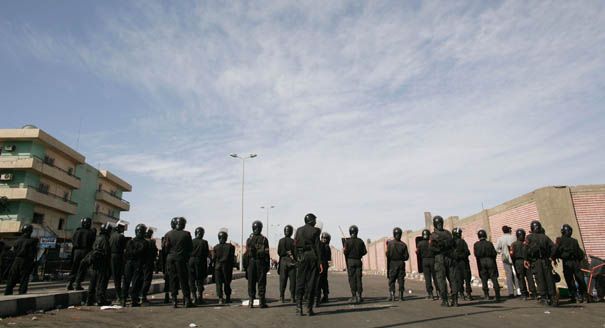
Security-sector reform in the Arab World cannot happen in isolation from the wider process of democratic transition and national reconciliation.
Source: Project Syndicate
Experience across the Arab world demonstrates that when it comes to security-sector reform, technocratic approaches are inadequate. Simply put, a technocratic focus on upgrading skills and operational capability, in the absence of improved governance of the security services, can be easily subverted by anti-reform coalitions, resulting in the continuation of regressive patterns of behavior.
This is especially true in polarized political and social environments – the most obvious cases today being Egypt, Iraq, Libya, and Yemen, not to mention Bahrain and Syria. But even in countries where there is some degree of political pluralism and an absence of civil strife or domestic armed conflict – such as Lebanon and Tunisia, and potentially the Palestinian Authority and Algeria – incremental approaches can achieve only partial success. Creating a fully modernized and accountable security service requires more than technocratic tinkering.
Regardless of formal legal frameworks, barriers to effective audits prevent the monitoring of financial flows to and within the police and internal security agencies. Moreover, such institutions are often able to absorb formal anti-corruption training and yet continue with business as usual. For effective security-sector reform in the Arab world to occur, the shroud of secrecy surrounding the sector must be removed. But among the Arab states, only Yemen drafted a Freedom of Information law after 2011. Conversely, several state institutions blocked a proposal by Egypt’s Central Auditing Agency for legislation stipulating citizens’ right to access information regarding corruption in any governmental agency.The problem, as Egyptian researcher Dina El-Khawaga has argued, is that it may be impossible “to introduce reform on a structurally corrupt basis.” What is needed is broad and effective oversight of public procurement, fuller transparency regarding budgets and routines, and substantially upgraded, multi-agency monitoring of national borders to dismantle illicit networks involving the security sector. Arab states like Jordan have shown that reducing corruption in the security sector enables significant improvements, even in a challenging environment comprising long borders, extensive black market trade fed by wars in neighboring states, and large refugee populations.
Effective governance of the security sector requires sustained political will at the top of the government, particularly a readiness to push reforms to sectors of the government and economy with which the security sector interacts. But change of this order of magnitude is highly contentious, and its path and outcome cannot be easily predicted or steered, no matter how determined the governmental leadership is.
There is a grim paradox at work here. The move toward more pluralist politics in Arab states has unleashed deep social divides over the nature and purpose of policing – divides that invariably complicate the reform process. For example, some demand that the security services should enforce religious values.
The specific dynamics of security-sector reform varies among states, depending on past modes of policing and the circumstances in which the authorities are challenged and forced to change existing structures. But, in most cases, people either look to the state and its officially mandated agencies to resolve problems and provide basic law enforcement, or would prefer to do so rather than resort – or just as often submit – to alternative, non-state providers. As a result, governments can claim a powerful legitimacy in embarking on reform efforts.
Despite support for the state as the ultimate arbiter of law, increasing social polarization in many Arab states over the last two decades has impeded consensus on how to restructure and reform policing. Marginalization of up to 40% of the population, who live at or below the poverty line, has fueled political challenges, in turn subjecting entire social segments to targeting by official security bodies.
Furthermore, the determination to crush dissent affects the urban middle classes, which might otherwise be the strongest proponents of security-sector reform in this area. Both Egypt and Syria are prime examples of this. The sectarian nature of Iraq’s security sector and partisan polarization in the Palestinian Authority imply similar risks.
Severe political and constitutional breakdown, as well as extensive social and institutional fragmentation, also hampers – or, in cases like Libya or Yemen, blocks – reform. Even Egypt, with its highly centralized and bureaucratized state, has devolved certain policing and security functions in marginalized urban communities or rural areas to baltagiyyeh (thugs) and to former henchmen of the ruling party, village headmen, and clan elders.
Clearly, formalizing policing and adjudication on the basis of clan, sectarian, or ethnic identity –as has happened with the revolutionary militias of Libya, the Shia Hashd militias in Iraq, or sectarian party militias in Lebanon – can be highly damaging. But the past emphasis on centrally managed security sectors has made them a crucial asset in political contests, enabling them to escape oversight and benefit from de facto legal impunity. So a better balance is needed to mitigate the concerns of diverse social and political actors whose participation is needed to renew constitutional frameworks, strengthen the rule of law, and revive national identity and state institutions in a context of democratic transition.
The bottom line is that security-sector reform cannot be undertaken in isolation from the wider process of democratic transition and national reconciliation. Today’s Arab states in transition are discovering how difficult it is to replace deep-seated authoritarian practices and relationships with sustained democratization, a process that depends crucially on transforming their security sectors. The added focus on counter-terrorism is further impeding reform, though the failure of unreformed security sectors to fulfill this role effectively, such as in Egypt and Tunisia, should cause it to have the opposite effect.
Those who advocate both democracy and security-sector reform must show consistent unity of purpose, build societal consensus and political coalitions for their programs, and formulate coherent, sustainable policies. Only then might the political, economic, and social roadblocks to creating modern, accountable security services be overcome.

Senior Fellow, Malcolm H. Kerr Carnegie Middle East Center
Yezid Sayigh is a senior fellow at the Malcolm H. Kerr Carnegie Middle East Center in Beirut, where he leads the program on Civil-Military Relations in Arab States (CMRAS). His work focuses on the comparative political and economic roles of Arab armed forces, the impact of war on states and societies, the politics of postconflict reconstruction and security sector transformation in Arab transitions, and authoritarian resurgence.
Recent Work
Yezid Sayigh
Yezid Sayigh
Carnegie does not take institutional positions on public policy issues; the views represented herein are those of the author(s) and do not necessarily reflect the views of Carnegie, its staff, or its trustees.

The Thai-Cambodian conflict highlights the limits to China's peacemaker ambition and the significance of this role on Southeast Asia’s balance of power.

Pongphisoot (Paul) Busbarat

Beijing believes that Washington is overestimating its own leverage and its ability to handle the trade war’s impacts.


Rick Waters, Sheena Chestnut Greitens
Tapping our network of China experts in the region, Carnegie China offers this latest “China Through a Southeast Asian Lens” report to offer preliminary assessments of whether the U.S. effort to reshape the global trading order will lead countries in the region to tilt toward Beijing.



Selina Ho, Khin Khin Kyaw Kyee, Joseph Ching Velasco, …
Because strategic, economic, and ideological perceptions of China contain multiple, sometimes contradictory facets in Southeast Asia, receptions of and responses to Beijing diverge across and within state lines.



Evan A. Feigenbaum, Chong Ja Ian, Elina Noor

Most Southeast Asian states behave as if the actions of their Northeast Asian neighbors and the Philippines will be sufficient to maintain a regional status quo from which they can benefit.
Chong Ja Ian