

Commentary
Aron Lund
{
  "authors": [
    "Aron Lund"
  ],
  "type": "legacyinthemedia",
  "centerAffiliationAll": "dc",
  "centers": [
    "Carnegie Endowment for International Peace",
    "Malcolm H. Kerr Carnegie Middle East Center"
  ],
  "collections": [
    "Arab Awakening"
  ],
  "englishNewsletterAll": "menaTransitions",
  "nonEnglishNewsletterAll": "",
  "primaryCenter": "Carnegie Endowment for International Peace",
  "programAffiliation": "MEP",
  "programs": [
    "Middle East"
  ],
  "projects": [],
  "regions": [
    "Middle East",
    "Iraq",
    "Syria"
  ],
  "topics": [
    "Political Reform",
    "Security",
    "Military",
    "Foreign Policy"
  ]
}
Source: Getty
A recent crackdown on demonstrators in rebel-held Idlib is testing the alliance between two of the Syrian insurgency’s most powerful factions.
Source: Syria Deeply
The U.S.-Russian brokered truce remains deeply controversial among rebels. Hardline jihadis have condemned the peace process, while more pragmatic Islamists have endorsed it. Now, a jihadi crackdown on demonstrators in rebel-held Idlib is testing the alliance between two of the insurgency’s most powerful factions.
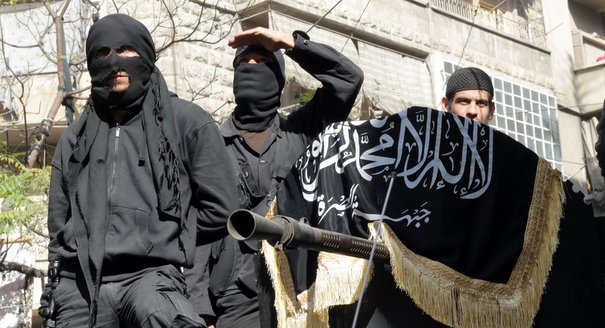
For Syria’s rebel movement, relations between its two most powerful Islamist factions is a life or death issue. Two large salafist factions, the Nusra Front and Ahrar al-Sham, dominate the insurgency in the Idlib region, and they play a key part in the Hama and Aleppo governorates as well. While these groups are close allies on the battlefield and have often worked hand in hand politically, there are important distinctions between them. The terrorist-listed Nusra Front is outspokenly salafi-jihadi, many of its leaders are foreigners, and the group has pledged allegiance to the international al-Qaida movement. While equally committed to establishing Syria as a Sunni theocracy, Ahrar al-Sham is an indigenously Syrian group, renounces foreign attacks, and courts international support. It is particularly close to Turkey and Qatar.The Russian-American agreement brokered on February 22, which led to a partial cessation of hostilities in Syria that began on February 27, has tested their alliance and brought previously latent conflicts of interest to the fore. The Nusra Front is explicitly opposed to the deal, indeed to the political process as a whole, describing it as a “crusader” scheme to extinguish the Syrian uprising. The group has called for continued attacks on the government of President Bashar al-Assad, although it has in practice exercised restraint since February 27, probably for fear of alienating Syrian civilians or drawing the ire of local allies such as Ahrar al-Sham. Nusra fighters describe this as a waiting game, telling a Reuters correspondent that they are “convinced that it will not work and it is only a matter of time before it officially ends.” Recently, some reports point to increased Nusra activity south of Aleppo, but it is difficult to know what side actually initiates fighting – the Assad government and its Russian allies have not fully ceased their skirmishing with the rebels either...
Former Nonresident Fellow, Middle East Program
Aron Lund was a nonresident fellow in the Middle East Program and the author of several reports and books on the Syrian opposition movement.
Recent Work
Aron Lund
Aron Lund
Carnegie does not take institutional positions on public policy issues; the views represented herein are those of the author(s) and do not necessarily reflect the views of Carnegie, its staff, or its trustees.

But their "principal to principal" model will only be as effective as the political strength of each leader back home.

Damien Ma

U.S. unpredictability has allowed China to capitalize on its positioning as the “responsible great power”. Paradoxically, the more China wins the perception game, the more likely expectations will rise for Beijing to deliver not just words but to demonstrate with its deeds.

Chong Ja Ian

Hanoi and Beijing have long treated each other as distant cousins rather than comrades in arms. That might be changing as both sides draw closer to hedge against uncertainty and America’s erratic behavior.

Nguyễn Khắc Giang

Across Asia, China is better positioned to withstand energy shocks from the fallout of the Iran war. Its abundant coal capacity can ensure stability in the near term. Yet at the same time, the country’s energy transition away from coal will make it even less vulnerable during the next shock.
Damien Ma

Malaysia’s chairmanship sought to fend off short-term challenges while laying the groundwork for minimizing ASEAN’s longer-term exposure to external stresses.

Elina Noor