

Commentary
But their "principal to principal" model will only be as effective as the political strength of each leader back home.
Damien Ma
{
  "authors": [
    "Richard Sokolsky",
    "Gordon Adams"
  ],
  "type": "legacyinthemedia",
  "centerAffiliationAll": "",
  "centers": [
    "Carnegie Endowment for International Peace"
  ],
  "collections": [],
  "englishNewsletterAll": "",
  "nonEnglishNewsletterAll": "",
  "primaryCenter": "Carnegie Endowment for International Peace",
  "programAffiliation": "",
  "programs": [],
  "projects": [],
  "regions": [
    "North America",
    "United States"
  ],
  "topics": [
    "Security",
    "Military",
    "Foreign Policy",
    "Nuclear Policy",
    "Arms Control"
  ]
}
Source: Getty
Creating a separate fund to protect service budgets from the costs of modernizing strategic nuclear weapons not only cheats the American taxpayer but also fuels an unnecessarily large arsenal stuffed with weapons the United States does not need to remain safe.
Source: Defense One
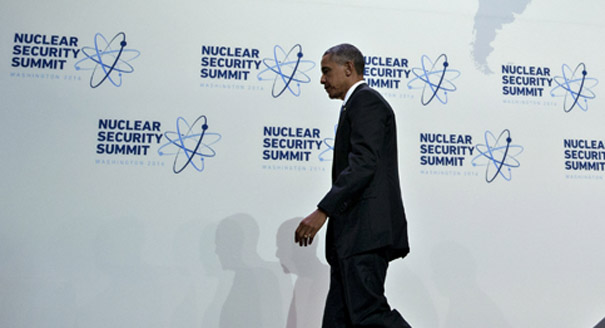
The recent Nuclear Security Summit was certainly the last act for an administration that appears to have run out of gas on what could—and should—have been a signature presidential initiative. Since 2010, President Barack Obama’s administration has been treading water in advancing the president’s goal of seeking the peace and security of a world (outside of Iran) without nuclear weapons. That was the year the last U.S. Nuclear Posture Review was done and the year Washington and Moscow agreed to very modest nuclear arsenal reductions in the New START Treaty. As a parting gift to the next administration, the Defense Department is considering funding a nuclear force for the future that, if carried out by Obama’s successor, would be both fiscally wasteful and strategically unnecessary.
The military services think they have a dilemma. A tidal wave of costly strategic nuclear modernization programs are bearing down on the defense budget over the next couple of decades, just when the services and members of Congress are anxious to take advantage of a now-rising defense budget to buy additional conventional (or, non-nuclear) military hardware. Maintaining and modernizing the U.S. nuclear arsenal over the next 30 years, according to the Center for Non-Proliferation Studies will cost nearly $1 trillion, a number supported by a 2015 study from the Center for Strategic and Budgetary Assessments. The cost could come to more than $350 billion in the next 15 years, according to the Congressional Budget Office.At the core of this nuclear modernization goal lie four expensive programs: a new nuclear-tipped cruise missile ($25 billion); a land-based missile to succeed the current Minuteman ($62 billion); 80 to 100 new B-21 bombers ($100 billion); and 12 new ballistic missile submarines ($139 billion). Not surprisingly, the Navy and Air Force would prefer to pay for nuclear modernization through an increase in their budgets rather than to cut funding for conventional hardware programs. Voilà! The Navy’s proposed National Sea-Based Deterrence Fund, or NSBDF, leaps into existence to solve this problem. The idea is to move the money out from the service budgets and into a different, and arguably more protected, account. The services already did this with missile defense, off-loading more than $200 billion since President Reagan first proposed it in 1983, by creating a new office and budget line under the secretary of defense. Although Pentagon Comptroller Michael McCord is “skeptical” about creating a new fund that implied new money, congressional authorizers wrote the separate Navy fund into the fiscal 2016 defense authorization act. (Appropriators failed to provide any separate resources for the fund.) Once the Navy fund had been put on the table, the Air Force was not far behind in asking that it, too, be included.
When pressed by interested members of Congress, the Pentagon’s senior leaders crumpled like a cheap suit. Defense Secretary Ash Carter has set a new tone, saying at a congressional hearing last month that, “a broader nuclear deterrent fund may be appropriate.” Carter’s willingness to overturn McCord and entertain a bad budgetary and planning idea reflects a growing perception in the Pentagon that Congress is now willing to increase defense spending above caps set five years ago by growing the regular defense budget rather than rely on increases in the off-books “war budget” known as the Overseas Contingency Operations, or OCO, account.
In the Pentagon’s logic, funding from training troops, mission readiness, or the other major conventional weapons programs cannot be cut to accommodate the absolutely necessary fiscal requirement for strategic force modernization. And since our strategic nuclear forces protect the entire nation, funds for nuclear modernization should be simply added to the budget, without cutting anything.
This is bad budgeting and bad planning. It would further erode any remaining budgetary discipline at DOD (where does the precedent of setting aside special funding stop?). And instead of using budget constraints to encourage the Pentagon to set priorities and make choices, it sends an all-too-common message to the services to simply request more. Nothing could do a greater disservice to U.S. national security than to allow such a profligate spending message to be sent to the Defense Department.
The Pentagon’s budgetary gimmick would not be necessary if the next administration can finally come to grips with how many and what type of strategic nuclear weapons and delivery systems are necessary to defend the nation. Despite the Obama administration’s conclusion that our security can be ensured with a strategic nuclear force only two-thirds the size permitted under New START, our nuclear force planning remains stuck in a Cold-War time warp, still inflating the number of warheads and platforms deemed necessary both to deter an enemy nuclear attack on the United States or its allies and to fight and win a nuclear war should deterrence fail.
Today, the United States has the capability, using just submarines, to conduct a range of large-scale and limited nuclear attacks. In addition to their operational flexibility, the SSBNs are a highly survivable nuclear platform. The odds that any enemy could achieve a catastrophic breakthrough in anti-submarine warfare capabilities or that the United States would suffer a catastrophic failure in the warheads used on the Trident’s missiles are close to zero. A small strategic bomber force based on the current aircraft (B-52, B-1, and B-2) and nuclear bombs could provide added insurance.
Creating a separate fund to protect service budgets from the costs of modernizing strategic nuclear weapons not only cheats the American taxpayer but also fuels an unnecessarily large arsenal stuffed with weapons America does not need to remain safe. Rather than make tough programmatic and budget choices on the size and structure of America’s strategic nuclear forces, Congress and now the Obama administration have opened up an irresponsible and unsustainable path for strategic force modernization that only kicks the can down the road.

Nonresident Senior Fellow, Russia and Eurasia Program
Richard Sokolsky is a nonresident senior fellow in Carnegie’s Russia and Eurasia Program. His work focuses on U.S. policy toward Russia in the wake of the Ukraine crisis.
Gordon Adams
Carnegie does not take institutional positions on public policy issues; the views represented herein are those of the author(s) and do not necessarily reflect the views of Carnegie, its staff, or its trustees.

But their "principal to principal" model will only be as effective as the political strength of each leader back home.

Damien Ma

U.S. unpredictability has allowed China to capitalize on its positioning as the “responsible great power”. Paradoxically, the more China wins the perception game, the more likely expectations will rise for Beijing to deliver not just words but to demonstrate with its deeds.

Chong Ja Ian

Hanoi and Beijing have long treated each other as distant cousins rather than comrades in arms. That might be changing as both sides draw closer to hedge against uncertainty and America’s erratic behavior.

Nguyễn Khắc Giang

Across Asia, China is better positioned to withstand energy shocks from the fallout of the Iran war. Its abundant coal capacity can ensure stability in the near term. Yet at the same time, the country’s energy transition away from coal will make it even less vulnerable during the next shock.
Damien Ma

Malaysia’s chairmanship sought to fend off short-term challenges while laying the groundwork for minimizing ASEAN’s longer-term exposure to external stresses.

Elina Noor