

Commentary
- +1
Paul Haenle, Xue Gong, Ngeow Chow Bing, …
{
  "authors": [
    "Paul Haenle"
  ],
  "type": "legacyinthemedia",
  "centerAffiliationAll": "",
  "centers": [
    "Carnegie Endowment for International Peace",
    "Carnegie China"
  ],
  "collections": [
    "U.S.-China Relations",
    "China’s Foreign Relations"
  ],
  "englishNewsletterAll": "",
  "nonEnglishNewsletterAll": "",
  "primaryCenter": "Carnegie China",
  "programAffiliation": "",
  "programs": [],
  "projects": [],
  "regions": [
    "North America",
    "United States",
    "East Asia",
    "China"
  ],
  "topics": [
    "Economy"
  ]
}
Source: Getty
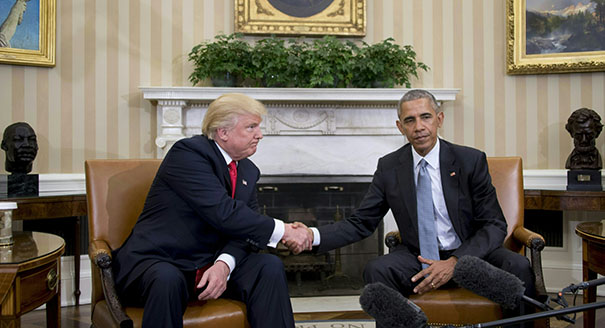
China supports Trump’s electoral win, but the political rhetoric surrounding tariffs on Chinese imports will not serve either countries’ interests if enacted.
Source: China Daily
China Daily: The American Chamber of Commerce in China held a seminar on "The Next U.S. President and Beyond" in Beijing. The following is an excerpt of the speech made by Paul Haenle.
Paul Haenle: Many Chinese scholars have come to the conclusion that Donald Trump is better for China (than Hillary Clinton). They like Trump because he talks about the United States growing inward instead of continuing its leadership role in the world. When he says the United States has exceeded its reach in the Middle East and that he will not pay much attention to Asia, it sounds good to the Chinese.
In reality, however, we have very little understanding of what Trump's China policy will look like. During the presidential campaign, he used very general and broad political rhetoric to appeal to the voters. This rhetoric worked. It got him elected. But now, he has to select his cabinet and key advisors, and devise comprehensive policies on key areas. Until that has been completed, there will be a lot of uncertainty about future China-U.S. ties.
No one likes uncertainty, and even though many Chinese like Trump because he has indicated the United States could pull back from Asia, the Chinese leadership doesn't like surprises. Trump's threat to impose a 45 percent tariff on imports from China would also threaten the interests of U.S. exporters that need access to foreign markets, as well as U.S. businesses that rely on commodities or products made overseas.
Other countries could retaliate in ways that are damaging to U.S. interests. This kind of rhetoric might make voters feel better during the campaign, but my own view is that such an approach will not work in practical terms. Imposing such a large tariff could actually hurt Americans as much (if not more) as China and would in that sense likely be a case of cutting our nose off to spite our face.
I do expect a tougher posture by the incoming Trump administration on issues related to international trade and commerce, including a major push for reciprocity in bilateral economic relations. But only time will tell how specifically this will be implemented.
This piece was republished with permission from China Daily.

Former Maurice R. Greenberg Director’s Chair, Carnegie China
Paul Haenle held the Maurice R. Greenberg Director’s Chair at the Carnegie Endowment for International Peace and is a visiting senior research fellow at the East Asian Institute, National University of Singapore. He served as the White House China director on the National Security Council staffs of former presidents George W. Bush and Barack Obama.
Recent Work


Paul Haenle, Xue Gong, Ngeow Chow Bing, …

Paul Haenle, Chong Ja Ian
Carnegie does not take institutional positions on public policy issues; the views represented herein are those of the author(s) and do not necessarily reflect the views of Carnegie, its staff, or its trustees.

The Plaza Accord was not an externally imposed punishment of Japan but part of a broader restructuring that Japanese economists and policymakers themselves recognized was necessary. Its effects were undermined, however, when Tokyo responded to the resulting slowdown with policies that exacerbated investment, credit expansion, and the very imbalances the adjustment was intended to resolve.

Michael Pettis

The nuclear relationship between China and the United States is increasingly shaped by widening perception gaps rather than deliberate strategic design.

Tong Zhao
China’s banking crisis in the 2000s was resolved by transferring the costs to households through financial repression—a decision that recapitalized the banks while exacerbating the structural imbalances that continue to shape the Chinese economy today.
Michael Pettis

Chinese biotech companies have been on the receiving end of U.S. economic coercion. Yet their responses have differed significantly because firm and state interests are not uniformly aligned. For Washington, treating all Chinese tech firms the same, irrespective of their actual interests, risks pushing them farther into Beijing’s corner.
Xue Gong

China’s latest energy plan explicitly calls for integrating data centers into the electricity system, particularly connecting them to green energy. It appears Beijing wants to use compute as a source of domestic demand to absorb renewables excess capacity.

Damien Ma