

Paper
Ashley J. Tellis
{
  "authors": [
    "Ashley J. Tellis"
  ],
  "type": "legacyinthemedia",
  "centerAffiliationAll": "dc",
  "centers": [
    "Carnegie Endowment for International Peace"
  ],
  "collections": [],
  "englishNewsletterAll": "ctw",
  "nonEnglishNewsletterAll": "",
  "primaryCenter": "Carnegie Endowment for International Peace",
  "programAffiliation": "SAP",
  "programs": [
    "South Asia"
  ],
  "projects": [],
  "regions": [
    "North America",
    "United States",
    "South Asia",
    "India",
    "Pakistan",
    "East Asia",
    "China"
  ],
  "topics": [
    "Foreign Policy"
  ]
}
Source: Getty
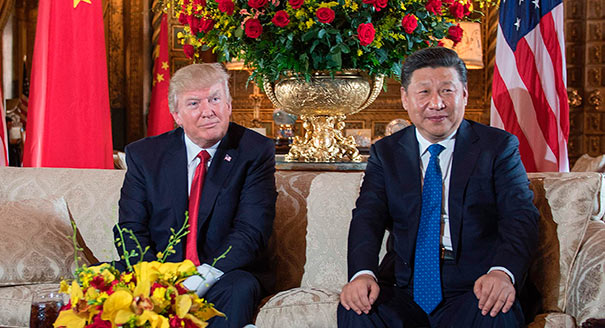
President Trump and Xi Jinping must focus on building personal chemistry and having an honest discussion of their world views.
Source: CGTN
Speaking on CGTN’s The Point, moderated by Liu Xin, Carnegie’s Ashley Tellis argued that during Xi Jinping’s visit with Donald Trump, the two leaders should focus on building personal chemistry and a general understanding of their worldviews.
He went on to discuss how an improving relationship between the United States and China can bring stability to the region, which could benefit countries like India. Right now, countries feel torn between the two nations, but there are opportunities to be gained from maintaining an economic relationship with both.
That being said, Tellis continued, Trump’s “America First,” strategy could cause challenges for many in the region, especially in terms of bilateral economic relations, as the United States may begin requiring more reciprocity. But on average, he said, India will likely gain from “America First,” because there is a general consensus that maintaining a good relationship with India is essential for maintaining balance in Asia.
Tellis concluded by arguing that China is likely perceived as a greater threat in India than it actually is, and that all countries must be open about their plans and actions to build trust in the region.
Former Senior Fellow
Ashley J. Tellis was a senior fellow at the Carnegie Endowment for International Peace.
Recent Work
Ashley J. Tellis
Ashley J. Tellis
Carnegie does not take institutional positions on public policy issues; the views represented herein are those of the author(s) and do not necessarily reflect the views of Carnegie, its staff, or its trustees.

China’s political future will be shaped between now and next October. As the Communist Party enters its intense “campaign season” to prepare for a major political transition in 2027, reading Beijing's actions and responses may become more difficult as domestic politics weigh on its behavior more than usual.

Damien Ma

China has showcased its engineering prowess with small modular reactor demonstration projects. But turning these technological achievements into commercial success will be a greater challenge.

Tong Zhao

The Plaza Accord was not an externally imposed punishment of Japan but part of a broader restructuring that Japanese economists and policymakers themselves recognized was necessary. Its effects were undermined, however, when Tokyo responded to the resulting slowdown with policies that exacerbated investment, credit expansion, and the very imbalances the adjustment was intended to resolve.

Michael Pettis

The nuclear relationship between China and the United States is increasingly shaped by widening perception gaps rather than deliberate strategic design.
Tong Zhao
China’s banking crisis in the 2000s was resolved by transferring the costs to households through financial repression—a decision that recapitalized the banks while exacerbating the structural imbalances that continue to shape the Chinese economy today.
Michael Pettis