

Article
C. Raja Mohan, Darshana M. Baruah
{
  "authors": [
    "C. Raja Mohan"
  ],
  "type": "legacyinthemedia",
  "centerAffiliationAll": "dc",
  "centers": [
    "Carnegie Endowment for International Peace",
    "Carnegie India"
  ],
  "collections": [],
  "englishNewsletterAll": "ctw",
  "nonEnglishNewsletterAll": "",
  "primaryCenter": "Carnegie India",
  "programAffiliation": "SAP",
  "programs": [
    "South Asia"
  ],
  "projects": [],
  "regions": [
    "Asia",
    "South Asia",
    "India",
    "East Asia",
    "China"
  ],
  "topics": [
    "Foreign Policy"
  ]
}
Source: Getty
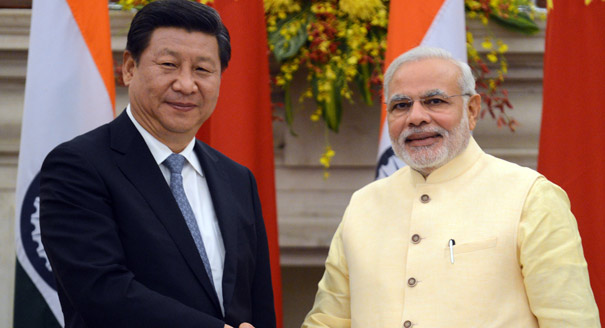
Indian and China would both benefit from regional connectivity. But New Delhi should debate the terms of each project, rather than saying “Yes” or “No” to the Belt and Road Initiative as a whole.
Source: Indian Express
Official India has turned its back on China’s celebration of President Xi Jinping’s “Belt and Road Initiative” (BRI) this week in Beijing. Some in Beijing and Delhi have warned India against isolating itself amidst the apparently growing international support for the ambitious project. Others have suggested diplomatic solutions to overcome India’s objections.
One of Delhi’s problems is that the China-Pakistan Economic Corridor (CPEC), an important part of the BRI, runs through a part of Jammu and Kashmir that is occupied by Islamabad. Solutions suggested to overcome this problem focus on language — why not have Beijing say the CPEC is not part of the BRI, or change the name of CPEC to CSEC (China South Asian Economic Corridor)? None of this has moved Delhi at the time of writing this column, for the problem may not be with language.
India’s difficulty lies deeper. It is about the prospect that the BRI will massively strengthen China’s commercial, economic, political and security influence on India’s neighbourhood and marginalise Delhi’s regional primacy. The BRI is not just about connecting the Eurasian landmass and the Indo-Pacific maritime domain through an overland “belt” and a maritime silk “road”. It involves the export of Chinese capital, labour, technology, industrial standards, commercial benchmarks, the use of the Yuan, the development of new ports, industrial hubs, special economic zones and military facilities, under Beijing’s auspices.
While the BRI is breathtaking in scope, it is not unprecedented. This is what the British Raj did through the 19th century — opening markets, building new trade routes, projecting power from the Suez to Shanghai, setting up alliances and protectorates that turned the Indo-Pacific into an expansive sphere of influence, controlled from Calcutta.
The scale of the Chinese project is, of course, much bigger, thanks to the massive economic resources and national ambition that Beijing can mobilise. Unlike the Raj, whose main focus was maritime, and barely nibbled at the inner regions of Asia, China is set to become the first non-Western power in the modern era to shape the geopolitics of Eurasia and the Indo-Pacific. While most nations are ready to accept this, grudgingly or otherwise, two of China’s neighbours — Japan and India — are reluctant.
Japan has, until recently, been the number one power in Asia. It is not yet ready to roll over and play dead. It has already outlined a Belt and Road initiative of its own, called the Partnership for Quality Infrastructure. While its propaganda might not be as effective as China’s, Japan has put up nearly $150 billion to support infrastructure projects all across the Indo-Pacific and Eurasia.
Delhi, that has long seen itself as equal to Beijing, finds it hard to play second fiddle. It has just about woken up to the long-term consequences of the BRI, marked by ever-deepening interdependence between China and India’s neighbours. Neither India’s strong objections, nor its weak political endorsement of the BRI will have any impact on its evolution; there is an air of inevitability to the BRI.
Coping with China’s transformation of India’s neighbourhood is likely to be Delhi’s single most important strategic challenge in the decades to come.
Whether India joins this week’s party in Beijing is utterly inconsequential in addressing this larger challenge. India’s long-term response to the BRI must instead focus on three areas: The first is to ramp up its own internal connectivity. China’s BRI, for example, did not start out as an external initiative. It was built on top of the internal “Go West” strategy that focused, over the last two decades, on unifying China’s domestic market and connecting its developed east coast with the interior provinces. India’s discourse on the BRI has no real meaning until Delhi improves internal connectivity to its frontier regions and upgrades rusting border infrastructure.
Second, Delhi should modernise connectivity across its land and maritime frontiers with its neighbouring countries. China is certainly not responsible for India neglecting its inherited trans-border connectivities since Independence; nor has Beijing stopped India from building road and rail links to its borders. Third, India can work with nations like Japan and multilateral institutions in developing regional connectivity in the Subcontinent and beyond.
The government of Narendra Modi has certainly begun to act on all three fronts. But the gap, between the scale of the Chinese challenge, and the intensity of the Indian effort continues to grow, thanks to enduring institutional weaknesses at home and political difficulties with the neighbours. As India begins to narrow the gap through purposeful action, its ability to engage China on the BRI will improve.
To be sure, Delhi has a common long-term interest with Beijing, in promoting regional connectivity. Delhi must, however, focus on debating the specific terms of individual projects rather than having to say “Yes” or “No” to the BRI as a whole. For now, though, Delhi’s urgent imperative is to recognise that China’s BRI is not a diplomatic problem for the foreign office to resolve. It is about mobilising the full resources of the Indian state and creating effective mechanisms — public and private — to purposefully address the long-term opportunities and challenges that China’s BRI presents.
This article was originally published in the Indian Express.
Former Nonresident Senior Fellow, Carnegie India
A leading analyst of India’s foreign policy, Mohan is also an expert on South Asian security, great-power relations in Asia, and arms control.
Recent Work

C. Raja Mohan, Darshana M. Baruah


Alexander Gabuev, Paul Haenle, C. Raja Mohan, …
Carnegie does not take institutional positions on public policy issues; the views represented herein are those of the author(s) and do not necessarily reflect the views of Carnegie, its staff, or its trustees.

China’s banking crisis in the 2000s was resolved by transferring the costs to households through financial repression—a decision that recapitalized the banks while exacerbating the structural imbalances that continue to shape the Chinese economy today.

Michael Pettis

Chinese biotech companies have been on the receiving end of U.S. economic coercion. Yet their responses have differed significantly because firm and state interests are not uniformly aligned. For Washington, treating all Chinese tech firms the same, irrespective of their actual interests, risks pushing them farther into Beijing’s corner.

Xue Gong
China’s latest energy plan explicitly calls for integrating data centers into the electricity system, particularly connecting them to green energy. It appears Beijing wants to use compute as a source of domestic demand to absorb renewables excess capacity.

Damien Ma

But their "principal to principal" model will only be as effective as the political strength of each leader back home.
Damien Ma

U.S. unpredictability has allowed China to capitalize on its positioning as the “responsible great power”. Paradoxically, the more China wins the perception game, the more likely expectations will rise for Beijing to deliver not just words but to demonstrate with its deeds.

Chong Ja Ian