

Article
Deborah Gordon, Smriti Kumble, David Livingston
{
  "authors": [
    "David Livingston"
  ],
  "type": "legacyinthemedia",
  "centerAffiliationAll": "dc",
  "centers": [
    "Carnegie Endowment for International Peace"
  ],
  "collections": [],
  "englishNewsletterAll": "ctw",
  "nonEnglishNewsletterAll": "",
  "primaryCenter": "Carnegie Endowment for International Peace",
  "programAffiliation": "SCP",
  "programs": [
    "Sustainability, Climate, and Geopolitics"
  ],
  "projects": [
    "Carnegie Oil Initiative"
  ],
  "regions": [
    "North America",
    "United States",
    "East Asia",
    "China"
  ],
  "topics": [
    "Climate Change"
  ]
}
Source: Getty
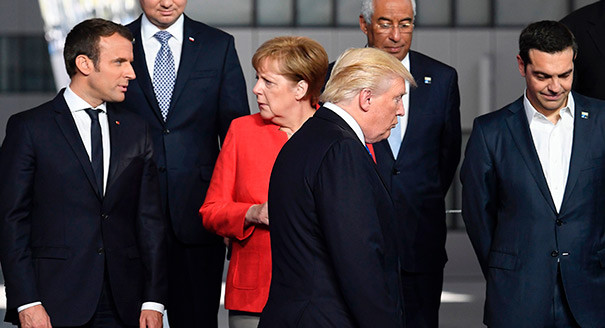
With U.S. climate leadership lagging, the G-7 is finding ways to move forward in spite of U.S. reluctance while China looms as the new international climate powerhouse.
Source: CGTN America
Carnegie’s David Livingston joined CGTN’s Rachelle Akuffo to discuss the outcomes of the G-7 environment meeting focusing on the new role being played by the United States under a Trump administration. Livingston noted that the U.S. decision to not engage on climate may have backfired.
“It should be noted that the U.S. probably hoped to really hold things up by refusing to make progress on climate in this round of G-7 environment ministers talks, but it was reduced to simply . . . being a footnote at the bottom of the leaders declaration.”
Livingston pointed out that while the G-7 talks did yield needed progress on “greening of the global financial system,” that the United States and EU lag considerably behind China on these efforts. In fact, with U.S. leadership lagging on climate, Livingston says that China’s role as a leader on climate “is probably the great story of the next few decades.”
Referring to the U.S. withdrawal from the Paris Climate Accord as essentially an “own goal,” Livingston points out that “China’s President, Xi Jinping met not with the energy secretary of the United States, but with California Governor Jerry Brown,” as China prepares for new ways to engage the world on climate.
Former Associate Fellow, Energy and Climate Program
Livingston was an associate fellow in Carnegie’s Energy and Climate Program, where his research focuses on emerging markets, technologies, and risks.
Recent Work

Deborah Gordon, Smriti Kumble, David Livingston

Erik Brattberg, David Livingston
Carnegie does not take institutional positions on public policy issues; the views represented herein are those of the author(s) and do not necessarily reflect the views of Carnegie, its staff, or its trustees.

China’s banking crisis in the 2000s was resolved by transferring the costs to households through financial repression—a decision that recapitalized the banks while exacerbating the structural imbalances that continue to shape the Chinese economy today.

Michael Pettis

Chinese biotech companies have been on the receiving end of U.S. economic coercion. Yet their responses have differed significantly because firm and state interests are not uniformly aligned. For Washington, treating all Chinese tech firms the same, irrespective of their actual interests, risks pushing them farther into Beijing’s corner.

Xue Gong

China’s latest energy plan explicitly calls for integrating data centers into the electricity system, particularly connecting them to green energy. It appears Beijing wants to use compute as a source of domestic demand to absorb renewables excess capacity.

Damien Ma

But their "principal to principal" model will only be as effective as the political strength of each leader back home.
Damien Ma

U.S. unpredictability has allowed China to capitalize on its positioning as the “responsible great power”. Paradoxically, the more China wins the perception game, the more likely expectations will rise for Beijing to deliver not just words but to demonstrate with its deeds.

Chong Ja Ian