

Commentary
Dmitri Trenin
{
  "authors": [
    "Dmitri Trenin"
  ],
  "type": "legacyinthemedia",
  "centerAffiliationAll": "",
  "centers": [
    "Carnegie Endowment for International Peace",
    "Carnegie China",
    "Carnegie Russia Eurasia Center"
  ],
  "collections": [
    "China’s Foreign Relations"
  ],
  "englishNewsletterAll": "",
  "nonEnglishNewsletterAll": "",
  "primaryCenter": "Carnegie Russia Eurasia Center",
  "programAffiliation": "",
  "programs": [],
  "projects": [],
  "regions": [
    "East Asia",
    "China",
    "Russia"
  ],
  "topics": [
    "Foreign Policy"
  ]
}
Source: Getty
It is not enough for China and Russia to work to reduce US dominance in “the grand Eurasian chessboard.” They have to work on a new continental order that other countries, not just the two of them, would find an improvement over the current situation.
Source: Global Times
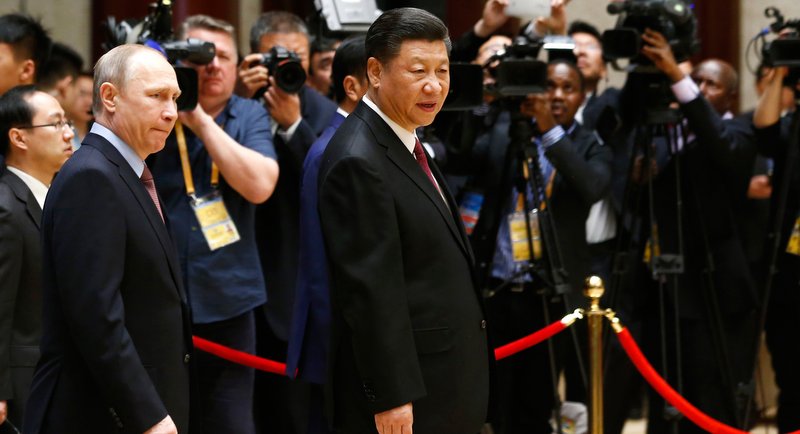
Chinese President Xi Jinping is visiting Moscow only six weeks after Vladimir Putin visited Beijing for the Belt and Road summit. This will be the two men's third get-together so far this year.
The big issue in the Sino-Russian relationship is the parameters of the Belt and Road initiative's "harmonization" with Moscow's own economic plans. The Kremlin has made it clear that Russia does not intend to simply "join" B&R, like other countries, but seeks instead to carve out a special economic relationship with China.
However, to be able to achieve this, Russia will need to display an initiative of its own backed with sufficient resources and engage its partner in areas of interest to Beijing. The ball is surely in Russia's court.
Xi arrives in Moscow en route to the G20 summit in Hamburg, Germany. Europe, not Russia, is the destination of China's current journey to the west. This journey contributes decisively to the emergence of the entire continent of Eurasia as an interconnected economic, political and strategic space.
Germany as a leader of the European Union is likely to play the role of one of the pillars of the emerging construct - alongside China, India, Japan and Russia. This time, no Sino-German-Russian trilateral summit is on the agenda in Hamburg. In the next decade, such meetings may become regular.
Meanwhile, Putin and Xi will spend some time in Moscow discussing their countries' relations with the US. For the first time in over a century, China and Russia have to deal with an America which is going through a crisis that is nothing less than political warfare. Trump is notoriously unpredictable, but the far bigger issue is that the US might become politically unstable: a huge challenge to everyone, and fraught with many dangers.
One immediate problem is North Korea, and the approach Trump may take toward Pyongyang. The US president is clearly disappointed that China's recent moves toward North Korea have not resulted in Kim Jong-un surrendering his nuclear and missile programs. The Chinese and the Russians have known all along that that was not in the cards. First Beijing, and now Moscow have announced diplomatic initiatives offering a path toward gradual easing of tensions on the Korean Peninsula and between Pyongyang and Washington.
It is not clear however whether Trump or Kim would be interested: the Sino-Russian proposal suggests the US giving security guarantees to the North Korean regime when it stops testing weapons, in exchange for Pyongyang renouncing the very programs which it sees as the only real guarantee of its security.
Much more likely is that Pyongyang will continue to build an intercontinental ballistic missile capable of delivering a nuclear weapon to the US West Coast, while Washington will erect missile defenses capable of intercepting any such missile.
Unless, of course, Trump decides to launch a preventative strike. Most experts doubt that Americans have enough reliable intelligence to wipe out the entire North Korean nuclear and missile complex, but Trump's and Vice President Mike Pence's words that they have run out of patience with the Kim regime cannot be simply ignored.
China and Russia should not only align their diplomatic efforts to bring peace to the Korean Peninsula but also think about coordinating their policies in the event of a war between North Korea and the US.
The Russians and the Chinese have also other geopolitical business to attend to. Last month, the Shanghai Cooperation Organization admitted India and Pakistan - its first enlargement after Uzbekistan joined the group in 2001. This time, the challenge is bigger by several orders of magnitude. Unless ways could be found to engage both Delhi and Islamabad with other SCO members in security building in the region, particularly in Afghanistan, this enlargement could render the SCO dysfunctional - hardly something which meets either Moscow's or Beijing's interest.
It is not enough for China and Russia to work to reduce US dominance in what the late Zbigniew Brzezinski once called “the grand Eurasian chessboard.” They have to work on a new continental order that other countries, not just the two of them, would find an improvement over the current situation.
This, of course, is a tall order, but not one on which either Putin or Xi can afford to drop the ball.
Former Director, Carnegie Moscow Center
Trenin was director of the Carnegie Moscow Center from 2008 to early 2022.
Recent Work
Dmitri Trenin
Dmitri Trenin
Carnegie does not take institutional positions on public policy issues; the views represented herein are those of the author(s) and do not necessarily reflect the views of Carnegie, its staff, or its trustees.

China’s political future will be shaped between now and next October. As the Communist Party enters its intense “campaign season” to prepare for a major political transition in 2027, reading Beijing's actions and responses may become more difficult as domestic politics weigh on its behavior more than usual.

Damien Ma
China has showcased its engineering prowess with small modular reactor demonstration projects. But turning these technological achievements into commercial success will be a greater challenge.

Tong Zhao

The Plaza Accord was not an externally imposed punishment of Japan but part of a broader restructuring that Japanese economists and policymakers themselves recognized was necessary. Its effects were undermined, however, when Tokyo responded to the resulting slowdown with policies that exacerbated investment, credit expansion, and the very imbalances the adjustment was intended to resolve.

Michael Pettis

The nuclear relationship between China and the United States is increasingly shaped by widening perception gaps rather than deliberate strategic design.
Tong Zhao
China’s banking crisis in the 2000s was resolved by transferring the costs to households through financial repression—a decision that recapitalized the banks while exacerbating the structural imbalances that continue to shape the Chinese economy today.
Michael Pettis