• Commentary
  • Research
  • Experts
  • Events
Carnegie China logoCarnegie lettermark logo
{
  "authors": [
    "Jake Sullivan",
    "Victor Cha"
  ],
  "type": "legacyinthemedia",
  "centerAffiliationAll": "",
  "centers": [
    "Carnegie Endowment for International Peace",
    "Carnegie China"
  ],
  "collections": [],
  "englishNewsletterAll": "",
  "nonEnglishNewsletterAll": "",
  "primaryCenter": "Carnegie Endowment for International Peace",
  "programAffiliation": "",
  "programs": [],
  "projects": [],
  "regions": [
    "North America",
    "United States",
    "East Asia",
    "China",
    "North Korea",
    "South Korea"
  ],
  "topics": [
    "Security",
    "Foreign Policy",
    "Nuclear Policy",
    "Arms Control",
    "Military"
  ]
}

Source: Getty

In The Media

The Right Way to Play the China Card on North Korea

It’s not enough to ask China to pressure Pyongyang to set up a U.S.-North Korea negotiation. China has to be a central part of the negotiation, too.

Link Copied
By Jake Sullivan and Victor Cha
Published on Jul 5, 2017

Source: Washington Post

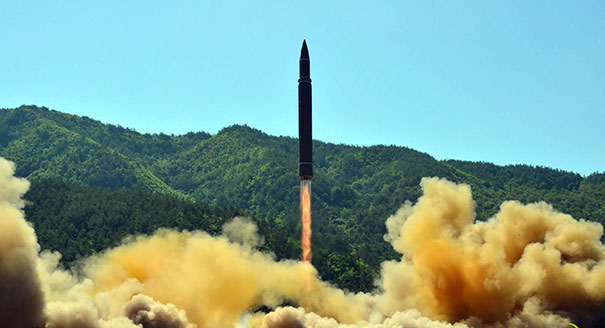
North Korea’s July 4 intercontinental ballistic missile test raises hard questions for the Trump administration: Is there any path forward that does not lead either to war or to living with a nuclear North Korea that can hit the continental United States? Can effective diplomacy prevent the “major, major conflict” that President Trump has talked about?

There is growing recognition that the old playbook won’t work. Reviving old agreements North Korea has already broken would be fruitless. The Chinese won’t deliver on meaningful pressure. And a military strike could lead to all-out war resulting in millions of casualties. We need to consider a new approach to diplomacy.

That means playing the China card, but not the way it has been played until now. It’s not enough to ask China to pressure Pyongyang to set up a U.S.-North Korea negotiation. China has to be a central part of the negotiation, too. China, rather than the United States, should be paying for North Korea to halt and roll back its nuclear and missile programs. Here’s the logic.

The best option would be for China to agree to work with us and South Korea toward getting new leadership in North Korea that is less obsessed with weapons of mass destruction. But this is unlikely to happen in the foreseeable future for a litany of reasons: China’s historical ties to its little communist brother; its concerns about regime collapse; its uncertainty about alternative viable power centers to the Kim family; its mistrust of U.S. motives; and its strained relations with South Korea.

The next option would be for China to cut off, or at least severely curtail, its commerce with North Korea, which accounts for 85 to 90 percent of North Korea’s trade, to restrain Pyongyang. But as Trump has recognized in recent tweets, China is unlikely to go this far right now, for the same reasons.

So we are left with a less dramatic form of carrots-and-sticks diplomacy, backed by increasing pressure. But it can’t be a repeat of previous rounds.

In the past, China has largely left it to the United States to put inducements on the table. Together the nuclear agreements executed by the Clinton and George W. Bush administrations cost the United States a half-billion dollars for denuclearization via monthly energy-assistance payments to Pyongyang. (Japan and South Korea also paid their fair share; China paid only a small amount in the Bush agreement.) Meanwhile, China continued to enjoy its trade relationship with North Korea, extracting mineral resources at a fraction of world market prices.

Now China is back, pushing us to the bargaining table, as evidenced by its statement with Russia after Tuesday’s missile test calling for the United States to give up military exercises in exchange for a missile-testing freeze.

We should reject the freeze-for- freeze. But beyond that, we should tell China that it has to pay to play. The basic trade would be Chinese disbursements to Pyongyang, as well as security assurances, in return for constraints on North Korea’s program. China would be paying not just for North Korean coal, but for North Korean compliance.

In a Chinese freeze-and-rollback agreement, the International Atomic Energy Agency would monitor compliance. If North Korea cheated, China would not be receiving what it paid for. The logical thing would be for it to withhold economic benefits until compliance resumed.

Of course, China might continue to fund the regime anyway. Or North Korea could very well reject such a deal from the start. But these scenarios would leave us no worse off than we are now. And it might well put us in a stronger position. Because China didn’t get what it paid for, or got the cold shoulder from Pyongyang, it might become more receptive to working with us and our allies on other options.

Why would China agree to this plan, given that it has never been willing to put its economic leverage to real use before?

Beijing wants a diplomatic off-ramp to the current crisis. President Xi Jinping is still seeking a good relationship with Trump in this critical year of China’s 19th Party Congress. Furthermore, Chinese frustrations with North Korean leader Kim Jong Un have grown after his execution of family members and regime figures close to China. All this may give the Trump administration marginally more leverage than its predecessors had.

We also have an important stick. If China refuses to proceed along these lines, we would be better positioned to pursue widespread secondary sanctions against Chinese firms doing business with North Korea beyond the Treasury Department’s sanctioning of a Chinese bank last week. We would be left with little choice.

Of course, this idea is no silver bullet. It doesn’t answer the question of how to get verifiable, enforceable, durable constraints on North Korea. It won’t go very far if what North Korea really cares about is extracting something from the United States. But North Korea is the land of lousy options. We should be looking for a strategy that gives us not only a better chance of success but also some advantages if it fails.

This article was originally published in the Washington Post.

About the Authors

Jake Sullivan

Former U.S. National Security Advisor to Former President Joe Biden

Jake Sullivan, a senior fellow at the University of New Hampshire's Carsey School of Public Policy, served as the United States national security advisor to former President Joe Biden from 2021 to 2025. Sullivan previously served as deputy assistant to former President Barack Obama, national security advisor to former Vice President Biden, director of policy planning in the State Department, and as deputy chief of staff to former U.S. Secretary of State Hillary Clinton.

Victor Cha

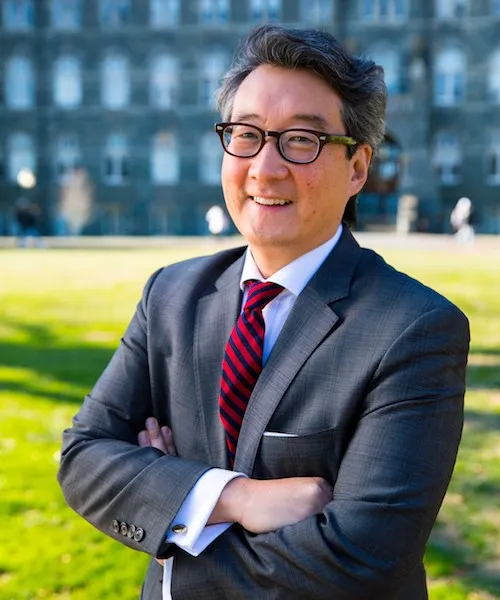
Victor Cha is director of Asian studies and holds the D.S. Song-KF chair in the department of Government and School of Foreign Service at Georgetown University. He is also a senior adviser and the inaugural holder of the Korea Chair at CSIS and previously served as director for Asian affairs on the National Security Council under former U.S. president George H. W. Bush.

Authors

Jake Sullivan
Former U.S. National Security Advisor to Former President Joe Biden
Jake Sullivan
Victor Cha

Victor Cha is director of Asian studies and holds the D.S. Song-KF chair in the department of Government and School of Foreign Service at Georgetown University. He is also a senior adviser and the inaugural holder of the Korea Chair at CSIS and previously served as director for Asian affairs on the National Security Council under former U.S. president George H. W. Bush.

SecurityForeign PolicyNuclear PolicyArms ControlMilitaryNorth AmericaUnited StatesEast AsiaChinaNorth KoreaSouth Korea

Carnegie does not take institutional positions on public policy issues; the views represented herein are those of the author(s) and do not necessarily reflect the views of Carnegie, its staff, or its trustees.

More Work from Carnegie China

  • Commentary
    China Sells Stability Amid American Volatility

    US unpredictability has allowed China to capitalize on its positioning as the “responsible great power”. Paradoxically, the more China wins the perception game, the more likely expectations will rise for Beijing to deliver not just words but to demonstrate with its deeds.

      Chong Ja Ian

  • Vietnam's Top Leader To Lam meets with young representatives from China and Vietnam participating in the "Red Study Tours" at the Great Hall of the People on April 15, 2026 in Beijing, China. T
    Commentary
    Why Vietnam Is Swinging in China’s Direction

    Hanoi and Beijing have long treated each other as distant cousins rather than comrades in arms. That might be changing as both sides draw closer to hedge against uncertainty and America’s erratic behavior.

      • Nguyen-khac-giang

      Nguyễn Khắc Giang

  • Commentary
    China’s Energy Security Doesn’t Run Through Hormuz but Through the Electrification of Everything

    Across Asia, China is better positioned to withstand energy shocks from the fallout of the Iran war. Its abundant coal capacity can ensure stability in the near term. Yet at the same time, the country’s energy transition away from coal will make it even less vulnerable during the next shock.


      • Damien Ma

      Damien Ma

  • Xi walking into a room with people standing and applauding around him
    Commentary
    Emissary
    The Xi Doctrine Zeros in on “High-Quality Development” for China’s Economic Future

    In the latest Five-Year Plan, the Chinese president cements the shift to an innovation-driven economy over a consumption-driven one.

      • Damien Ma

      Damien Ma

  • Commentary
    Malaysia’s Year as ASEAN Chair: Managing Disorder

    Malaysia’s chairmanship sought to fend off short-term challenges while laying the groundwork for minimizing ASEAN’s longer-term exposure to external stresses.

      Elina Noor

Get more news and analysis from
Carnegie China
Carnegie China logo, white
Keck Seng Tower133 Cecil Street #10-01ASingapore, 069535Phone: +65 9650 7648
  • Research
  • About
  • Experts
  • Events
  • Contact
  • Careers
  • Privacy
  • For Media
Get more news and analysis from
Carnegie China
© 2026 Carnegie Endowment for International Peace. All rights reserved.