

Commentary
- +1
Paul Haenle, Xue Gong, Ngeow Chow Bing, …
{
  "authors": [
    "Paul Haenle"
  ],
  "type": "legacyinthemedia",
  "centerAffiliationAll": "",
  "centers": [
    "Carnegie Endowment for International Peace",
    "Carnegie China"
  ],
  "collections": [
    "U.S.-China Relations",
    "China’s Foreign Relations"
  ],
  "englishNewsletterAll": "",
  "nonEnglishNewsletterAll": "",
  "primaryCenter": "Carnegie China",
  "programAffiliation": "",
  "programs": [],
  "projects": [],
  "regions": [
    "North America",
    "United States",
    "East Asia",
    "China"
  ],
  "topics": []
}
Source: Getty
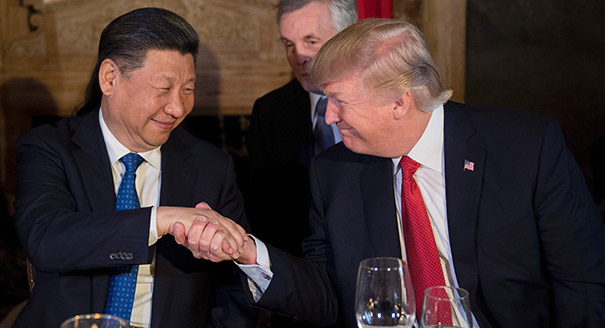
Meetings between senior U.S. and Chinese officials have exposed the widening expectations gap between the two governments, leading President Trump to take action.
Source: CNN
When Donald Trump was elected president of the United States in November, most Chinese cheered.
Hillary Clinton was associated with Barack Obama’s Asia “pivot” strategy, which Chinese saw as synonymous with “containment,” while Trump appeared to be a pragmatic businessman.
Chinese expected him to focus on domestic economic issues and relieve some pressure in the political and military arenas of the bilateral relationship.
In the days that followed the election, however, Trump’s phone call with Taiwanese President Tsai Ing-wen and threats of a trade war significantly tempered Chinese optimism about relations with the United States in the post-Obama era. Some on the extremes editorialized it was time for China to "abandon its illusions and prepare for a struggle.”
Others held fast to the “Mar-a-Lago fantasy”—a world of history lessons from Xi, flattering tweets from Trump, and where no problem, not even Taiwan, could not be resolved through the Cui-Kushner channel—China's ambassador to the United States and Trump’s son-in-law and trusted mediator.
To those ascribed to such views, Beijing had figured Trump out and was more than capable of managing the new administration's policy on China.
Yet, since the U.S.-China Diplomatic and Security Dialogue in June, it appears the Trump administration is beginning to shed its illusions, too, and face the realities of Chinese behavior and cooperation on a range of economic and security issues.
At the talks between the state and defense departments and their Chinese counterparts, the United States had hoped to elevate and focus discussions with China on key issues in order to break through old sticking points. The Chinese side, however, appeared chiefly concerned with protocol—confirming Trump’s bilateral with Xi at the G20 summit in Hamburg and his state visit to China later this year.
Thus, the meetings exposed the widening expectations gap between the U.S. and Chinese governments, and led Trump to take action.
In the span of just three days last week, the United States conducted a freedom-of-navigation operation in the South China Sea, announced new arms sales to Taiwan, and sanctioned a Chinese bank in response to North Korea's nuclear program.
This set the stage for a more frank exchange between the two presidents on the sidelines of the G20 this week, as well as a more clear-eyed framework for the U.S.-China relationship.
On the Chinese side, while Xi was able to restore stability to U.S.-China relations at April’s Mar-a-Lago summit and reassure an anxious Chinese public that he was in control, assuming that China has Trump wrapped around its finger is a dangerous miscalculation.
Trump’s veneration for Xi has been based on an expectation that China can and will make fundamental changes to its economic behavior and North Korea policy.
Although Beijing has been willing to make progress on low-hanging fruit in White House priority areas since Mar-a-Lago, there are few signs it intends to address the more systemic and fundamental contradictions at the core of U.S.-China tensions.
So much in the U.S.-China relationship is now riding on China solving the North Korea challenge, which most experts say Beijing lacks the political will to do.
China already appears to be reaching the limits of its willingness to pressure Pyongyang, as evidenced by the treasury department’s recent actions. Despite its suspension of coal imports from North Korea in February, Chinese trade with North Korea grew nearly 40 percent in the first quarter of the year compared with 2016.
The Chinese continue their longstanding calls for dialogue as North Korean weapons grow more advanced and sophisticated. At the same time, Beijing is resistant to U.S. invitations to engage in contingency-planning discussions involving our militaries in the event of a worst-case scenario on the Korean Peninsula.
In the economic arena, the U.S. and Chinese business communities have long served as a stabilizing force for relations during times of political tension. The 100-Day Action Plan established at Mar-a-Lago was an important step toward addressing imbalances in the commercial and economic relationship that threaten that ballast, and reinstating a pragmatic agenda for bilateral trade and investment liberalization.
But while concessions made at Mar-a-Lago to open Chinese market access for U.S. beef, biotechnology applications, and financial services will benefit American businesses, more significant Chinese structural reforms have run into much greater difficulty. Underwhelming results at the end of the 100 days could lead to disappointment that cuts against the two leaders’ constructive tone.
Much work lies ahead to ensure that constructive ties can be sustained over the long term. Avoiding whiplash in U.S.-China relations will require that both countries establish a more comprehensive foundation for the relationship.
For China, preventing U.S. disappointment will require that it makes concrete progress in priority areas. In agreeing to elevate bilateral discussions with the new Comprehensive Dialogue Mechanism, the United States was underscoring to China the importance of a results-oriented relationship.
For the United States, the singular focus on North Korea is not only naive and ineffectual, but also masks other consequential issues in the relationship that need to be addressed directly and candidly.
As the Trump administration presses the Chinese leadership to deal more proactively with Pyongyang, it must also be able to robustly defend U.S. interests in the South China Sea, raise human rights concerns, and identify common regional and global challenges where our countries can work together constructively.
Both administrations have the opportunity at Hamburg to expand the purview of the bilateral relationship and develop clear-eyed goal posts for progress.
Given the challenges confronting Presidents Trump and Xi at home and abroad, a more robust and comprehensive framework for relations that is capable of narrowing areas of difference and deepening cooperation in areas of common interests will best support the domestic agendas of both countries and the security and prosperity of the world.

Former Maurice R. Greenberg Director’s Chair, Carnegie China
Paul Haenle held the Maurice R. Greenberg Director’s Chair at the Carnegie Endowment for International Peace and is a visiting senior research fellow at the East Asian Institute, National University of Singapore. He served as the White House China director on the National Security Council staffs of former presidents George W. Bush and Barack Obama.
Recent Work


Paul Haenle, Xue Gong, Ngeow Chow Bing, …

Paul Haenle, Chong Ja Ian
Carnegie does not take institutional positions on public policy issues; the views represented herein are those of the author(s) and do not necessarily reflect the views of Carnegie, its staff, or its trustees.

China’s banking crisis in the 2000s was resolved by transferring the costs to households through financial repression—a decision that recapitalized the banks while exacerbating the structural imbalances that continue to shape the Chinese economy today.

Michael Pettis

Chinese biotech companies have been on the receiving end of U.S. economic coercion. Yet their responses have differed significantly because firm and state interests are not uniformly aligned. For Washington, treating all Chinese tech firms the same, irrespective of their actual interests, risks pushing them farther into Beijing’s corner.
Xue Gong

China’s latest energy plan explicitly calls for integrating data centers into the electricity system, particularly connecting them to green energy. It appears Beijing wants to use compute as a source of domestic demand to absorb renewables excess capacity.

Damien Ma

But their "principal to principal" model will only be as effective as the political strength of each leader back home.
Damien Ma

U.S. unpredictability has allowed China to capitalize on its positioning as the “responsible great power”. Paradoxically, the more China wins the perception game, the more likely expectations will rise for Beijing to deliver not just words but to demonstrate with its deeds.
Chong Ja Ian