

In The Media
David Rothkopf
{
  "authors": [
    "David Rothkopf"
  ],
  "type": "legacyinthemedia",
  "centerAffiliationAll": "dc",
  "centers": [
    "Carnegie Endowment for International Peace"
  ],
  "collections": [],
  "englishNewsletterAll": "asia",
  "nonEnglishNewsletterAll": "",
  "primaryCenter": "Carnegie Endowment for International Peace",
  "programAffiliation": "AP",
  "programs": [
    "Asia"
  ],
  "projects": [],
  "regions": [
    "South Asia",
    "India",
    "East Asia",
    "China"
  ],
  "topics": [
    "Economy",
    "Trade",
    "Global Governance"
  ]
}
Source: Getty
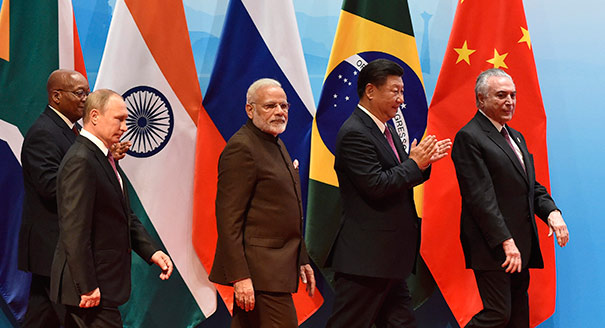
The original conception of BRICS, to bring together the world’s most important emerging markets, may have become obsolete, destined to be replaced by ChIPs: China and India Plus.
Source: National
Last week in Xiamen, China, the Chinese government rolled out the red carpet for the leaders of the Brics countries. There were banquets and musical galas and a host of announcements of new cooperation between Brazil, Russia, India, China and South Africa. A special focus was put on efforts to smooth over tensions between China and India that had recently flared in the Doklam region in the Himalayas along the border between the two countries. A statement was issued following the meeting between Chinese president Xi Jinping and India’s prime minister Narendra Modi, underscoring both sides agreement that the relationship was important and that every effort should be made to improve it. Importantly, the meeting ended with a joint statement condemning terrorism that, in a victory for the Indians, specifically called out several Pakistani-based terrorist organizations.

Former Visiting Scholar
David Rothkopf was a visiting scholar at the Carnegie Endowment as well as the former CEO and editor in chief of the FP Group.
Recent Work
David Rothkopf
David Rothkopf
Carnegie does not take institutional positions on public policy issues; the views represented herein are those of the author(s) and do not necessarily reflect the views of Carnegie, its staff, or its trustees.

But their "principal to principal" model will only be as effective as the political strength of each leader back home.

Damien Ma

U.S. unpredictability has allowed China to capitalize on its positioning as the “responsible great power”. Paradoxically, the more China wins the perception game, the more likely expectations will rise for Beijing to deliver not just words but to demonstrate with its deeds.

Chong Ja Ian

Hanoi and Beijing have long treated each other as distant cousins rather than comrades in arms. That might be changing as both sides draw closer to hedge against uncertainty and America’s erratic behavior.

Nguyễn Khắc Giang

Across Asia, China is better positioned to withstand energy shocks from the fallout of the Iran war. Its abundant coal capacity can ensure stability in the near term. Yet at the same time, the country’s energy transition away from coal will make it even less vulnerable during the next shock.
Damien Ma

In the latest Five-Year Plan, the Chinese president cements the shift to an innovation-driven economy over a consumption-driven one.
Damien Ma