

Article
Cara Abercrombie
{
  "authors": [
    "Cara Abercrombie"
  ],
  "type": "legacyinthemedia",
  "centerAffiliationAll": "dc",
  "centers": [
    "Carnegie Endowment for International Peace",
    "Carnegie India"
  ],
  "collections": [],
  "englishNewsletterAll": "ctw",
  "nonEnglishNewsletterAll": "",
  "primaryCenter": "Carnegie Endowment for International Peace",
  "programAffiliation": "SAP",
  "programs": [
    "South Asia"
  ],
  "projects": [],
  "regions": [
    "South Asia",
    "India",
    "Russia",
    "United States"
  ],
  "topics": [
    "Security",
    "Military",
    "Foreign Policy"
  ]
}
Source: Getty
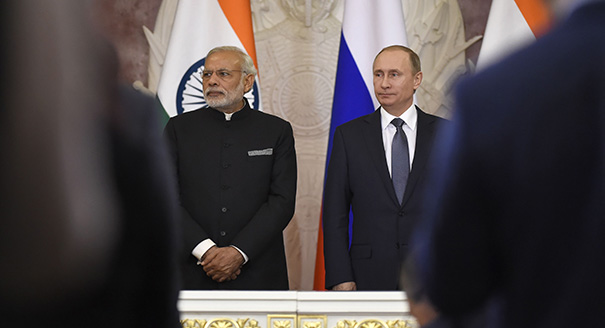
India may soon close a deal with Russia to purchase two S-400 air defense systems, thereby triggering secondary sanctions from the United States. Without Congressional action, the U.S.-India defense relationship will likely suffer.
Source: Axios
India may close a major defense deal with Russia as early as next week, when Indian Defense Minister Nirmala Sitharaman will make her first trip to Moscow. The deal covers two S-400 air defense systems, which include radar, missile launchers and command center technology.
Why it matters: In August 2017, President Trump signed into law the Countering America’s Adversaries through Sanctions Act (CAATSA) against Russia. Because the sanctions target any country trading with Russia's defense and intelligence sectors, India's pending deal may put it on a collision course with the U.S.
The background: Approximately 60% of India’s defense inventory is Russian-made, a legacy of India’s Cold War–era relationship with the Soviet Union. While the U.S. has become its second largest defense supplier — mainly of aircraft and artillery — India still relies heavily on Russian equipment, such as submarines and missiles, that the U.S. has been unwilling to provide.
India has good reason to want high-end weapons systems: It is the only country in the world that has contested borders with two nuclear neighbors — Pakistan and China — and has fought wars with both. Forcing India to abruptly cut off Russian supplies would create unacceptable risk to India's self-defense. If forced to choose between a robust, well-equipped military and U.S. goodwill, India would likely choose the former.
What's next: These sanctions, like penalties the U.S. imposed after India's nuclear tests in the 1990s, would sour relations. At worst, they could stoke domestic backlash and close off U.S. defense sales to India for the foreseeable future. Given bipartisan support for the U.S.–India defense relationship, Congress should grant India waiver authority under CAATSA. Without waivers, other important regional partners, like Vietnam and Indonesia, are also likely to trigger sanctions.
The bottom line: India warrants an exemption from these secondary sanctions, as does any country with which the U.S. is forging new and strategically important defense relations.
Former Visiting Scholar, South Asia Program
Cara Abercrombie was a visiting scholar with Carnegie’s South Asia Program. She focuses on U.S. security interests in Asia, particularly opportunities for greater U.S.-India defense cooperation.
Recent Work
Cara Abercrombie
Carnegie does not take institutional positions on public policy issues; the views represented herein are those of the author(s) and do not necessarily reflect the views of Carnegie, its staff, or its trustees.

The nuclear relationship between China and the United States is increasingly shaped by widening perception gaps rather than deliberate strategic design.

Tong Zhao

But their "principal to principal" model will only be as effective as the political strength of each leader back home.

Damien Ma

U.S. unpredictability has allowed China to capitalize on its positioning as the “responsible great power”. Paradoxically, the more China wins the perception game, the more likely expectations will rise for Beijing to deliver not just words but to demonstrate with its deeds.

Chong Ja Ian

Hanoi and Beijing have long treated each other as distant cousins rather than comrades in arms. That might be changing as both sides draw closer to hedge against uncertainty and America’s erratic behavior.

Nguyễn Khắc Giang

Across Asia, China is better positioned to withstand energy shocks from the fallout of the Iran war. Its abundant coal capacity can ensure stability in the near term. Yet at the same time, the country’s energy transition away from coal will make it even less vulnerable during the next shock.
Damien Ma