

Commentary
Dmitri Trenin
{
  "authors": [
    "Dmitri Trenin"
  ],
  "type": "commentary",
  "centerAffiliationAll": "",
  "centers": [
    "Carnegie Endowment for International Peace",
    "Carnegie Russia Eurasia Center"
  ],
  "collections": [],
  "englishNewsletterAll": "",
  "nonEnglishNewsletterAll": "",
  "primaryCenter": "Carnegie Russia Eurasia Center",
  "programAffiliation": "",
  "programs": [],
  "projects": [
    "Eurasia in Transition"
  ],
  "regions": [],
  "topics": [
    "Economy"
  ]
}
Source: Getty
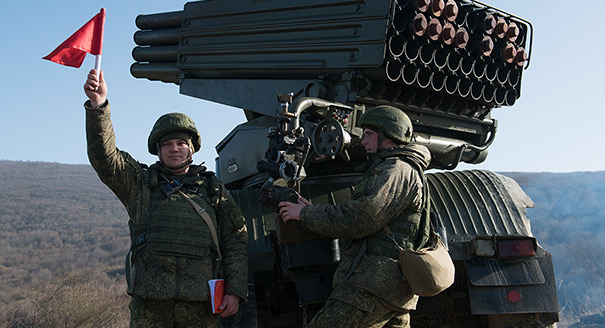
To ensure its national security, Russia needs a comprehensive strategy in the South Caucasus region.
In 2015, Russia intervened in force in Syria and once again became an actor in the Middle East. The Middle East, however, borders a region that is critical to the security and stability of southern Russia: the South Caucasus. To ensure its national security, Russia must develop a comprehensive strategy in the Caucasus and beyond.
War erupted in the Caucasus’ Nagorno-Karabakh region before the collapse of the Soviet Union and helped bring about the USSR’s downfall. Following the dissolution of the USSR, overt armed conflicts ignited in Georgia—between Georgians and Abkhaz, between Georgians and Ossetians, and within Georgia proper.
Russia’s own North Caucasus has also seen its share of conflict. The war in Chechnya, which dragged on for over a decade, was not only a colossal tragedy for Russia’s ethnic groups, but also a harsh test for the country’s policymakers, armed forces, and law enforcement agencies. The resolution of the Chechen conflict by the mid-2000s was one of the key pillars for internal consolidation of the Russian Federation. Since then, the situation in the North Caucasus has remained a critical indicator of the stability and competence of the Russian state.
Much has changed in the South Caucasus since the Soviet days. In place of three former Soviet republics, there are now effectively six states and (quasi)state formations with varying degrees of legitimacy and independence. The 2008 war between Russia and Georgia has left a deep scar on relations between the two countries. Russia’s annexation of Crimea in 2014 has fundamentally changed the geopolitical situation in the Black Sea basin. The April 2016 flare-up in Nagorno-Karabakh has demonstrated that the conflict, which was frozen back in 1994, remains like a dormant volcano that could erupt at any time with greater force than in the past.
Much like the Soviet Union before it, the former Soviet Union—as a sociopolitical entity that persisted for years by inertia—has been relegated to history. This requires Moscow to take a fresh look at the South Caucasus.
Having achieved independence from Russia, the region has returned to its own history and geography. For the Armenian, Georgian, and Azerbaijani peoples, the “Russian period” of their histories was impactful but relatively brief—less than two centuries. Geopolitically, the disappearance of the Soviet border has meant the return of regional powers such as Turkey and Iran to the Caucasus, as well as the arrival of global players like the United States and China.
The collapse of “little Eurasia”—the Soviet Union, the successor to the Russian Empire—in the late twentieth century was replaced in the early twenty-first century by the formation of Greater Eurasia as an interconnected economic, political, and military network that spans the entire continent from Portugal to Korea. China’s economic and, to some extent, political expansion—reflected in Beijing’s Belt and Road Initiative—has been a key driver of this process. One of the routes set to link China and Europe passes through the South Caucasus. Based upon all this, we can make several important conclusions about the significance of the region for Russia’s military and foreign policy.
The South Caucasus is one of the most dynamic sectors of Russia’s southern neighborhood. The conflict in Nagorno-Karabakh could bring about not only a local war between Azerbaijan and Armenia, but also a regional war involving Turkey, into which Russia would most likely be drawn.
The conflicts with Georgia in Abkhazia and South Ossetia remain on ice, but they have not been resolved. If a government that wants to reclaim the breakaway territories should come to power in Tbilisi, the borders of Abkhazia and South Ossetia, guarded by Russian border troops, might again become battlelines.
To prevent and respond to these threats, Russia must enhance its military capabilities in the region. But, above all, it needs active regional diplomacy. Russia must maintain a balance between its ally Armenia and its important partner Azerbaijan, and firmly hold back Yerevan, Baku, and the Karabakh leadership from a new war.
It is also important for Moscow to maintain dialogue with Tbilisi, even in the absence of diplomatic relations. It must continue discussing options for gradually and partially normalizing relations, including on the borders of Abkhazia and South Ossetia.
NATO expansion—the issue that sparked the war in Georgia in 2008 and in Ukraine in 2014—is not a pressing threat. Essentially, the two wars have set limits on attempts to further expand NATO toward Russia’s borders.
The United States will remain Georgia’s leading military partner. U.S. military experts will still work on Georgian territory, and Georgia will continue to hold joint exercises with the United States and other NATO members. However, Georgia’s accession to NATO and the establishment of permanent U.S. military bases on Georgian territory appear to be a very remote possibility. It is equally improbable that Georgia will join the European Union in the foreseeable future. This situation gives Moscow an additional opportunity to convince Tbilisi that it should maintain smooth relations with Russia and pursue a pragmatic approach to the existing challenges.
Forces that really threaten the security of all states in the South Caucasus, as well as of Russia (especially in the North Caucasus), include Islamic extremism and terrorism. Russia should join forces not only with its neighbors in the South Caucasus but also with Turkey and Iran, countries with which Moscow has already built an alliance of convenience in Syria. Cooperation in counterterrorism—with the understanding that different countries have different definitions of what makes a terrorist—could serve as the prototype for a regional security system that Russia could build to the south of the Greater Caucasus Range.
Although Russia’s alliances with Turkey and Iran are situational and limited, some of these countries’ concrete interests are close. Moscow should use this to develop a new model for long-term relations with Ankara and Tehran in Syria and the Middle East in general. If based upon mutual trust in the military-political sector and a common understanding of the challenges directly impacting the security of each country, these relations could substantially improve the security of Russia’s southern regions, from the Black Sea to the Caspian.
To meet increasingly serious regional challenges, Moscow’s foreign and military policy must clearly identify Russia’s interests and objectives and outline Russia’s strategy for achieving them at both the regional and national level. This requires a thorough knowledge and deep understanding of the current realities and trends in the South Caucasus. A much higher level of regional expertise, research, and analysis is necessary — both in Moscow and in Russia’s North Caucasus and Southern federal districts. Russian military commanders, diplomats, and members of the intelligence community, as well as invited outside experts, must also work much more closely at all levels, from Moscow down to their regional headquarters.

Former Director, Carnegie Moscow Center
Trenin was director of the Carnegie Moscow Center from 2008 to early 2022.
Recent Work
Dmitri Trenin
Dmitri Trenin
Carnegie does not take institutional positions on public policy issues; the views represented herein are those of the author(s) and do not necessarily reflect the views of Carnegie, its staff, or its trustees.

In the latest Five-Year Plan, the Chinese president cements the shift to an innovation-driven economy over a consumption-driven one.

Damien Ma

Rather than climate ambitions, compatibility with investment and exports is why China supports both green and high-emission technologies.

Mathias Larsen
“Involution” is a new word for an old problem, and without a very different set of policies to rein it in, it is a problem that is likely to persist.

Michael Pettis

While China's investment story seems contradictory from the outside, the real answers to Beijing's high-quality growth ambitions are hiding in plain sight across the nation's cities.

Yuhan Zhang
China's stimulus addiction cannot go on forever. Beijing still has policy space to clean up the country's massive debt issue, but time is running short.
Michael Pettis