

Paper
Douglas H. Paal
{
  "authors": [
    "Douglas H. Paal"
  ],
  "type": "legacyinthemedia",
  "centerAffiliationAll": "dc",
  "centers": [
    "Carnegie Endowment for International Peace",
    "Carnegie China"
  ],
  "collections": [],
  "englishNewsletterAll": "asia",
  "nonEnglishNewsletterAll": "",
  "primaryCenter": "Carnegie China",
  "programAffiliation": "AP",
  "programs": [
    "Asia"
  ],
  "projects": [],
  "regions": [
    "North America",
    "United States",
    "East Asia",
    "South Korea",
    "China",
    "Japan",
    "North Korea"
  ],
  "topics": [
    "Security",
    "Foreign Policy",
    "Nuclear Policy",
    "Arms Control"
  ]
}
Source: Getty
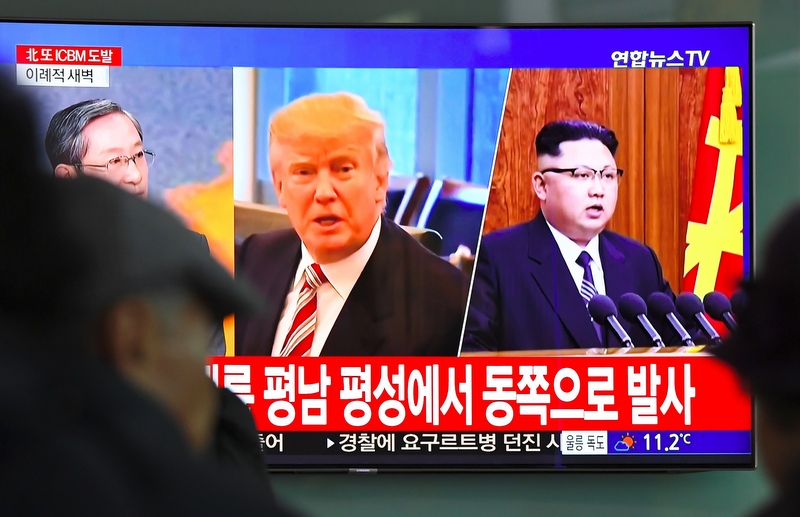
As the United States, North Korea, South Korea, and China make moves to tilt the outcome of the Trump-Kim summit in their favor, time is running out to prepare for any real outcomes in Singapore.
Source: Hill
The anticipated June 12 Singapore summit between President Trump and North Korean leader Kim Jong Un is still likely to take place, but the jockeying for position has now begun in earnest. On Tuesday, Trump told President Moon Jae In that the summit may be postponed or canceled, citing recent actions by China and North Korea. This is just one example of the United States, North Korea, South Korea and China making moves to gain leverage and tilt the outcome of the summit in their favor.
The man in the hot seat is President Moon, America’s ally in Seoul. He is the one who set in motion the diplomacy that has brought the Korean Peninsula from the brink of conflict in December to talk of Nobel Peace prizes in May. Moon won the presidency last year with a weak mandate, but used the opportunity of the Winter Olympics to deliver an unlikely thaw on the Korean Peninsula, with summits between himself and Kim, and planned between Kim and Trump. South Korea goes to the polls for local elections on June 13, and Moon has been hoping progress toward peace will boost his party’s standing.
Kim played his own leverage game a week ago, suspending an inter-Korean dialogue on implementing the outcomes of the late April summit between Moon and Kim at Panmunjom. Kim’s regime also attacked Trump’s new national security adviser, John Bolton, for comparing Korean denuclearization with the Libyan denuclearization in 2003, which the North sees having ended with the collapse of Muammar Gaddafi’s regime and the murder of the leader. Kim was probably trying to press Moon to get Trump to moderate his position this week.
Before that, Kim gave China their chance to play for advantage as well. Kim met on short notice with Chinese President Xi Jinping in the port city of Dalian, presumably to show the world that the North is not isolated as Trump often describes. There is no public account of what was discussed, but the North’s subsequent announcement of suspension of inter-Korean ministerial talks and criticism of Bolton motivated Moon to get Trump to be more accommodating.
Trump mused that the Chinese were interfering with the procession to Singapore in a news conference shortly after. There is no evidence that the Chinese were behind Kim’s more belligerent moves, but some in the Trump administration are pushing that view in order to blame China if the Singapore summit ends in failure.
As the jockeying continues with Trump making the latest effort to gain leverage by saying the summit may not happen at all, time is running out to prepare for any real outcomes for Singapore. Given the apparent disagreement over the meaning of “denuclearization” between the United States and North Korea, the leaders may end up meeting and talking past each other, or canceling the meeting altogether.
Either result is not to America’s advantage. After five months of happy talk about peace and denuclearization on the Korean Peninsula, the South Korean people will not be content to return to a war footing with the United States threatening to give the North a “bloody nose.” A wedge will appear between the progressive South Korean government in Seoul and hawks in Washington, achieving a longstanding objective of the North to divide the United States from its allies. Japan should shudder too.
The unanimity on the United Nations Security Council in passing harsh resolutions against a belligerent Pyongyang is unlikely to be sustained after the North’s overtures to limiting its nuclear capabilities by dismantling its nuclear test site and continuously advertising its willingness to go further. The lack of missile and nuclear tests since last year reinforces the North’s message of peaceful negotiations and denuclearization. The issues of leakage of trade and humanitarian assistance to the North will rise to the surface again.
The Trump administration and U.S. officials must get to work immediately. This is the time for intense direct diplomacy to prepare the way to Singapore and concerted public messaging by the United States about its objectives, not random efforts to manipulate leverage among the interested parties. The balance of benefits may otherwise shift from much to gain to too much to lose in Singapore.

Distinguished Fellow, Asia Program
Paal previously served as vice chairman of JPMorgan Chase International and as unofficial U.S. representative to Taiwan as director of the American Institute in Taiwan.
Recent Work
Douglas H. Paal


Douglas H. Paal, Tong Zhao, Chen Qi, …
Carnegie does not take institutional positions on public policy issues; the views represented herein are those of the author(s) and do not necessarily reflect the views of Carnegie, its staff, or its trustees.

The Plaza Accord was not an externally imposed punishment of Japan but part of a broader restructuring that Japanese economists and policymakers themselves recognized was necessary. Its effects were undermined, however, when Tokyo responded to the resulting slowdown with policies that exacerbated investment, credit expansion, and the very imbalances the adjustment was intended to resolve.

Michael Pettis

The nuclear relationship between China and the United States is increasingly shaped by widening perception gaps rather than deliberate strategic design.
Tong Zhao
China’s banking crisis in the 2000s was resolved by transferring the costs to households through financial repression—a decision that recapitalized the banks while exacerbating the structural imbalances that continue to shape the Chinese economy today.
Michael Pettis

Chinese biotech companies have been on the receiving end of U.S. economic coercion. Yet their responses have differed significantly because firm and state interests are not uniformly aligned. For Washington, treating all Chinese tech firms the same, irrespective of their actual interests, risks pushing them farther into Beijing’s corner.

Xue Gong

China’s latest energy plan explicitly calls for integrating data centers into the electricity system, particularly connecting them to green energy. It appears Beijing wants to use compute as a source of domestic demand to absorb renewables excess capacity.

Damien Ma