

Commentary
Alexander Baunov
{
  "authors": [
    "Alexander Baunov"
  ],
  "type": "legacyinthemedia",
  "centerAffiliationAll": "",
  "centers": [
    "Carnegie Endowment for International Peace",
    "Carnegie Russia Eurasia Center"
  ],
  "collections": [],
  "englishNewsletterAll": "",
  "nonEnglishNewsletterAll": "",
  "primaryCenter": "Carnegie Endowment for International Peace",
  "programAffiliation": "",
  "programs": [],
  "projects": [],
  "regions": [],
  "topics": [
    "Foreign Policy"
  ]
}
Source: Getty
Any agreement that results in rapprochement with the West may provide some economic growth from sanctions relief, but it may also shift balance of power within the Russian political establishment from the powerful hawks to the system’s liberals.
Source: Axios
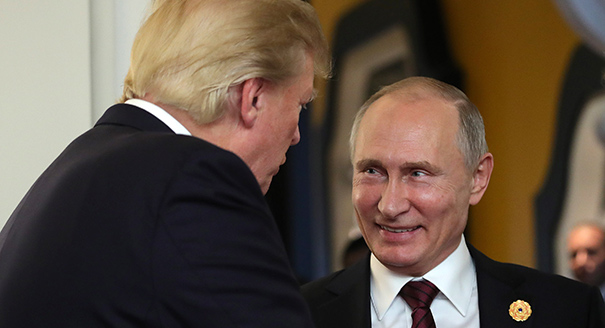
Many critics of President Trump's foreign policy believe he is giving Russian President Vladimir Putin a gift by agreeing to a summit while ignoring sources of tension such as the annexation of Crimea and foreign election meddling. But a chummy photo op goes a very short way to meeting Putin’s actual needs.
Reality check: In his fourth and final term, Putin is focused on domestic priorities such as lifting the economy out of stagnation, improving infrastructure and raising the retirement age to ease social-program budgets. Sanctions and a toxic international environment are big obstacles to these plans. To deliver on this agenda, he needs Trump to deliver on a calmer foreign-policy and business environment.
The Russian angle: Russia’s political class and its allies are as concerned about the Helsinki summit as their American counterparts. The hawks in Moscow think Putin is ready to exchange part of Russia’s political and military resurgence — perhaps through concessions in Donbas and Syria — to ease sanctions and spur economic growth.
Conservatives in the Russian security establishment want to ensure that Western nations can’t mobilize a unified, anti-Russian front. They like the fact that the West is split and see Trump as widening this divide — with his disregard for U.S. allies and NATO, including the previously unthinkable collapse of U.S.–German relations. Satisfaction with the status quo is why many Russians oppose major new agreements with Trump’s White House.
The bottom line: Any agreement that results in rapprochement with the West may provide some economic growth from sanctions relief, but it may also shift balance of power within the Russian political establishment from the powerful hawks to the system’s liberals.

Senior Fellow, Editor-in-Chief, Carnegie Russia Eurasia Center
Baunov is a senior fellow and editor-in-chief at the Carnegie Russia Eurasia Center.
Recent Work
Alexander Baunov
Alexander Baunov
Carnegie does not take institutional positions on public policy issues; the views represented herein are those of the author(s) and do not necessarily reflect the views of Carnegie, its staff, or its trustees.

But their "principal to principal" model will only be as effective as the political strength of each leader back home.

Damien Ma

U.S. unpredictability has allowed China to capitalize on its positioning as the “responsible great power”. Paradoxically, the more China wins the perception game, the more likely expectations will rise for Beijing to deliver not just words but to demonstrate with its deeds.

Chong Ja Ian

Hanoi and Beijing have long treated each other as distant cousins rather than comrades in arms. That might be changing as both sides draw closer to hedge against uncertainty and America’s erratic behavior.

Nguyễn Khắc Giang

Across Asia, China is better positioned to withstand energy shocks from the fallout of the Iran war. Its abundant coal capacity can ensure stability in the near term. Yet at the same time, the country’s energy transition away from coal will make it even less vulnerable during the next shock.
Damien Ma

Malaysia’s chairmanship sought to fend off short-term challenges while laying the groundwork for minimizing ASEAN’s longer-term exposure to external stresses.

Elina Noor