

Article
Zaha Hassan, Charles H. Johnson
{
  "authors": [
    "Zaha Hassan"
  ],
  "type": "legacyinthemedia",
  "centerAffiliationAll": "dc",
  "centers": [
    "Carnegie Endowment for International Peace"
  ],
  "collections": [],
  "englishNewsletterAll": "menaTransitions",
  "nonEnglishNewsletterAll": "",
  "primaryCenter": "Carnegie Endowment for International Peace",
  "programAffiliation": "MEP",
  "programs": [
    "Middle East"
  ],
  "projects": [],
  "regions": [
    "North America",
    "United States",
    "Middle East",
    "Israel",
    "Palestine"
  ],
  "topics": [
    "Political Reform",
    "Security",
    "Foreign Policy",
    "Global Governance"
  ]
}
Source: Getty
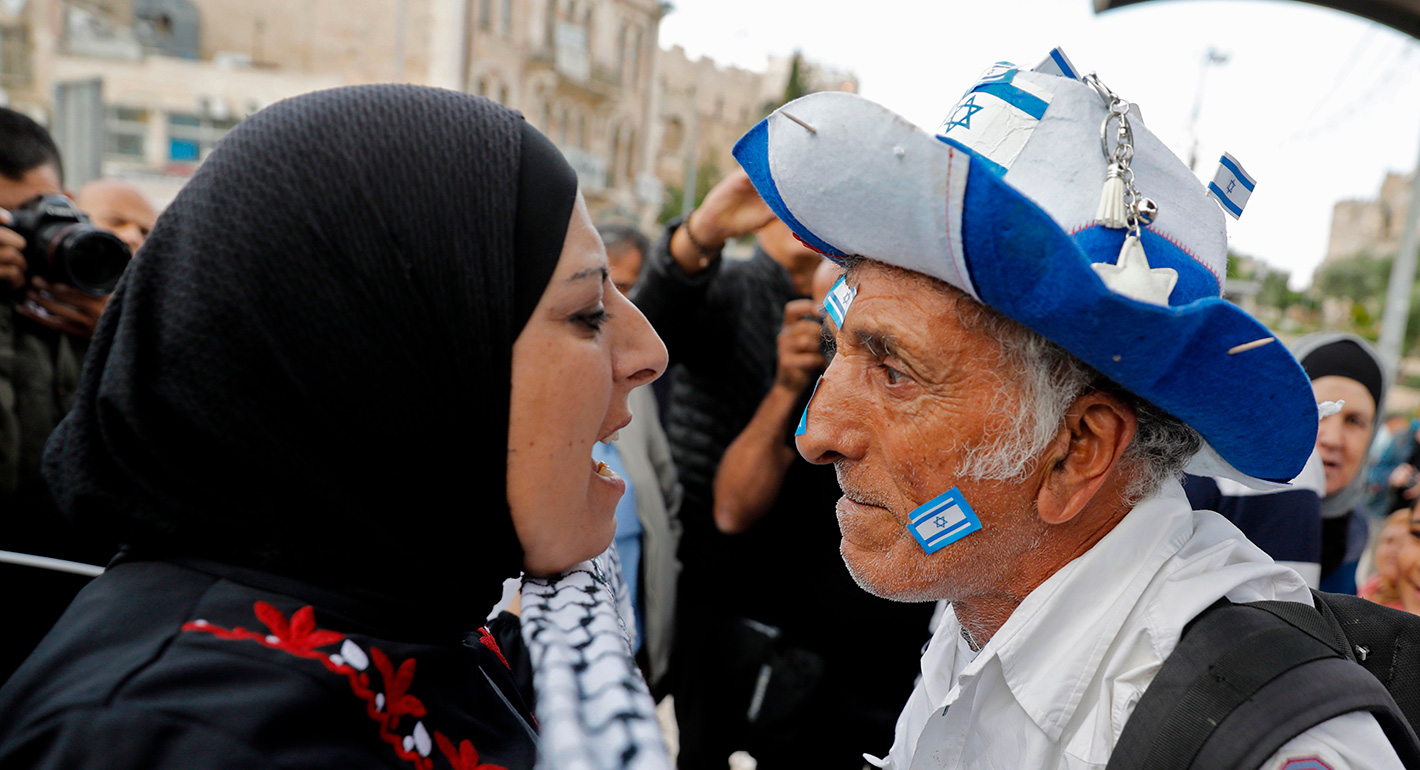
Netanyahu made a campaign promise to go the next step, extending Israeli sovereignty to settlements and the Jordan Valley, while Gantz stated only that he supports holding on to the areas.
Source: Hill
The latest Israeli elections confirm the definitive lurch of voters to the right. The government will be right wing, making a peaceful resolution to conflict between Israel and Palestine remote. For Palestinians, a Likud Kahol Lavon unity government or a Likud hard right coalition makes little difference. The United States will stand behind whatever actions the Israeli government takes, however antithetical to a negotiated solution they may be, unless Congress takes steps to preserve the possibility of peaceful resolution. Instead, Congress is poised to lay the ground for a American peace plan that will only guarantee perpetual conflict.
For the almost two million Palestinian citizens of Israel, frequently referred to as “Israeli Arabs” to obscure their indigeneity, little will change. Despite criticizing the incitement of Israeli Prime Minister Benjanmin Netanyahu against Palestinian citizens, Gantz has not promised to repeal the Jewish nation state basic law, which constitutionalizes the second class status of Palestinians. The Palestinian Joint List party will be unable to stop the evictions of entire Palestinian communities inside Israel, like Al Araqib, whose residents must pay for the demolition of their own homes.
The approximately five million Palestinians in the occupied West Bank and Gaza will feel less safe. Gantz, who is defending war crimes charges in the Hague, is more hawkish than the current prime minister, bragging in past campaign ads that he bombed Gaza “back to the Stone Age.” The years long siege and blockade of Gaza will continue, denying Palestinians their basic human dignity, as will the fits and starts of low to high intensity violence between the Israeli military and the militant groups and in the West Bank, where Palestinians will be confined to ever shrinking areas of land surrounded by ever expanding Israeli settlements. As for Palestinian Jerusalemites, they will continue to face revocation of their residency rights and additional attempts to zone them out of the city.
One potential difference between Gantz and Netanyahu may be on annexation. Although Israel has effectively annexed large swathes of the West Bank, it has not officially declared its extension of sovereignty there to avoid international repercussions. Instead, the Israeli government has been gradually integrating the settlements by connecting its sewage system, road network, and electricity grid, and by applying Israeli laws to settlements. Netanyahu made a campaign promise to go the next step, extending Israeli sovereignty to settlements and the Jordan Valley, while Gantz stated only that he supports holding on to the areas.
The Trump administration and members of the Middle East peace team have signaled support for legal annexation in myriad ways by denying that an Israeli occupation exists or that it only represents a tiny portion of the West Bank, removing the term “occupied” from the State Department human rights country reports, deleting “Palestinian Territories” from the lists of countries under one of its bureaus, taking a sledgehammer to the earth beneath Palestinian homes in occupied East Jerusalem, and stating that Israel has the right to annex some part of the West Bank.
To buttress this shift in policy, members of the Trump administration rely on biblical history. In an address before the annual American Israel Public Affairs Committee conference, Ambassador David Friedman said that he and the Trump administration could not leave a peace plan to another administration in order for Israeli to control Judea and Samaria, which is the occupied West Bank, and the Jordan Valley to be ensured.
President Trump has an interest in keeping something in his back pocket to gift his evangelical base ahead of the American elections. The continuation of his close partnership with the Israeli government is critical, which explains how easily he caste aside his bromance with Netanyahu by saying that “our relations are with Israel” rather than supporting the increasingly unlikely continuation of the status quo.
Where is Congress in all of this? Senate Republicans and Democrats cannot even agree on a nonbinding resolution to support a negotiated two state solution. A bill is advancing that would delegitimize Palestinian national aspirations and soveriegnty by forcing the Palestinian Liberation Organization to downgrade its status at the United Nations and the International Criminal Court, where Palestine must be deemed a state to refer war crimes cases. Although the principal aim is to compel the Palestinian Liberation Organization sand the Palestinian Authority to pay previously dismissed awards of damages to victims of political violence during the Second Intifada, the bill would bankrupt the Palestinian Liberation Organization out of existence. This ultimately means no Palestinian representative to sign a peace agreement with Israel.
In order to incentivize Palestinian acquience to annexation, the Senate Appropriations Committee is calling for funding to support partnerships between Israeli and Palestinians businesses in the West Bank, which means between Palestinians and settler businesses that are expropriating their land and natural resources. With that move, all that is left to turn the page on United States policy in the Middle East is the release of the American peace plan that recognizes complete Israeli sovereignty.
Senior Fellow, Middle East Program
Zaha Hassan is a human rights lawyer and a senior fellow at the Carnegie Endowment for International Peace.
Recent Work
Zaha Hassan, Charles H. Johnson
Carnegie does not take institutional positions on public policy issues; the views represented herein are those of the author(s) and do not necessarily reflect the views of Carnegie, its staff, or its trustees.

But their "principal to principal" model will only be as effective as the political strength of each leader back home.

Damien Ma

U.S. unpredictability has allowed China to capitalize on its positioning as the “responsible great power”. Paradoxically, the more China wins the perception game, the more likely expectations will rise for Beijing to deliver not just words but to demonstrate with its deeds.

Chong Ja Ian

Hanoi and Beijing have long treated each other as distant cousins rather than comrades in arms. That might be changing as both sides draw closer to hedge against uncertainty and America’s erratic behavior.

Nguyễn Khắc Giang

Across Asia, China is better positioned to withstand energy shocks from the fallout of the Iran war. Its abundant coal capacity can ensure stability in the near term. Yet at the same time, the country’s energy transition away from coal will make it even less vulnerable during the next shock.
Damien Ma

Malaysia’s chairmanship sought to fend off short-term challenges while laying the groundwork for minimizing ASEAN’s longer-term exposure to external stresses.

Elina Noor