

Other
François Godement, Ashley J. Tellis
{
  "authors": [
    "François Godement"
  ],
  "type": "legacyinthemedia",
  "centerAffiliationAll": "dc",
  "centers": [
    "Carnegie Endowment for International Peace"
  ],
  "collections": [],
  "englishNewsletterAll": "asia",
  "nonEnglishNewsletterAll": "",
  "primaryCenter": "Carnegie Endowment for International Peace",
  "programAffiliation": "AP",
  "programs": [
    "Asia"
  ],
  "projects": [],
  "regions": [
    "East Asia",
    "China",
    "Western Europe",
    "France"
  ],
  "topics": []
}
Source: Getty
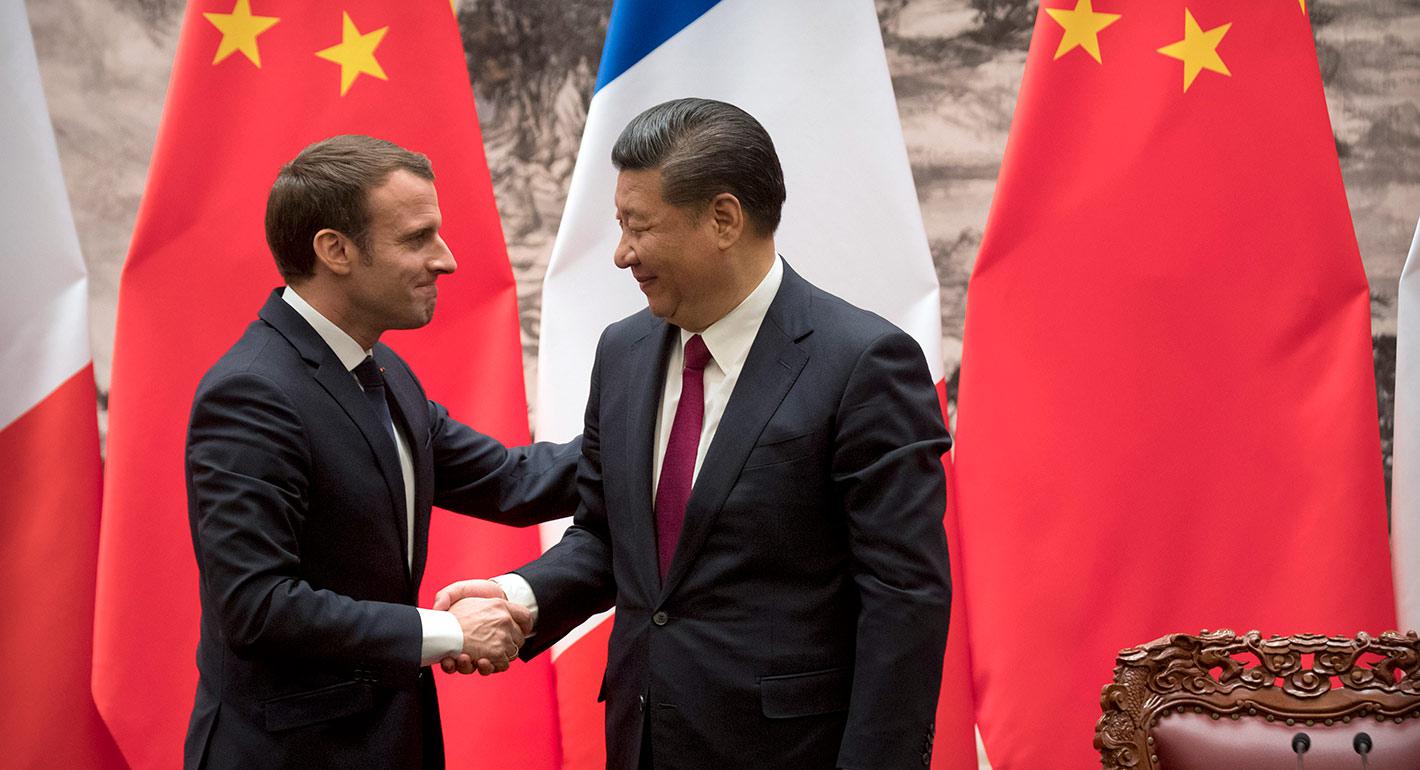
Emmanuel Macron must confront at least four contradictory imperatives during his visit to China.
Source: Institut Montaigne
The visit Emmanuel Macron is starting today in China promises to be a difficult one, as he is confronted to contradictory imperatives. There are perhaps four of them. First, that of French national diplomacy, which aims at delivering a global message at a time when the multilateralist space is shrinking. Climate change and biodiversity protection will be more favorable grounds for this than the WTO reform, where China is clinging to its special statute. Then there is Europe, where Emmanuel Macron must confirm the message that he had delivered to China during Xi Jinping’s Paris visit last March: he had then invited Jean-Claude Juncker and Angela Merkel to take part in Xi’s reception. This kind of gesture demands continuity, even more so as Chinese leaders tend to believe in deeds rather than in words.
The French president must also present itself as a defender of universal values – at a time when human rights are particularly under challenge in China. The dehumanizing treatment of Uyghurs, Kazakhs and more generally Muslims and some Christian communities in western China is a major issue. Even if it is less dramatic for the time being, the fate of Hong Kong is worrying. Finally, the commercial imperative has not disappeared. Mr. Macron has to sell planes (here also in the name of Europe), reach for contracts, including in the nuclear industry, and advocate more opening of China’s services and public markets.
How are these goals manageable in today’s charged international environment? In Europe, a Commission that has reached its end is nonetheless not completely replaced, thus inevitably creating a period of wavering. Certainly, EU civil servants are busy implementing the changes that were – finally – decided by the Juncker Commission: screening foreign investment, countering lobbying and, most importantly, reforming competition policies and support for innovation, which are the two positive changes that the EU can bring to match China’s entry inside Europe. An interim EU report on the security threats associated with 5G, has a running thread in the narrative that points towards the special risks from Chinese companies in this sector. It seems that Europe has got its act together to face the challenge and pressure from China’s hybrid economy. And France has been instrumental in this change of attitude and shift towards new rules.
This article was originally published by Institut Montaigne.

Former Nonresident Senior Fellow, Asia Program
Godement, an expert on Chinese and East Asian strategic and international affairs, was a nonresident senior fellow in the Asia Program at the Carnegie Endowment for International Peace.
Recent Work
François Godement, Ashley J. Tellis

François Godement, Abigaël Vasselier
Carnegie does not take institutional positions on public policy issues; the views represented herein are those of the author(s) and do not necessarily reflect the views of Carnegie, its staff, or its trustees.

China’s banking crisis in the 2000s was resolved by transferring the costs to households through financial repression—a decision that recapitalized the banks while exacerbating the structural imbalances that continue to shape the Chinese economy today.

Michael Pettis

Chinese biotech companies have been on the receiving end of U.S. economic coercion. Yet their responses have differed significantly because firm and state interests are not uniformly aligned. For Washington, treating all Chinese tech firms the same, irrespective of their actual interests, risks pushing them farther into Beijing’s corner.

Xue Gong

China’s latest energy plan explicitly calls for integrating data centers into the electricity system, particularly connecting them to green energy. It appears Beijing wants to use compute as a source of domestic demand to absorb renewables excess capacity.

Damien Ma

But their "principal to principal" model will only be as effective as the political strength of each leader back home.
Damien Ma

U.S. unpredictability has allowed China to capitalize on its positioning as the “responsible great power”. Paradoxically, the more China wins the perception game, the more likely expectations will rise for Beijing to deliver not just words but to demonstrate with its deeds.

Chong Ja Ian