

Commentary
Richard Youngs
{
  "authors": [
    "Richard Youngs"
  ],
  "type": "other",
  "centerAffiliationAll": "dc",
  "centers": [
    "Carnegie Endowment for International Peace",
    "Carnegie Europe"
  ],
  "collections": [],
  "englishNewsletterAll": "ctw",
  "nonEnglishNewsletterAll": "",
  "primaryCenter": "Carnegie Europe",
  "programAffiliation": "EP",
  "programs": [
    "Europe",
    "Democracy, Conflict, and Governance"
  ],
  "projects": [],
  "regions": [
    "Europe",
    "Western Europe",
    "Iran"
  ],
  "topics": [
    "Foreign Policy",
    "EU",
    "Security",
    "Economy"
  ]
}
Source: Getty
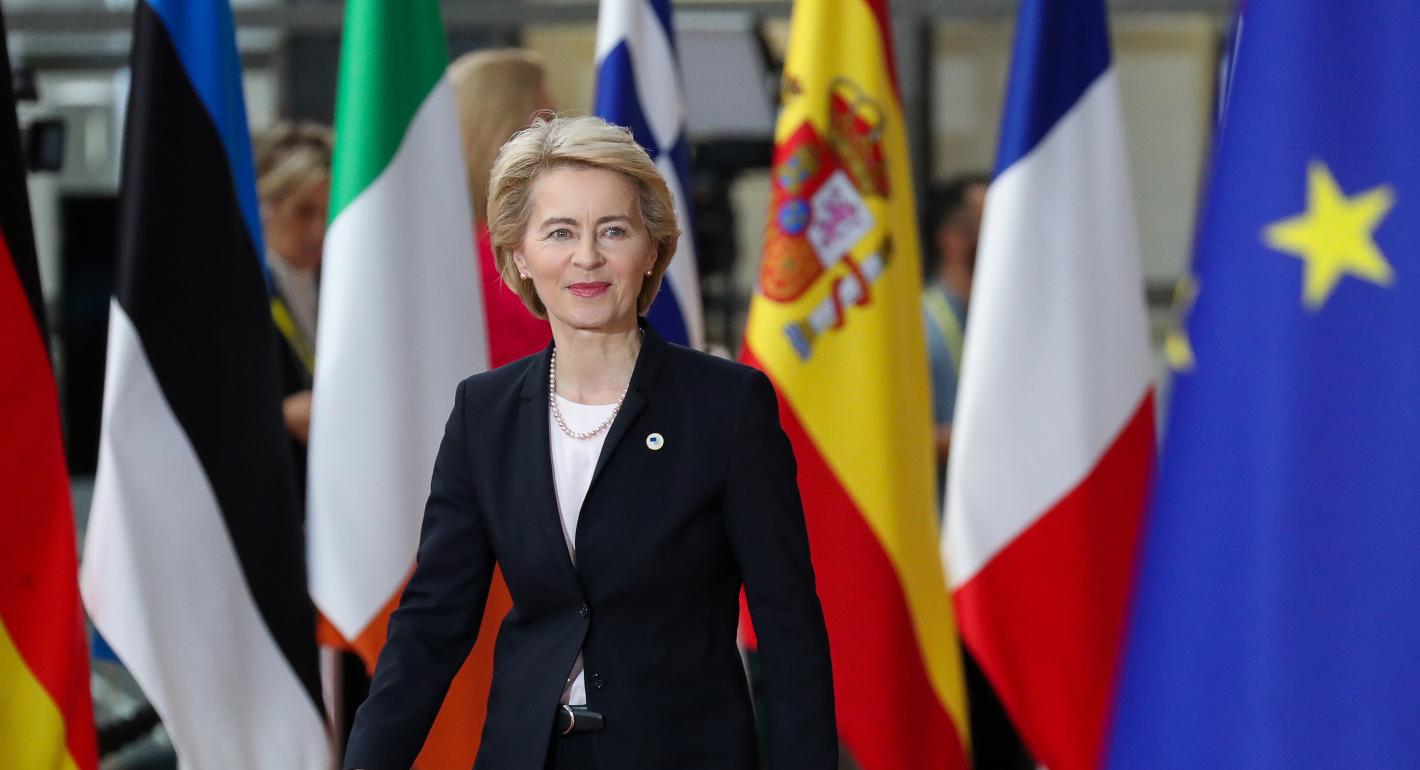
The EU’s new geopolitical narrative is based on some questionable assumptions about EU foreign policy. To avoid uncertainty over Europe’s international identity, its leaders must define a modern and innovative form of geopolitics.
Source: Swedish Institute for European Policy Studies
In the last year a narrative has gained prominence: the European Union (EU) needs to be more “geopolitical.” The new EU leadership has promised a “geopolitical Commission.” French President Emmanuel Macron has called for the Union to be a “geopolitical power.” High Representative Josep Borrell has enjoined the EU to “re-learn the language of power.” Politicians, diplomats and analysts seem almost universally to welcome this incipient geopolitical turn.
This policy analysis takes a contrarian line by questioning some of the core assumptions on which the EU’s new geopolitical narrative is based. It challenges the received wisdom that EU external action has erred mainly in being insufficiently driven by realpolitik self-interest. The report identifies three powerful recent trends or axes in EU external action that relate to geopolitical strategy in complex and varied ways: “protective security,” geo-economics and a more instrumental approach to liberal order. These axes add nuance to what lies behind the EU’s geopolitical narrative, and in important ways cast doubt on its sufficiency and appropriateness. Crucially, the report argues that the COVID-19 pandemic is set to intensify these existing trends in EU external policies. The coronavirus emergency makes the EU’s geopolitical narrative an even more problematic way of framing external aims.
Geopolitics has long been a fiercely contested concept; it is not in itself a term that prescribes any particular course of foreign policy action. It is ostensibly about having an overarching strategy for managing the geography of power. To this end, acting geopolitically can mean almost anything, from assertive foreign interventions through to strategically astute inaction. While a geopolitical narrative has gained prominence, the EU has so far offered little detail about how it defines a geopolitical policy. In practice, European leaders and senior officials customarily deploy the term geopolitics loosely to denote a kind of more committed, generic realpolitik.
In this respect the EU’s base justification – the starting point – for its geopolitical turn is built upon some questionable assumptions. The fairly common diagnosis is that EU foreign policy has erred for many years in being too weak in the pursuit of European self-interest. The widely accepted starting point is that the EU has been a liberal power whose benign concern with norms and global public goods is increasingly and sadly thwarted by a world of raw power politics. The line is that the EU has been too liberally noble for its own good, too enlightened and other-regarding to wield power in the name of Europe’s own interests. The common call is for the EU to be more deeply engaged in global challenges in ways that assertively prioritise interest and power calculations.
Post-liberalism in denial. For those long on the receiving end of European power and foreign policies these claims might seem curious. In truth, the EU and its member states have always been strongly driven by their interests and in recent years have engaged in a great deal of hard-nosed realpolitik. For quite some number of years the EU has already exhibited in a fairly pronounced form at least some features of a post-liberal power; in adapting to a more challenging global context it has overridden many of its ostensibly liberal principles. The European narrative supposes that threats to liberal order are due entirely to others’ actions; yet member state governments have themselves often acted in ways that compound the fragilities and imbalances of the current global order. Far from having to “re-learn power” the EU has for at least a decade been doubling-down on a much more narrowly instrumental understanding of what its own power-protection requires.
This article was originally published by the Swedish Institute for European Policy Studies.

Senior Fellow, Democracy, Conflict, and Governance Program
Richard Youngs is a senior fellow in the Democracy, Conflict, and Governance Program, based at Carnegie Europe. He works on EU foreign policy and on issues of international democracy.
Recent Work
Richard Youngs

Richard Youngs, Erik Jones, Dan Baer, …
Carnegie does not take institutional positions on public policy issues; the views represented herein are those of the author(s) and do not necessarily reflect the views of Carnegie, its staff, or its trustees.

China’s banking crisis in the 2000s was resolved by transferring the costs to households through financial repression—a decision that recapitalized the banks while exacerbating the structural imbalances that continue to shape the Chinese economy today.

Michael Pettis

But their "principal to principal" model will only be as effective as the political strength of each leader back home.

Damien Ma

U.S. unpredictability has allowed China to capitalize on its positioning as the “responsible great power”. Paradoxically, the more China wins the perception game, the more likely expectations will rise for Beijing to deliver not just words but to demonstrate with its deeds.

Chong Ja Ian

Hanoi and Beijing have long treated each other as distant cousins rather than comrades in arms. That might be changing as both sides draw closer to hedge against uncertainty and America’s erratic behavior.

Nguyễn Khắc Giang

Across Asia, China is better positioned to withstand energy shocks from the fallout of the Iran war. Its abundant coal capacity can ensure stability in the near term. Yet at the same time, the country’s energy transition away from coal will make it even less vulnerable during the next shock.
Damien Ma