• Commentary
  • Research
  • Experts
  • Events
Carnegie China logoCarnegie lettermark logo
{
  "authors": [
    "Ishac Diwan",
    "Nadim Houry",
    "Yezid Sayigh"
  ],
  "type": "other",
  "centerAffiliationAll": "dc",
  "centers": [
    "Carnegie Endowment for International Peace",
    "Malcolm H. Kerr Carnegie Middle East Center"
  ],
  "collections": [
    "Coronavirus"
  ],
  "englishNewsletterAll": "menaTransitions",
  "nonEnglishNewsletterAll": "",
  "primaryCenter": "Malcolm H. Kerr Carnegie Middle East Center",
  "programAffiliation": "MEP",
  "programs": [
    "Middle East"
  ],
  "projects": [],
  "regions": [
    "Egypt",
    "North Africa"
  ],
  "topics": [
    "Political Reform"
  ]
}

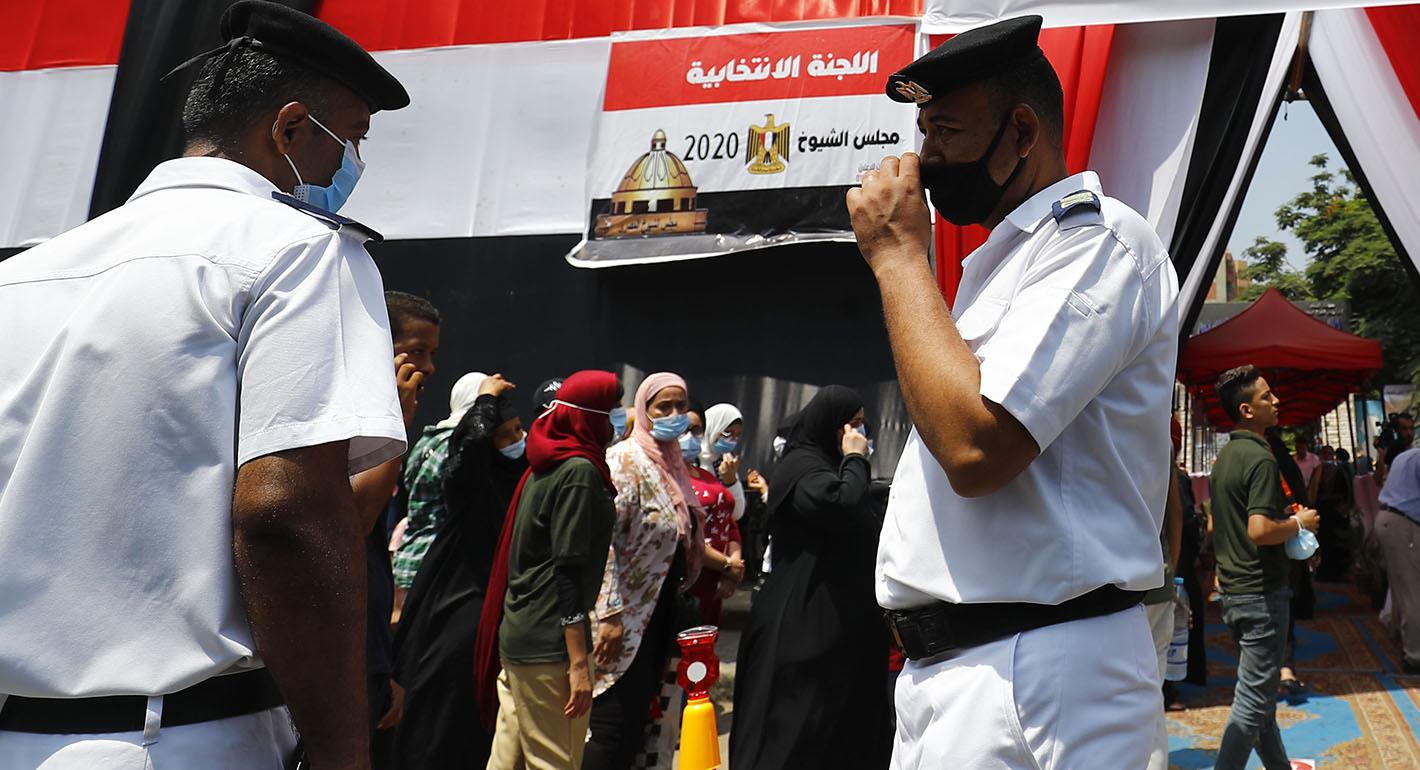
Source: Getty

Other
Malcolm H. Kerr Carnegie Middle East Center

Egypt After the Coronavirus: Back to Square One

Egypt’s recent security and macro-economic stabilization has been built on weak foundations and Covid-19 has further exposed this fragility.

Link Copied
By Ishac Diwan, Nadim Houry, Yezid Sayigh
Published on Aug 27, 2020

Source: The Arab Reform Initiative

Introduction

President Sisi has managed a successful security and macro-economic stabilization, but it has been built on weak foundations. Economically, he has relied on the military and the public sector to become the engines of growth and has been unable, or unwilling, to elicit a private sector supply response. His reforms have also come at a great social cost with poverty and precarious employment increasing.

The external shock due to Covid-19 has now hit all the sources of foreign exchange (FX) in Egypt: tourism, remittances, Foreign Direct Investment (FDI), gas export, and international capital flows. On economic and social grounds, Egypt’s stability now appears brittle - resilient on the surface but fragile underneath. Can the current governance and economic model evolve to sustain stability in Egypt following the current Covid-19 crisis?

We argue below that while Egypt's financial prospects had improved after its successful 2016 stabilization, led by the IMF, it was insufficient to deal with the long term fundamental problems confronting the economy, and like previous stabilization efforts, have only provided Egypt with a window of a few years to implement deeper reforms. Post-Covid-19, this window has become much tighter. The economy is now at a serious risk of unravelling in the medium term if the key fundamentals – the economy, social conditions, and politics – do not improve. Accumulating foreign debt to push the problems away will only compound existing imbalances to the point of becoming insurmountable in the future.

Egypt is now back to square one, in a situation broadly similar to that before the 2011 revolution: stable on the surface, but with deep structural problems and simmering social grievances, and buffers available to mitigate them depleting. We discuss in this note the three main sources of vulnerability that expose Egypt to a possible blowout. These are: a macro stabilization with no private sector supply response, the militarization of its economy and the weakening of its civilian component, and the absence of a pressure valve and political space to absorb the deteriorating social conditions and rise of discontent. In order to make Egypt's growth path more resilient in the future, and in a post-Covid-19 world, some of these tensions will need to start being released. To do so will require an inflexion in the ways the country is currently governed that favour greater openness in markets as well as politics, and encouragement by the international community to finally start addressing its long-term challenges head-on. Misusing this crisis, as has repeatedly happened before, can this time around usher the beginning of the unravelling of the country.

Read Full Text

This paper was originally published by The Arab Reform Initiative.

About the Authors

Ishac Diwan

Research Director at the Finance for Development Lab at the Paris School of Economics, Professor of Practice at the Department of Economics at the American University of Beirut.

Ishac Diwan is the research director at the Finance for Development Lab at the Paris School of Economics, Professor of Practice at the Department of Economics at the American University of Beirut.


Nadim Houry

The executive director of the Arab Reform Initiative.

Nadim Houry is the executive director of the Arab Reform Initiative. Previously, he was at Human Rights Watch where he opened and ran the Beirut office, before taking on the role of director of HRW’s Terrorism and Counter-Terrorism Program.

Yezid Sayigh

Senior Fellow, Malcolm H. Kerr Carnegie Middle East Center

Yezid Sayigh is a senior fellow at the Malcolm H. Kerr Carnegie Middle East Center in Beirut, where he leads the program on Civil-Military Relations in Arab States (CMRAS). His work focuses on the comparative political and economic roles of Arab armed forces, the impact of war on states and societies, the politics of postconflict reconstruction and security sector transformation in Arab transitions, and authoritarian resurgence.

Authors

Ishac Diwan
Research Director at the Finance for Development Lab at the Paris School of Economics, Professor of Practice at the Department of Economics at the American University of Beirut.
Ishac Diwan
Nadim Houry
The executive director of the Arab Reform Initiative.

Nadim Houry
Yezid Sayigh
Senior Fellow, Malcolm H. Kerr Carnegie Middle East Center
Yezid Sayigh
Political ReformEgyptNorth Africa

Carnegie does not take institutional positions on public policy issues; the views represented herein are those of the author(s) and do not necessarily reflect the views of Carnegie, its staff, or its trustees.

More Work from Carnegie China

  • Commentary
    China’s Rising Influence in the Middle East

    Transactional relationships are stable but can be shallow.

      • +1

      Paul Haenle, Maha Yahya, Benjamin Ho, …

  • Commentary
    What the Russian War in Ukraine Means for the Middle East

    It’s about managing oil prices, bread prices, and strategic partnerships.

      • +8

      Amr Hamzawy, Karim Sadjadpour, Aaron David Miller, …

  • Commentary
    A Message to the Carnegie Endowment Community

    The murder of George Floyd has underscored the deep inequities that have long plagued American society. In a note to the Carnegie community, Bill Burns reflects on Carnegie’s commitment to build a more just future here at home and around the world, without which peace will remain beyond our grasp.

      William J. Burns

  • Commentary
    U.S., China Should Pursue Peace, Not Military Brinkmanship

    While the world hoped this pandemic might lead to more cooperation between these two great powers, American and Chinese leaders instead fell into a blame game and allowed their increasing suspicions to guide their decision-making.

      Lyu Jinghua

  • Commentary
    Travails of an Interconnected World: From Pandemics to the Digital Economy

    Biological viruses and computer malware differ in important respects. They have considerable potential to spread widely, invading, disrupting and destroying their targets.

      Ariel (Eli) Levite, Lyu Jinghua

Get more news and analysis from
Carnegie China
Carnegie China logo, white
Keck Seng Tower133 Cecil Street #10-01ASingapore, 069535
  • Research
  • About
  • Experts
  • Events
  • Contact
  • Careers
  • Privacy
  • For Media
Get more news and analysis from
Carnegie China
© 2026 Carnegie Endowment for International Peace. All rights reserved.