

Commentary
- +8
Sophia Besch, Eric Ciaramella, Steve Feldstein, …
{
  "authors": [
    "Aaron David Miller"
  ],
  "type": "legacyinthemedia",
  "centerAffiliationAll": "",
  "centers": [
    "Carnegie Endowment for International Peace",
    "Malcolm H. Kerr Carnegie Middle East Center"
  ],
  "collections": [],
  "englishNewsletterAll": "",
  "nonEnglishNewsletterAll": "",
  "primaryCenter": "Carnegie Endowment for International Peace",
  "programAffiliation": "",
  "programs": [],
  "projects": [],
  "regions": [
    "North America",
    "United States",
    "Middle East",
    "Palestine",
    "Levant"
  ],
  "topics": [
    "Political Reform",
    "Foreign Policy"
  ]
}
Source: Getty
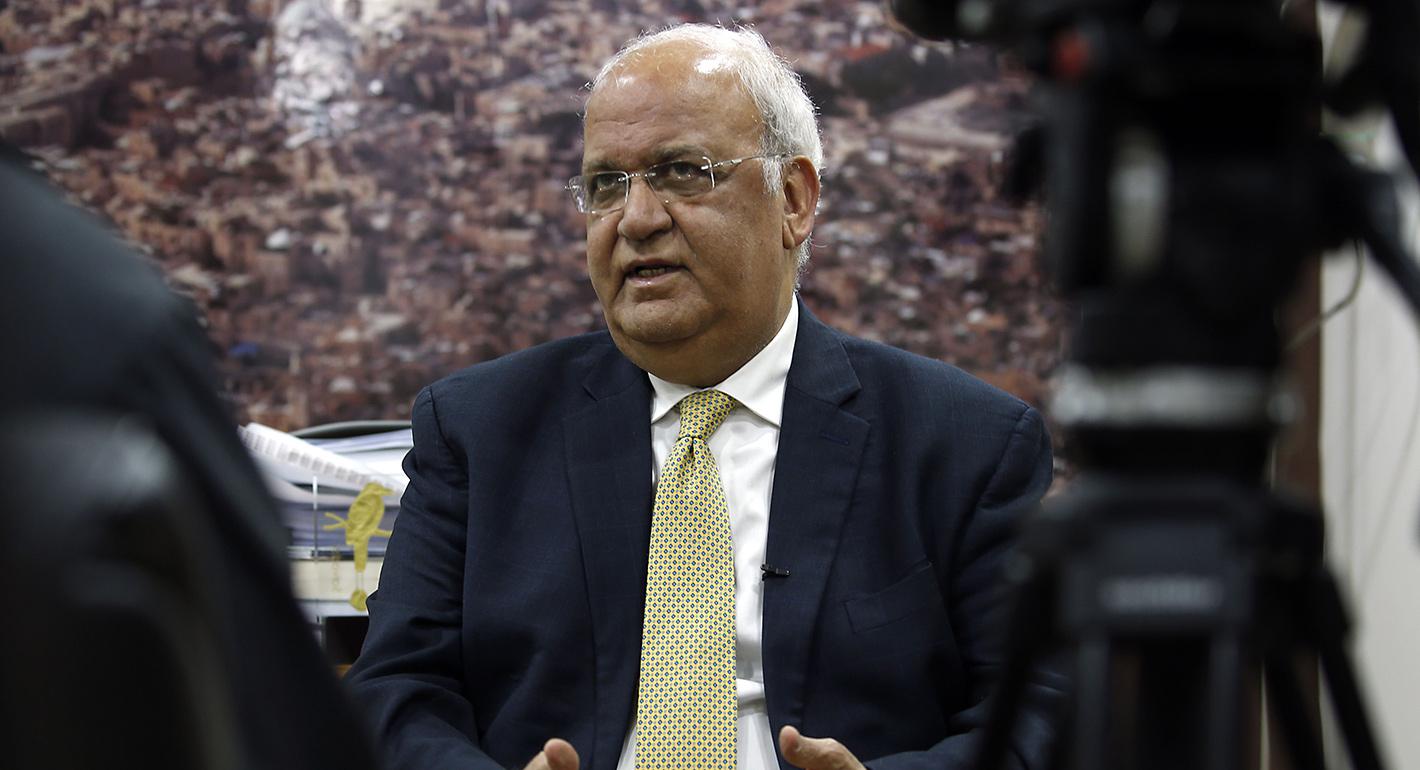
Saeb was a unique figure among Palestinian officials and negotiators with whom we dealt.
Source: Haaretz
Together, we mourn the passing of Saeb Erekat and extend our heartfelt condolences to his wife Niemeh and his four children Salam, Dalal, Ali and Muhammed.
They should be proud of who he was and what he accomplished in his life, through his decades of dedicated involvement in Israeli-Palestinian negotiations, even though he would not live to see his greatest hope realized – a two state solution in which an independent Palestinian state would live in peace beside a secure Israel.
Saeb was a unique figure among Palestinian officials and negotiators with whom we dealt. With degrees from U.S. and UK universities, and teaching experience at the West Bank’s An-Najah University, he lacked the PLO diaspora credentials, the political standing, and the street cred of Israeli prison time of many of his colleagues in the Palestinian national movement.
Indeed, those colleagues often joked at his expense that he was “Mr. CNN” because of his fondness for the media and his passionate presentations before the cameras.
And yet, from the 1991 Madrid Peace Conference onward, he would be involved in almost every negotiating effort between Israelis and Palestinians.
Saeb’s influence flowed from different sources. Both Yasser Arafat and Mahmoud Abbas needed a negotiator who could relate to both the Israelis and the Americans as well as the international community and the media; his command of English and his capacity to analyze and draft texts became essential once the negotiations reached that stage.
No one else on the Palestinian side could play that role. His diligence was remarkable, and he became the most reliable repository of the negotiating record. Sometimes to a fault.
We had our differences because at times he could be inflexible. But then, without an independent base of his own and subject to Arafat’s whims, Saeb had little flexibility to depart from core Palestinian positions, and we often suspected, his bosses did not want him to do so.
The other reality is that no other Palestinian negotiator was as committed and indefatigable as Saeb in pursuit of a two state solution to be achieved through peaceful means.
Saeb genuinely believed – even well past the time when many of us had given up hope – that a conflict-ending solution was possible, no matter how bleak the moment. As he confronted his own mortality during his lung transplant in 2018, he told some of us that what kept him alive was his determination to achieve peace.
This was no talking point. This man deeply believed in dialogue and reconciliation with Israelis, eschewed violence, and lived his life accordingly. He sent his children to Seeds of Peace, a program that fosters coexistence and dialogue, sat on its Advisory Board and spoke on behalf of the organization and Israeli-Palestinian reconciliation whenever and wherever he could.
We mark Saeb’s passing knowing full well that prospects for an enduring peace between Israelis and Palestinians seem now like a distant dream. Having worked on this issue for years, we have no illusions, and neither did Saeb. But he never abandoned hope that with leadership, courage and determination peace remained possible.
Saeb Erekat never gave up hope, and to honor him, neither should we. May his memory and good works always be a blessing.

Senior Fellow, American Statecraft Program
Aaron David Miller is a senior fellow at the Carnegie Endowment for International Peace, focusing on U.S. foreign policy.
Recent Work



Sophia Besch, Eric Ciaramella, Steve Feldstein, …
Daniel C. Kurtzer, Aaron David Miller
Carnegie does not take institutional positions on public policy issues; the views represented herein are those of the author(s) and do not necessarily reflect the views of Carnegie, its staff, or its trustees.

But their "principal to principal" model will only be as effective as the political strength of each leader back home.

Damien Ma

U.S. unpredictability has allowed China to capitalize on its positioning as the “responsible great power”. Paradoxically, the more China wins the perception game, the more likely expectations will rise for Beijing to deliver not just words but to demonstrate with its deeds.

Chong Ja Ian

Hanoi and Beijing have long treated each other as distant cousins rather than comrades in arms. That might be changing as both sides draw closer to hedge against uncertainty and America’s erratic behavior.

Nguyễn Khắc Giang

Across Asia, China is better positioned to withstand energy shocks from the fallout of the Iran war. Its abundant coal capacity can ensure stability in the near term. Yet at the same time, the country’s energy transition away from coal will make it even less vulnerable during the next shock.
Damien Ma

Malaysia’s chairmanship sought to fend off short-term challenges while laying the groundwork for minimizing ASEAN’s longer-term exposure to external stresses.

Elina Noor